



As long-dated government bond yields keep climbing around the world, macro strategist Simon White says a more radical debate over sovereign debt is moving closer to the mainstream. In a recent report, the Variant Perception co-founder warned that calls in France to cancel part of the country’s public debt should be treated as an early signal, not an isolated outburst.
White said the idea is contagious. Governments are already struggling under heavy debt burdens, and some politicians are putting forward increasingly aggressive proposals. In his view, similar non-orthodox demands could emerge in other countries soon. If they do, he expects the endpoint to be familiar: stronger inflation and weaker financial assets.
France revives an old debt playbook
White said one of the classic scenes from past global financial stress is now reappearing. His latest example is French left-wing populist politician Jean-Luc Melenchon, who recently called for canceling 18% of France’s public debt. In White’s retelling, Melenchon’s formulation was blunt: take the bonds and “burn them.”
White argued that the rhetoric is not new. Europe heard similar arguments during the 2009 eurozone debt crisis, and the United States saw comparable thinking at roughly the same time.
For White, debt cancellation is simply monetary financing under another label. He said that route would inevitably trigger sharp inflation, and that would strengthen the case for real assets over financial assets.
The $1 trillion platinum coin is back in the conversation
White also pointed to a proposal that many market participants still remember from 2011, one that was later denied by officials: the US Treasury would mint a platinum coin with a face value of $1 trillion, the Federal Reserve would exchange that coin for $1 trillion in government bonds, and the Treasury would then cancel those bonds.
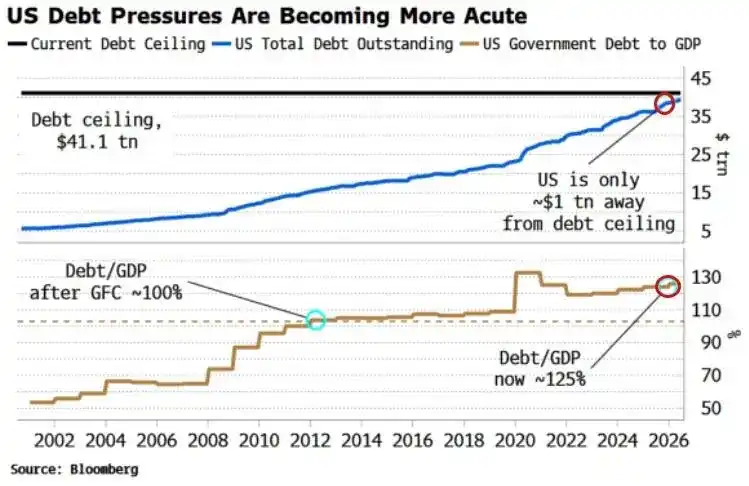
The point of that plan was to work around the US debt ceiling as pressure intensified after the Lehman crisis. White said the issue is becoming relevant again. The United States is now only $1.1 trillion away from hitting the debt ceiling, and the approach is accelerating. At the same time, the country’s debt-to-GDP ratio is 25 percentage points higher than it was 15 years ago.
He added that interest costs have climbed above $1 trillion. Against that backdrop, White said it would not be surprising if voices inside the US began echoing Melenchon and called for canceling or writing down part of Treasury debt.
White says the US remains the biggest debt concern
White described current US debt dynamics as the most worrying in the world. Measured against GDP, he said the US “twin deficit” — the current account deficit plus the budget deficit — is larger than that of every major emerging-market and developed economy except Brazil.
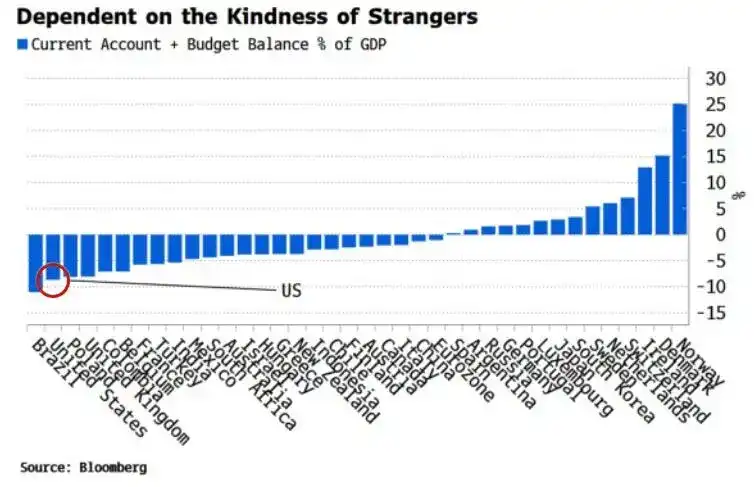
That scale of deficit makes little sense for an economy at this stage of the cycle, he argued. Part of the deterioration comes from surging interest expense, but even excluding that factor, White said the US still runs the world’s largest deficit both as a share of GDP and in dollar terms.
Political polarization is widening the tail risk
White said Western politics has, in recent years, lost the will to withdraw fiscal stimulus. Political forces and elected officials are drifting away from the center and toward unconventional policy ideas. In that setting, debt cancellation no longer looks unthinkable as a live policy proposal.
Even if such plans never get implemented, White said low-probability, high-impact tail events have already changed the distribution of risk in a meaningful way. The tail is thicker than many had assumed. He pointed to visible anxiety from the current Trump administration after the US Treasury announced a bigger long-end bond buyback program last week, saying the possibility now deserves serious attention.
If that anxiety turns into desperation, which White said cannot be ruled out, more unorthodox debt remedies could be put into practice by policymakers or pushed into the center of the political agenda by the opposition.
Six ways to reduce debt, but one may look politically easier
White listed six ways governments can reduce debt: fiscal consolidation; growth and inflation; financial repression; sales of government assets; default or restructuring; and debt cancellation, or other forms of monetary financing.
He then walked through why most of those options are difficult. Fiscal consolidation carries heavy electoral risk. Growth is already being constrained by massive government deficits, while inflation has become a problem because interest costs are rising. Financial repression will come eventually, he said, but too late; if the Treasury’s expanded buybacks are included, the process may already have started. Selling state assets, including Fort Knox gold, would be a one-off measure and unlikely to make a meaningful difference. Default or restructuring, in his view, would do more harm than good.
That is why direct debt cancellation can start to look attractive, White said. It appears relatively easy to execute.
Easy is not the same as effective
White said that would be a serious mistake. A policy can be easier to launch than the alternatives and still produce severe inflation. If France ever goes down that road, he argued, it would discover that debt cancellation is simply monetary financing in different packaging.
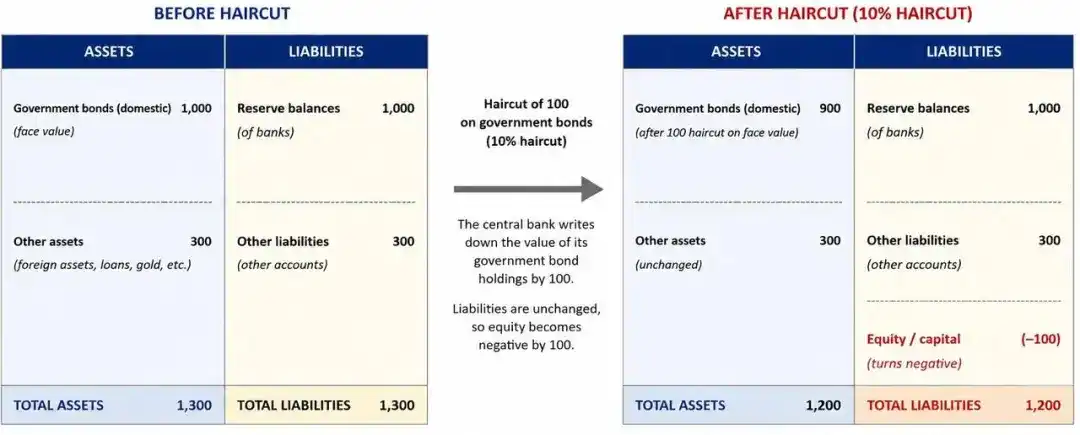
Using the US as an example, White said the Treasury could write down the government bonds held by the Federal Reserve, perhaps by 10%, or erase them outright. The Fed would then do something only a central bank can do: mark its own equity down into negative territory.
There are other versions of the same idea, he noted, including minting platinum coins as new assets or opening an overdraft line at the central bank. But the economic substance does not change.
The core risk is permanent money creation
What makes these plans dangerous, White said, is that they do not merely rearrange accounting entries. The reserves created by the Federal Reserve through quantitative easing were supposed to disappear naturally when the Treasury repaid principal and interest at maturity. If the debt is canceled directly, that cancellation point disappears. The reserves stop being temporary and become an explicit, permanent injection of money.
White said that expectation mattered in the past. Quantitative easing did not trigger runaway inflation at the outset because markets believed those reserves would eventually be withdrawn.
Under normal conditions, he added, if the private sector expects deficit spending to be repaid through delayed taxation — in other words, if Ricardian equivalence still holds — households and firms tend to cut consumption. Once monetary financing breaks that balance, the private sector may spend freely alongside the government.
Even in a system already flush with reserves, White argued, making an increase in base money permanently explicit crosses a red line that is hard to reverse and is highly likely to produce severe inflation. Whether the mechanism is QE combined with fiscal expansion, yield curve control, or what he described as giving the Treasury an unlimited credit card from the central bank, the destination is the same: inflation.
White said that is the track the world is on now. As long as painful but effective structural fixes keep being postponed and replaced with ineffective speculative measures — including ideas as extreme as the trillion-dollar coin — the tail risk he described will continue to rise.