
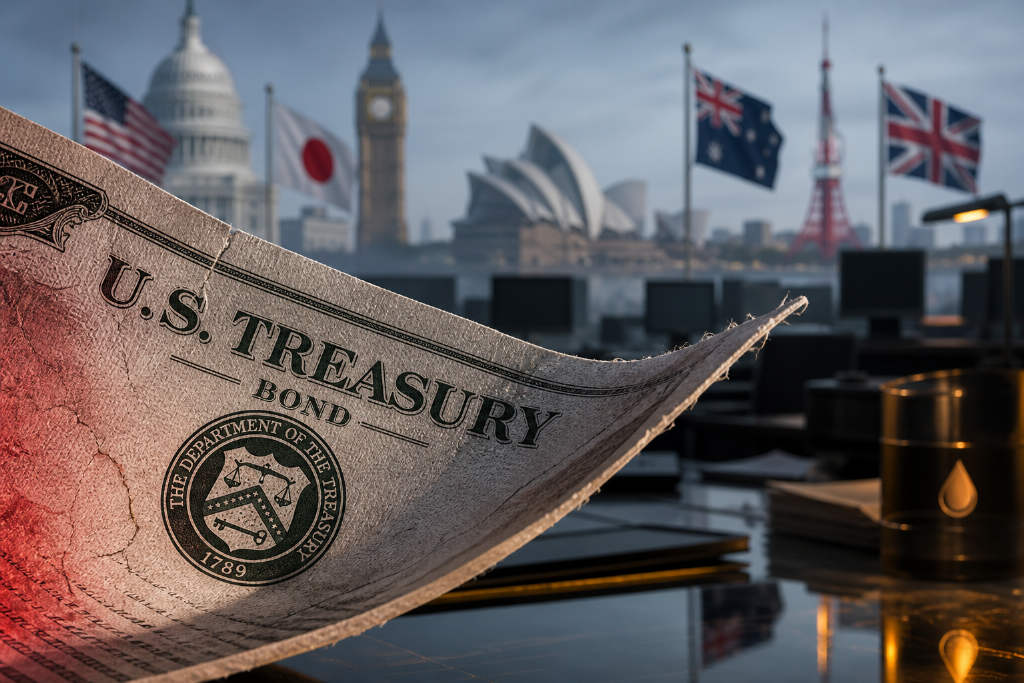
Global bond markets are going through one of their most severe selloffs in nearly two decades. The Bloomberg global government bond index yield rose for a fourth straight trading day to 3.72%, the highest level since mid-2008, in a move that the report describes as a system-wide repricing rather than a local dislocation in any single market.
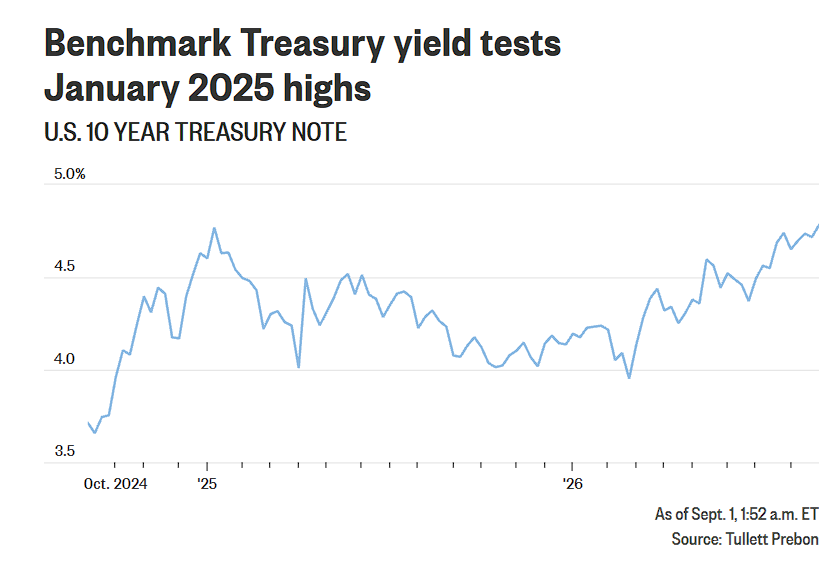
On Tuesday, Sept. 1, the US 10-year Treasury yield briefly climbed to 4.78%, its highest level since January 2025. Japan’s 10-year government bond yield touched 3% for the first time in 30 years. Australia’s 10-year yield rose to its highest since 2011, while the UK 10-year gilt yield added 7 basis points to 5.223%, the highest since June 2008.
The article, written by Dong Jing and sourced from Wallstreetcn, says the selloff is being driven by a chain of factors: Federal Reserve Chair Kevin Warsh reiterated a hard line on inflation at Jackson Hole, the US-Iran conflict pushed Brent crude back above $90 a barrel, and the US debt load moved beyond $40 trillion as fiscal deficits kept widening. Together, those factors have forced a fresh market rethink of higher rates lasting longer.
The report also cites analysts as saying that a 5% US Treasury yield may not be the endpoint, but the starting point of a new normal.
Warsh remarks and oil prices set off the latest leg lower
The immediate trigger came from two developments at once.
Warsh, speaking last Friday at Jackson Hole, again said the Fed would fully suppress inflation. The report notes that this is the fifth straight year in which the Fed has failed to return inflation to target. After the speech, the swaps market repriced the probability of a September Fed rate hike from 34% to 65%.
At the same time, the renewed escalation in the US-Iran conflict raised fears of continued disruption to energy flows through the Strait of Hormuz. Brent crude rose 1.2% to about $91.55 a barrel. Higher oil prices strengthened inflation expectations and pushed bond prices lower.
According to Bloomberg, several current and former US and Iranian officials said they expected the Middle East conflict to last for months. In the report’s framing, that leaves upward pressure on energy prices in place and keeps uncertainty around the inflation path hanging over bond markets.
After Warsh’s speech, Barclays and Societe Generale both revised their rate forecasts and added September and December hikes to their base-case scenarios, moves they had not previously expected.
US Treasuries face deeper pressure from deficits and real-rate repricing
The report argues that the rise in Treasury yields goes well beyond geopolitics. US national debt surpassed $40 trillion in August, adding to supply pressure in the Treasury market. At the same time, large technology companies are issuing long-dated corporate bonds on a large scale to finance artificial intelligence infrastructure. Roughly $200 billion in high-grade corporate debt is expected to hit the market in September, competing with Treasuries for the same pool of capital.
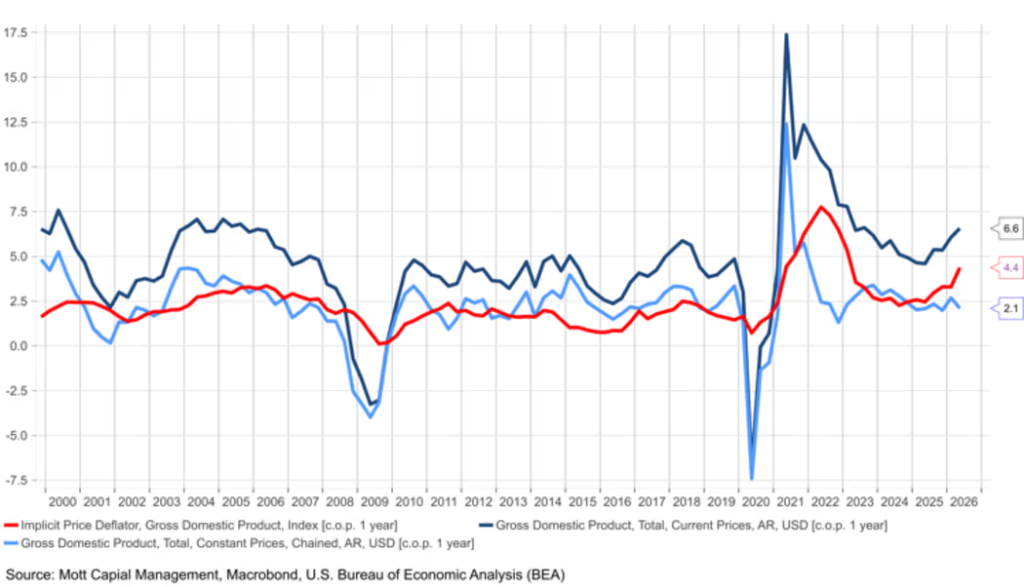
MarketWatch data cited in the article show US nominal GDP growth accelerating to about 6.6% year over year, while real growth stands at just 2.1%. The gap mainly reflects inflation, with the GDP deflator up 4.4% from a year earlier. Historically, the 10-year Treasury yield has usually traded above the GDP deflator. The current spread between the two is now near historical lows, which the report says leaves room for yields to move higher.
It also says the latest jump in yields has come mainly through real rates rather than inflation expectations. In other words, bond investors are asking for a higher real return, pointing to a more basic repricing of the long-run equilibrium rate in the US economy.
MarketWatch was also cited as saying nominal GDP growth is running faster than money supply growth, lifting the velocity of money, a pattern that has historically been closely linked to higher long-end yields.
The article adds that Treasury Secretary Bessent said Monday that he and Warsh were aligned on issues in the roughly $31.5 trillion Treasury market. The Treasury Department had already announced in mid-August that it would expand buybacks of 10-year to 30-year Treasuries, but analysts cited in the report said the goal may only be to stabilize yields rather than actively push them lower.
The era of cheap global funding is being challenged
Another central thread in the selloff is the possible end of the cheap-money era in global fixed income.
For years, low Treasury yields were supported in part by steady inflows from low-rate economies such as Japan and Europe. That framework is now weakening as major central banks around the world tighten policy.
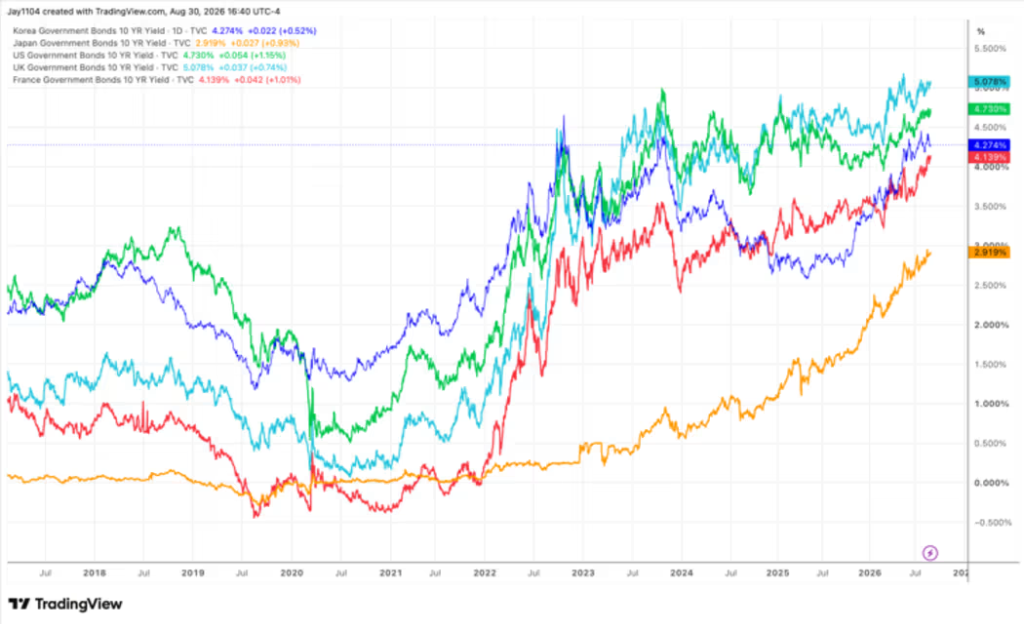
As overseas yields rise, US Treasuries become less attractive on a relative basis for foreign buyers, especially after hedging costs are taken into account. Bloomberg strategist Mark Cranfield said: 「G10 fixed-income traders are paying closer and closer attention to Japanese government bonds, and Australian bonds are increasingly following JGBs rather than Treasuries in pricing. The backdrop is extremely unfavorable: sticky inflation combined with large fiscal deficits in the US, Japan, the UK and France.」
Japan’s shift stands out. After the Bank of Japan ended the world’s last negative interest-rate policy in 2024, Japanese government bond yields moved up quickly. The 10-year JGB yield was about 1.5% a year ago and has now reached 3%, a doubling over that period.
International investors’ share of monthly cash trading in Japanese government bonds has also risen from 12% in 2009 to about two-thirds. The report says JGBs are becoming an important allocation option again for global investors, implying that some capital that had previously gone into Treasuries is returning to Japan.
Fiscal pressure is also part of the story in Japan. Prime Minister Sanae Takaichi’s government has rolled out an unprecedented spending plan, but has yet to clarify how it would finance a cut to the food consumption tax. Concern over fiscal sustainability has added to pressure on JGB yields. In the Finance Ministry’s initial budget request for the next fiscal year, debt-servicing costs rose to a record JPY 36.6 trillion, or about $230 billion.
Rate-hike expectations are rising across major central banks
As the bond selloff spread, market pricing for tighter policy also moved higher around the world. Bloomberg data cited in the article show that after the Jackson Hole central bank symposium, swaps markets raised the implied probability of a September Fed hike from 34% before Warsh spoke to 65%.
Swaps pricing also shows that a European Central Bank rate hike at the Sept. 10 meeting has been fully priced in. The probability of a Reserve Bank of New Zealand hike this week stands at 98%. For the Bank of Japan, the chance of a Sept. 18 hike is 92%, and an October hike has been fully priced in.
The Wallstreetcn article says that, according to Japanese public broadcaster NHK, US Treasury Secretary Bessent met separately with Japanese Finance Minister Satsuki Katayama and Bank of Japan Governor Kazuo Ueda during the G20 finance ministers’ meeting on Monday. Bessent clearly told both sides that Japan should raise rates next.
Later, in an interview with CNBC, Bessent said: 「I have information that the market doesn’t know, and I believe the Japanese government and the Bank of Japan will take action to push the yen stronger.」 The report describes that as the clearest signal yet from Washington on Japanese monetary policy.
Pepperstone Group strategist Dilin Wu said: 「The policy paths of major central banks will be revealed in a concentrated way within the same month, creating a highly dense pricing window for rates and foreign-exchange markets.」
Australia and Europe are moving in the same direction
The selloff has developed into a synchronized global move rather than an isolated market event.
On Tuesday, Australia’s 10-year government bond yield rose to its highest level since 2011 after the country reported stronger-than-expected inflation data. Traders then increased bets on a fourth Reserve Bank of Australia rate hike this year, with the implied probability rising to 54%.
Prashant Newnaha, senior Asia-Pacific rates strategist at TD Securities, said: 「The bond market is not collapsing, but it is sending a very clear memo: the stickier inflation is, the longer policy rates need to stay higher. Fiscal deterioration and higher term premium will remain the market’s focus.」
Seasonal patterns cited by Bloomberg also point to continued pressure. Over the past 10 years, September and October have been the two worst months for global bond index performance, with average monthly declines of more than 1% in each month.
Higher yields are feeding into stocks and household borrowing costs
Rising yields are now passing through to both financial markets and the real economy.
For equities, Robert Pavlik, senior portfolio manager at Dakota Wealth Management, said 4.75% on the US 10-year Treasury is the level where investors 「really start to pay attention,」 and markets are beginning to worry that a move to 5% could trigger a stock-market correction.
Chris Galipeau, chief market strategist at the Franklin Templeton Institute, said equities can still absorb current rate levels, but if the 10-year yield breaks above 5%, stocks 「could run into some trouble.」
For households, the 10-year Treasury yield is a pricing benchmark for 30-year mortgage rates, so higher yields directly lift home-buying costs. Drew Matus, chief market strategist at MetLife Investment Management, said a move beyond the 3.5% to 4.5% 「comfort zone」 would force households to save more and weigh on consumption.
The 30-year Treasury yield now stands at 5.27%. Since January this year, it has closed above 5% on 55 trading days, the most since 2006. In mid-August, the 30-year yield briefly touched 5.34%, the highest level since 2007.
Garrett Melson, portfolio strategist at Natixis Investment Managers, warned that if yields keep rising, the headwinds facing equities will intensify, especially as recent hard economic data have softened. He said: 「Attractive real yields plus even a hint of slower growth are enough to shift the market narrative and revive demand for bonds.」
The report ends by saying Friday’s August nonfarm payrolls release will be the next key point for markets to watch.