
GnosisDAO has put forward GIP-153, a governance proposal seeking directional community consensus on turning Gnosis Chain from a standalone Layer 1 into an Ethereum Economic Zone, or EEZ, rollup. The proposal was formally introduced on July 27 and was co-authored by Gnosis co-founder Friederike Ernst, Philippe Schommers, and Ben Carvill. It is currently in its first stage and does not include a funding request.
The sharpest line in the proposal is also the simplest: Gnosis Chain’s positioning as an independent L1 has failed.
Why Gnosis says the standalone L1 model no longer works
The proposal argues that Gnosis Chain was built around credible neutrality, but that pitch now overlaps too closely with Ethereum itself. Gnosis is far smaller in both scale and liquidity, yet it still has to pay for its own full security infrastructure.
According to GIP-153, fee revenue on Gnosis Chain falls well short of covering network security spending. The gap has been financed by the GnosisDAO treasury, which the proposal says causes about 2.3% annual dilution for non-stakers. As a comparison point, it notes that Ethereum’s annual issuance rate is below 1%, with part of that offset by fee burning, leaving net dilution lower still.
Gnosis Chain’s total value locked is listed at about $91 million, while GNO’s market capitalization is put at roughly $280 million. In the proposal’s framing, that leaves the chain at the edge of relevance in the L1 competition. Beyond security, GnosisDAO is also paying for explorers, RPC endpoints, and incentives for third-party protocols. Liquidity has to be repeatedly seeded and maintained, and the network effect has not come close to Ethereum mainnet.
The authors also argue that simply becoming a conventional L2 would not fix the core problem. Out of more than 100 L2s, the proposal says, most have little meaningful usage, and the few with traction did not win because of technical differentiation. They won because they already had distribution. In that sense, the differentiation problem moves from the L1 layer to the L2 layer, but it does not disappear.
Gnosis’ conclusion is that a migration only makes sense if it delivers a technical capability that current L2s do not have.
EEZ’s main pitch is synchronous composability with Ethereum
GIP-153 builds that case around the EEZ framework. The proposal says EEZ was introduced in March 2026 at EthCC in Cannes by Friederike Ernst and Zisk founder Jordi Baylina, with co-funding from the Ethereum Foundation.
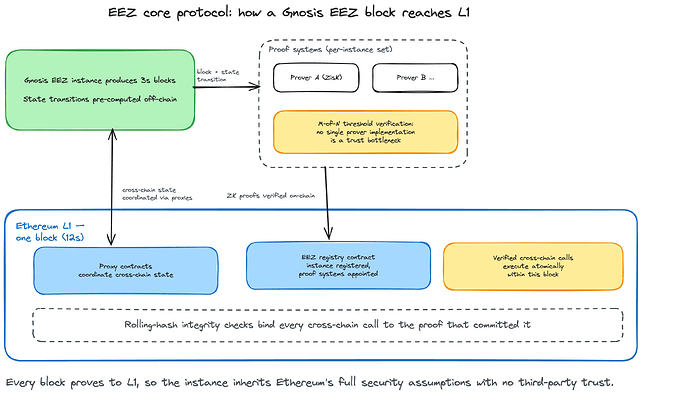
The core technical feature is synchronous composability. Under the proposed design, the new Gnosis Chain would produce blocks every 2 seconds, while each Ethereum block would carry one state proof and settlement back to Ethereum L1.
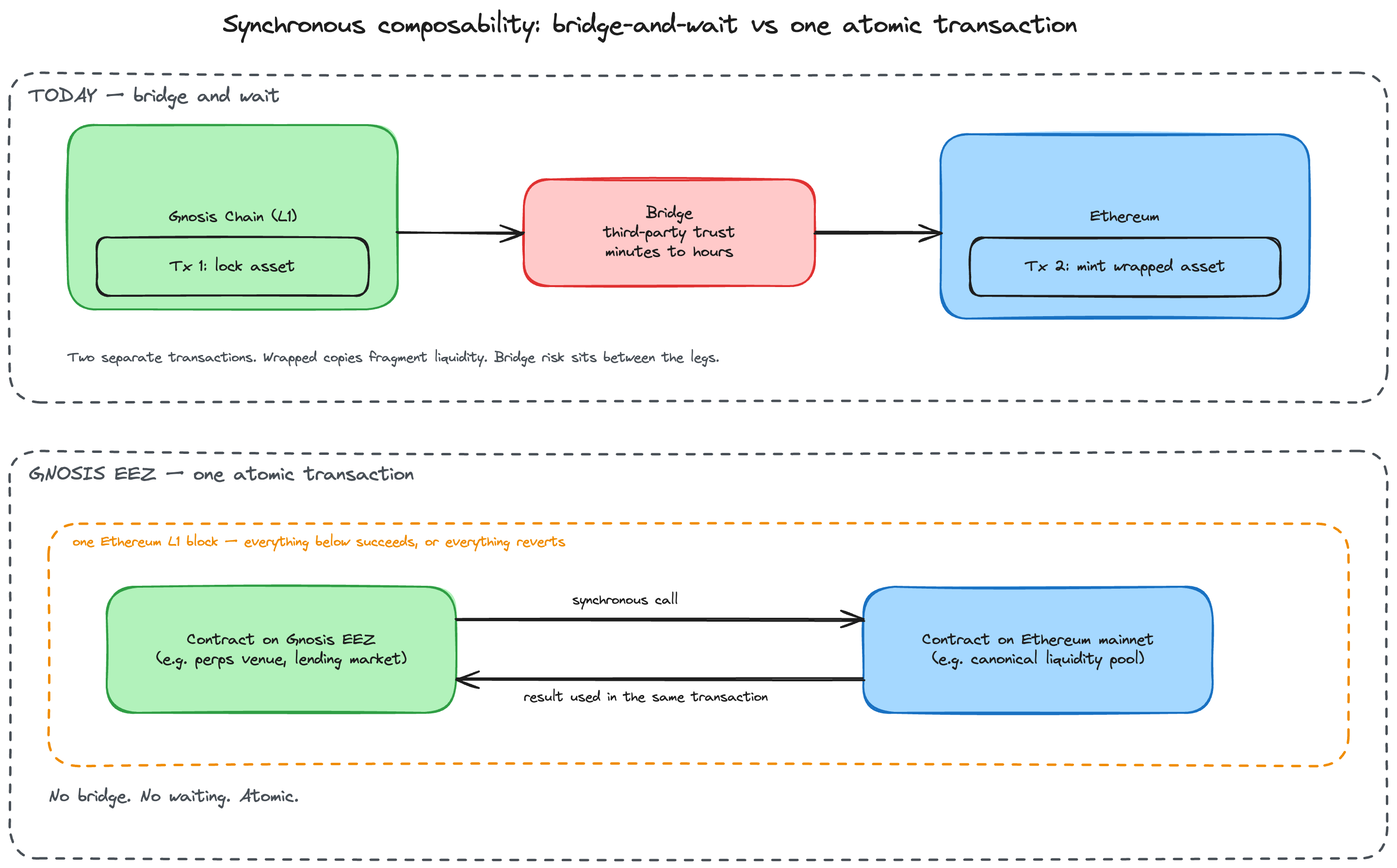
In practice, that means smart contracts on Gnosis EEZ would be able to call contracts on Ethereum mainnet inside a single transaction, receive return values, and use those values in the same transaction flow. The execution would remain atomic: either everything succeeds, or everything reverts. If that works as described, liquidity, oracles, on- and off-ramps, and even centralized exchange rails on Ethereum could be called directly as if they were local to Gnosis Chain, without bridging.
The proposal is explicit about the limits of the first release. Initial composability would be one-way only, supporting calls from the L2 to L1. Full bidirectional cross-instance composability would require later EEZ protocol work and is expected to arrive gradually through 2027. During the transition, an intents-based bridge would provide bidirectional atomic bridging.
GIP-153 estimates that the first version could deliver about 80% of the value of synchronous composability while requiring only 40% to 50% of the engineering effort needed for the full design.
The document draws a hard line between this and existing cross-rollup approaches. Current bridging systems, messaging layers, and shared sequencer designs are asynchronous, it says, with delays ranging from minutes to hours. It also names Optimism’s Superchain, Polygon’s AggLayer, and =nil;’s zkSharding as projects trying to address L2 fragmentation, while saying none has reached true synchronous atomic execution. EEZ, by contrast, is described as already running on devnet with end-to-end cross-chain execution.
The first version would not use ZK proofs
Jordi Baylina is identified in the proposal as a key technical contributor. Baylina created the ZK proving language Circom, co-created Polygon zkEVM, and in June 2025 launched Zisk as an independent company to build a ZKVM aimed at real-time proving.
Even so, the proposal makes clear that the first version of Gnosis EEZ would not use ZK proofs. It would rely instead on interim validation schemes such as TEE, with the specific mechanism to be chosen during the technical specification phase. Real-time ZK proving would come later as the full EEZ specification is completed. The proposal says the direction of travel is toward fewer trust assumptions, not more.
When EEZ was introduced, Friederike Ernst said Ethereum does not have a scaling problem; it has a fragmentation problem. “Every new L2 with its own liquidity pool and bridge is a new walled garden.”
The founding members of the EEZ alliance are listed as Aave, block builders Titan and Beaver Build, RWA platform Centrifuge, and tokenized stocks project xStocks. The framework itself is described as a public good run through a Swiss non-profit structure, led jointly by Gnosis and Zisk and co-funded by the Ethereum Foundation. All software is open-source, and the framework has no token of its own.
What the shift would mean for stakers, validators, and sequencing
About 350,000 GNO is currently staked, equal to around 27% of circulating supply, according to the proposal. If the transition goes ahead, all of that stake would be unlocked, and Gnosis Chain’s large independent validator set would leave.
GIP-153 openly calls that the biggest regret in the plan. The authors say they want to find new roles for the validator community, with one possible path being participation in Gnosis VPN operations. Existing bridge validators would move into prover roles and serve as initial operators in an M-of-N multi-prover setup.
Sequencing would move to centralized operation under Gnosis Ltd. The proposal does not try to soften that point. It says becoming less decentralized is a deliberate choice. Its argument is that the risks of a centralized sequencer are bounded because every block is proved and settled on Ethereum, meaning the sequencer cannot forge state or steal funds. The worst-case damage would be delaying or excluding transactions.
The proposal goes further and says maximum censorship resistance is Ethereum’s own domain and does not fit neatly with most financial applications, which need fraud response, compliance, and recourse. In that framing, a chain controlled by an operator can intercept suspicious transactions and proactively protect users. The proposal treats that as a feature rather than a flaw.
Once staking rewards are removed, value capture would shift toward fees generated by network activity, with pricing set dynamically by route. The precise mechanism, whether fee sharing, buybacks, or something else, would come in a later GIP after the prover economy can be observed. Until that new model is published, the potential sell pressure from unlocked GNO is likely to remain a key market focus.
GIP-150 and GIP-153 together point to a broader GnosisDAO restructuring
GIP-153 sits alongside a broader governance reset at GnosisDAO. On June 27, 2026, GnosisDAO passed GIP-150, allowing GNO holders to redeem a proportional share of DAO treasury assets. The proposal valued liquid treasury assets at about $223 million and changed GNO from a pure governance token into a direct claim on the DAO balance sheet.
The article says the treasury is worth about $300 million in total. Roughly 51% is GNO itself, with the rest including about $93 million in major assets such as ETH and around $23 million in stablecoins.
Taken together, GIP-150 and GIP-153 amount to two major moves happening at the same time. One gives token holders a path to exit at net asset value. The other rewrites the technical structure of the chain underneath them. The Gnosis team is effectively trying to offer an exit option while using EEZ’s synchronous composability to persuade the community to stay.
Public-good framework, commercial deployment model
On the business side, Gnosis Ltd would serve in two roles at once: co-architect of the EEZ framework and operator of its first production instance. The proposal says Gnosis plans to commercialize its early experience in migrating an active chain, running the stack, and building compliance modules by offering EEZ instances as a service to banks and fintech companies.
The framing is straightforward. EEZ itself is a public good, but the expertise required to deploy and run it is not. Gnosis’ own products, including Pay, Circles, and VPN, are expected to act as consumer-layer anchor applications and use synchronous composability to access stablecoin liquidity on L1 directly.
Roadmap and the open questions
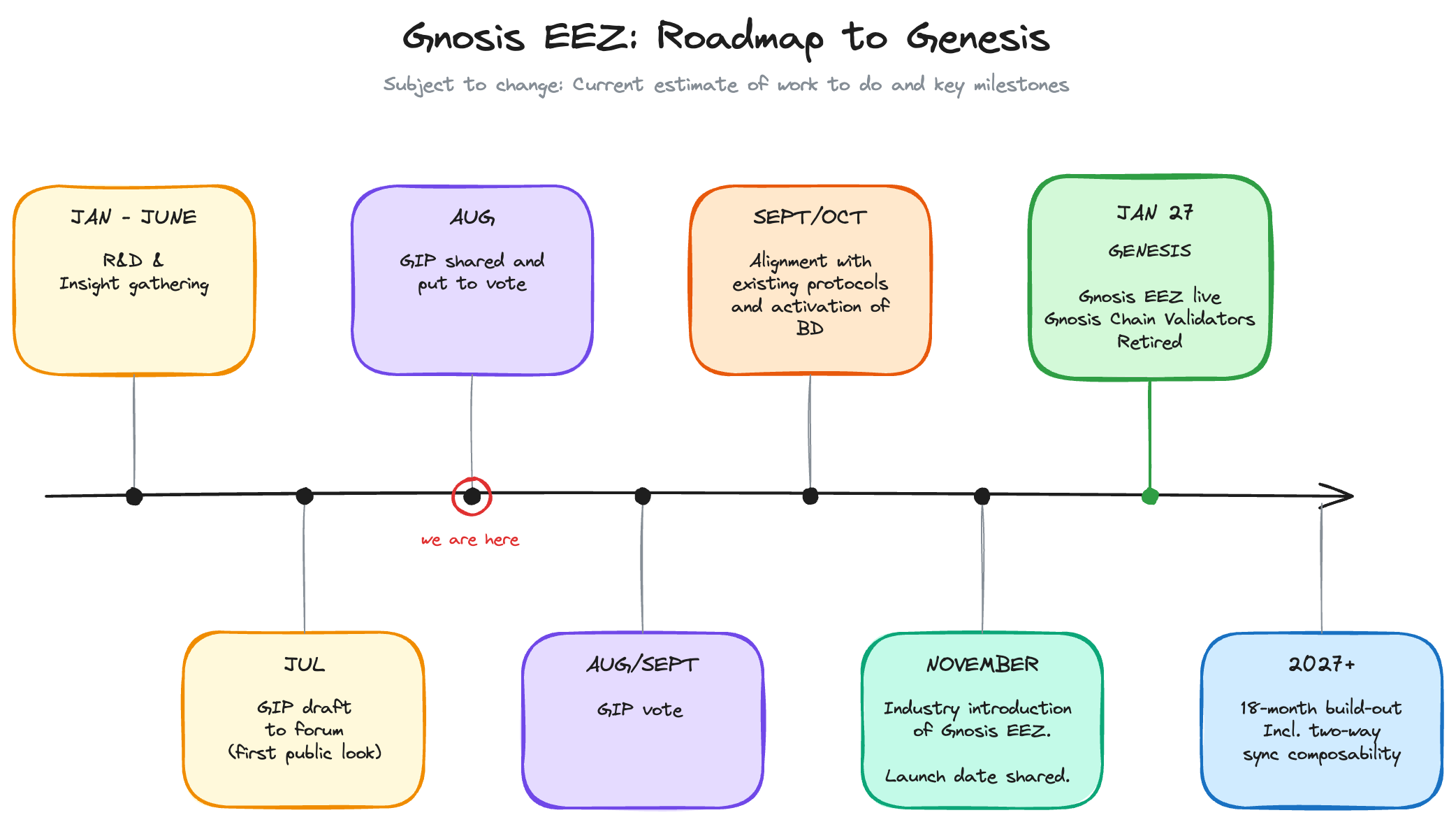
Under the GIP-153 roadmap, community voting is expected in August to September 2026. The target for the genesis block is late 2026 to early 2027, when Gnosis Chain validators would formally exit and the first EEZ block would be produced.
The full EEZ specification, including bidirectional composability, nested calls, and real-time ZK proofs, is expected to roll out across 2027.
Governance after the transition would be split into three layers:
- Changes at the EEZ protocol layer, including the rollup protocol, proving standards, and L1-to-L2 messaging primitives, would be led by Ethereum governance, and Ethereum L1 EIPs would automatically be reflected on Gnosis Chain;
- GnosisDAO would continue to govern gas token policy, fee distribution, and the ecosystem treasury;
- Long-term governance for prover operations would be defined in later GIPs.
The proposal itself highlights the variables that now matter most: whether GIP-153 can secure directional consensus, how the market absorbs the unlocking of 350,000 GNO, whether a new token economic model can replace staking income with enough fee capture, whether the community accepts the security profile of an interim TEE-based proving setup, and how censorship risk under a centralized sequencer plays out in real operation.
The pitch is ambitious. The path from a first release built around one-way L2-to-L1 calls and TEE-based validation to a complete bidirectional ZK-based experience is much longer.