
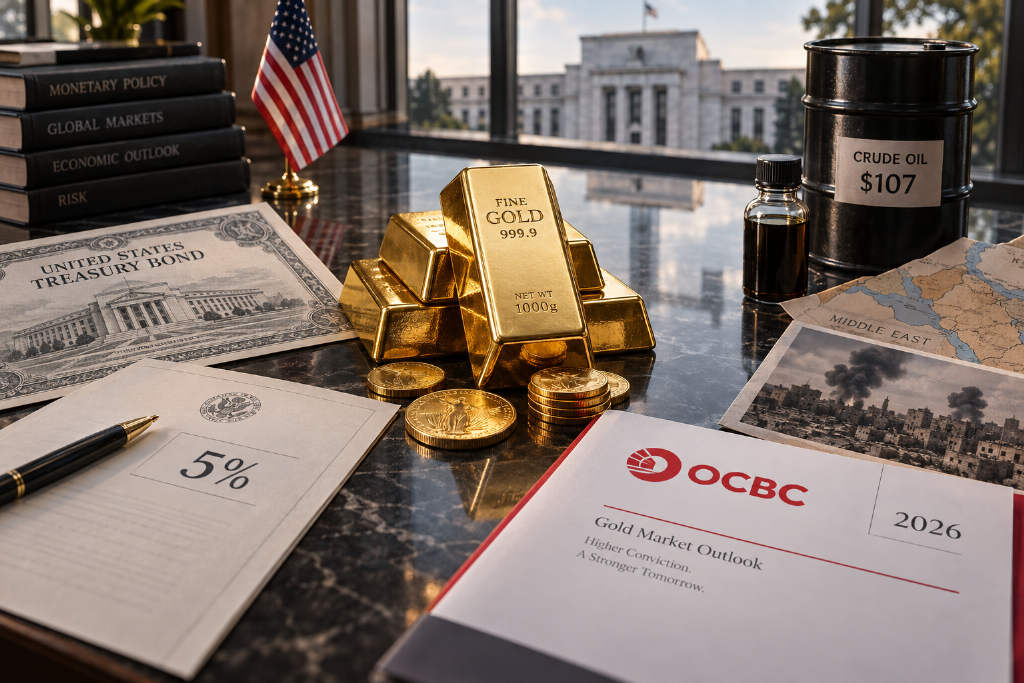
Gold stayed near $4,300 even as expectations for another Federal Reserve rate increase intensified, the U.S. 10-year Treasury yield briefly touched 5%, and oil rose to around $107 a barrel on renewed Middle East tensions. OCBC has lifted its gold forecast and now expects the metal to reach $4,600 an ounce by December 2026.
Higher yields and safe-haven demand are pulling gold in opposite directions
The report said rate futures this week pushed the implied probability of a Fed hike to about 92% to 93%. At the same time, the 10-year Treasury yield touched 5% intraday on Monday for the first time since October 2023.
Under normal conditions, that mix would weigh on gold. Rising rate expectations lift the risk-free rate, a stronger dollar makes bullion less attractive, and higher oil prices can reinforce concerns that inflation will stay sticky. All of those are near-term headwinds for a non-yielding asset.
Gold, however, has not broken down. The report said safe-haven demand tied to geopolitical risk, along with longer-term structural buying, has helped the metal hold key levels.
Middle East tensions sent oil close to $107
The latest move was linked to developments in the Middle East. According to Xinhua News Agency, Yemen's Houthi forces launched a new round of attacks on Saudi Arabia, after which Saudi Arabia shut down its east-west oil pipeline. The pipeline's daily transport volume involves about 4% of global oil supply.
Oil prices jumped to roughly $107 a barrel, with Brent crude quoted at $106.96. The market is now watching when the pipeline might return to operation and whether Saudi Arabia can increase shipments through the Strait of Hormuz to offset the disruption. That uncertainty has kept inflation concerns and geopolitical anxiety elevated, supporting gold's safe-haven appeal.
Why gold did not collapse after Treasury yields hit 5%
The report noted that spot gold fell more than 1% on Monday to a five-week low, then steadied slightly on Tuesday at $4,298.86 an ounce. Compared with the late-August high of $4,600, the metal is down more than 3%, but it has still held the $4,000 line and continued to trade around the $4,300 area.
The macro chain is straightforward: higher oil prices lift inflation expectations, stronger inflation expectations increase the likelihood of further Fed tightening, tighter policy drives Treasury yields higher, and higher yields support the dollar. None of that is friendly to gold.
That chain has run into a competing force this time. With the Middle East conflict still unresolved and uncertainty lingering after the attack on the Saudi pipeline, safe-haven buying has continued to give bullion support.
Inflation, labor data, and fiscal pressure are all pushing long-end yields higher
The report argued that the move above 5% in the 10-year yield was not driven by one factor alone. Several forces are converging.
Inflation was one trigger. U.S. CPI for August rose 3.4% year over year. Core CPI increased 2.4% year over year, while the month-over-month pace accelerated to 0.3%. In the labor market, nonfarm payrolls rose by 162,000 and the unemployment rate held at 4.1%. That combination of still-present inflation and resilient employment has strengthened expectations for a Fed move at the September FOMC meeting.
A Reuters survey also showed economists expect at least one more rate increase this year.
Fiscal conditions have added to the pressure on long-end yields. Public data cited in the report showed that net U.S. interest spending in the first 11 months of the fiscal year exceeded $1 trillion for the first time, while total federal debt rose past $40 trillion.
Corporate financing demand has also increased. Goldman Sachs data showed that hyperscale cloud service providers including Alphabet and Amazon have issued about $194 billion in bonds this year, with full-year issuance projected at roughly $250 billion, tied to AI infrastructure spending.
What institutions are saying about the yield path
Greg Peters, co-chief investment officer at PGIM Credit, said: "I keep asking myself what could be a catalyst to push yields lower. Other than a traditional recession, it's really hard to find much else. The conditions for yields to remain high and even keep rising are fully in place."
Zach Griffiths, head of investment grade and macro strategy at CreditSights, said the 10-year Treasury yield could move further toward 5.5%.
The report added that for this FOMC meeting, the more important issue for markets is not the rate increase itself but the policy-path signals delivered through the dot plot and the press conference.
Morgan Stanley expects the Fed to raise rates by 25 basis points in both September and December, citing second-round effects from energy prices, strong demand linked to AI investment, a potentially higher neutral rate for a period, and the need to preserve policy credibility.
Steven Barrow, head of G10 strategy at Standard Bank South Africa, raised his year-end forecast for the 10-year Treasury yield to 5.2% and expects it to reach 5.3% in the first quarter of 2027. "One thing that convinces me yields will break through 5% is that they have already moved close to that level even without inflation data clearly surprising to the upside," Barrow said. He also expects the Fed to raise rates in September and December and then hold them steady through the end of 2027.
A team led by TD Securities strategist Gennadiy Goldberg said yields are unlikely to spiral sharply higher on the rate increase itself because markets have already priced in much of that expectation. Still, unless the economy shows signs of deterioration, long-dated Treasury yields should remain elevated through 2027.
OCBC raises its gold target to $4,600 by end-2026
On the gold outlook, OCBC foreign exchange analyst Christopher Wong said a combination of high oil prices, high Treasury yields, and fading safe-haven sentiment has supported the dollar. But with rate hikes already substantially priced in, any further meaningful upside in the dollar would require the Fed to clearly keep the option of more tightening on the table.
Even with near-term pressure still in place, OCBC has not turned negative on gold over the longer run. The bank has raised its precious metals forecasts, citing a higher starting price level, improved investor participation, and continued structural demand support.
Chez Anbu, head of wealth advisory at OCBC, said gold's strong rebound in August reversed its earlier weak trend and that the macro backdrop has improved. OCBC now expects gold to reach $4,600 an ounce by December 2026. The report also said the bank set a target for silver, but the specific figure was not fully shown in the source text.