
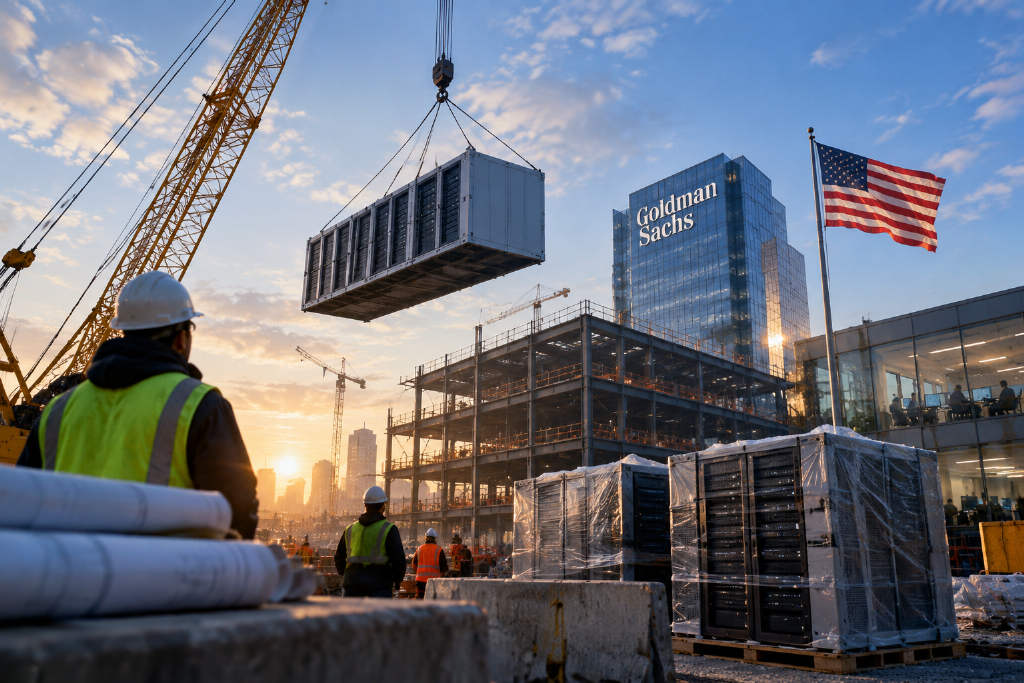
Goldman Sachs says the near-term labor-market drag from artificial intelligence has briefly turned positive, at least in the industries it tracks most closely.
In an AI adoption tracker published on Sept. 1, Goldman Sachs economists Sarah Dong and Joseph Briggs wrote that industries exposed to AI added about 4,000 jobs per month on average over the past three months. The chart title described the employment drag as a temporary reversal.
That reading differs from Goldman’s April estimate. In that earlier report, economist Elsie Peng calculated that AI was costing the U.S. about 16,000 net jobs each month, with Gen Z workers and entry-level roles taking the biggest hit.
Two Goldman numbers, two different methods
The 16,000 monthly net decline from April came from a regression-based estimate rather than a direct job count. Goldman split AI’s labor impact into two forces. One was substitution, where AI replaces human labor directly, eliminating about 25,000 jobs per month over the prior year. The other was augmentation, where AI raises worker output and can lead companies to hire more, adding back about 9,000 jobs per month. Netting the two produced the 16,000-job decline.
Goldman also said at the time that the true macro impact could be smaller because the model did not fully capture hiring tied to data centers, electricity and construction. It also noted that the estimate was an inference from regression analysis, not a real-time count of jobs.
The June and September figures came from a different tracker. Instead of estimating the effect statistically, Goldman looked directly at Bureau of Labor Statistics data on employment changes in AI-exposed industries, including management consulting, graphic design, telephone call centers and software publishing.
In Goldman’s June tracker, net job losses in those industries had narrowed to about 11,000 per month. In the latest report, the three-month average turned positive at about 4,000 jobs per month.
Younger workers still face heavier pressure
The newer tracker does not erase Goldman’s earlier warning on who bears the cost. In occupations most exposed to AI substitution, the unemployment gap between entry-level workers and senior workers widened noticeably relative to the pre-pandemic average.
Goldman’s April analysis said that for every one standard deviation increase in substitution exposure, the wage gap between those groups widened by about 3.3 percentage points.
The bank also cited U.S. Census Bureau survey data showing AI adoption among U.S. businesses has risen to 22.4% and is expected to climb further over the next six months. Unemployment among younger tech workers has fallen back in line with the broader tech sector, but across industries, younger workers still show slightly higher unemployment in sectors with higher AI adoption.
Construction is filling the gap, for now
Goldman wrote in its September report that AI’s labor-market effects remain visible, but narrow in scope. Employment pressure continues in marketing, graphic design, customer service and some technology roles, but those losses have been offset by growth in data-center-related construction jobs.
According to the report, employment tied to that segment has increased by more than 200,000 since 2022.
There is also a limit to that offset. American Edge Project estimated that the data center boom could create about 4.7 million temporary construction jobs, compared with only about 697,000 permanent operating roles, roughly a 7-to-1 ratio.
That split matters. Electricians and HVAC technicians may be needed while facilities are being built, but those jobs wind down once server rooms are completed. Operating a data center requires maintenance and operations staff, not construction crews. The workers filling the gap are not the same group facing displacement in marketing, design and customer service.
Goldman says the drag remains, but it is not broad-based
Taken together, Goldman’s April estimate and September tracker do not form a single clean line. One is model-based, the other tracks observed employment changes, and the gap between them shows how fluid the labor impact of AI still is.
Goldman’s latest conclusion is narrower: the employment drag from AI has not disappeared, but for now it is concentrated in specific occupations, while data center construction has offset part of the damage.