

Goldman Sachs said in its Aug. 21 Asia-Pacific weekly report that MXAPJ rose 1% over the week, with Hong Kong stocks up 4%, offshore China up 3%, and Taiwan down 2%. The report also said ex-China emerging Asia saw $1.5 billion in foreign outflows, while the 30-year U.S. Treasury yield climbed to its highest level since 2007.
MXAPJ stood at 891 in the report. Goldman set a 12-month target of 1,080, implying 21% upside. Including dividends, the bank put expected total return at about 24%.
Earnings growth remains the core support for a rerating
Goldman said earnings growth is the underlying support for valuation recovery. In the second quarter, 84% of MXAPJ companies had reported results. Net profit increased 135% from a year earlier and 52% from the prior quarter. Among those companies, 46% beat expectations, with a median surprise of 4.3%.
Information technology led the region, with earnings up 390% year over year. The report also pointed to strong results from healthcare, materials, and energy.
On valuation, MXAPJ was trading at 11 times forward earnings, which Goldman said was 2 standard deviations below its 10-year average.
Hedge fund leverage has dropped to the lowest level in more than a year
Goldman’s prime brokerage data showed that since August, gross leverage for Asia fundamental long-short funds fell by 14.5 percentage points to 181%. That marked the lowest level in more than a year and placed the reading at the 43rd percentile of the past five years.
Net leverage held at 59.3%, which the report placed at the 59th percentile over one year and the 82nd percentile over five years.
On regional positioning, net Asia allocation was unchanged this month at 28.5%, an 11.7 percentage-point overweight relative to the MSCI World Index. South Korea and Japan were the most heavily net sold markets, followed by Taiwan, while China saw net buying. On a year-to-date basis, Japan was the only market in net buying territory, while South Korea saw the largest net selling.
Goldman said buying in China strengthened in August. A-shares and H-shares accounted for most of the purchases, and A-shares also saw the main deleveraging activity. Even after the recent buying, net positioning in Chinese equities remained near the lowest level of the past five years.
Profit growth and fund outflows moved in opposite directions
MXAPJ net profit rose 135% year over year and 52% quarter over quarter in the second quarter. Information technology made the largest contribution, with profit up 390% from a year earlier and 68% from the previous quarter. Net margin in the sector expanded by 21 percentage points.
In Taiwan, 99% of companies had reported results. Net profit there rose 131% year over year and 54% quarter over quarter, and the market posted the highest beat ratio. Singapore and Taiwan had the largest number of earnings beats, while Australia and India had the fewest.
By sector, energy, materials, and information technology had the highest concentration of upside surprises. Real estate, communication services, and healthcare had the least.
Flows told a different story. EPFR data showed that in July, Asia funds cut exposure to Taiwan, Hong Kong, China, and India, while raising positions in South Korea and ASEAN. Ex-China emerging Asia recorded $1.5 billion in foreign outflows, including $1.6 billion from South Korea.
Valuation discounts differ across markets
Goldman’s market breakdown showed MXAPJ at 11 times forward earnings, 2 standard deviations below its 10-year average. South Korea was at 5.2 times, or 2.7 standard deviations below its long-term average. China was at 10.8 times, 0.5 standard deviations below, while Taiwan traded at 18.8 times, 1.6 standard deviations above.
The bank said the discount reflects earnings expectations that have not been fully priced in. Consensus forecasts call for MXAPJ earnings per share growth of 71% in 2026 and 24% in 2027, while current valuations still reflect a bearish slowdown scenario. Goldman said that once the reporting season confirms earnings resilience, a valuation recovery becomes a matter of time.
MSCI rebalance could trigger about $42 billion in two-way flows
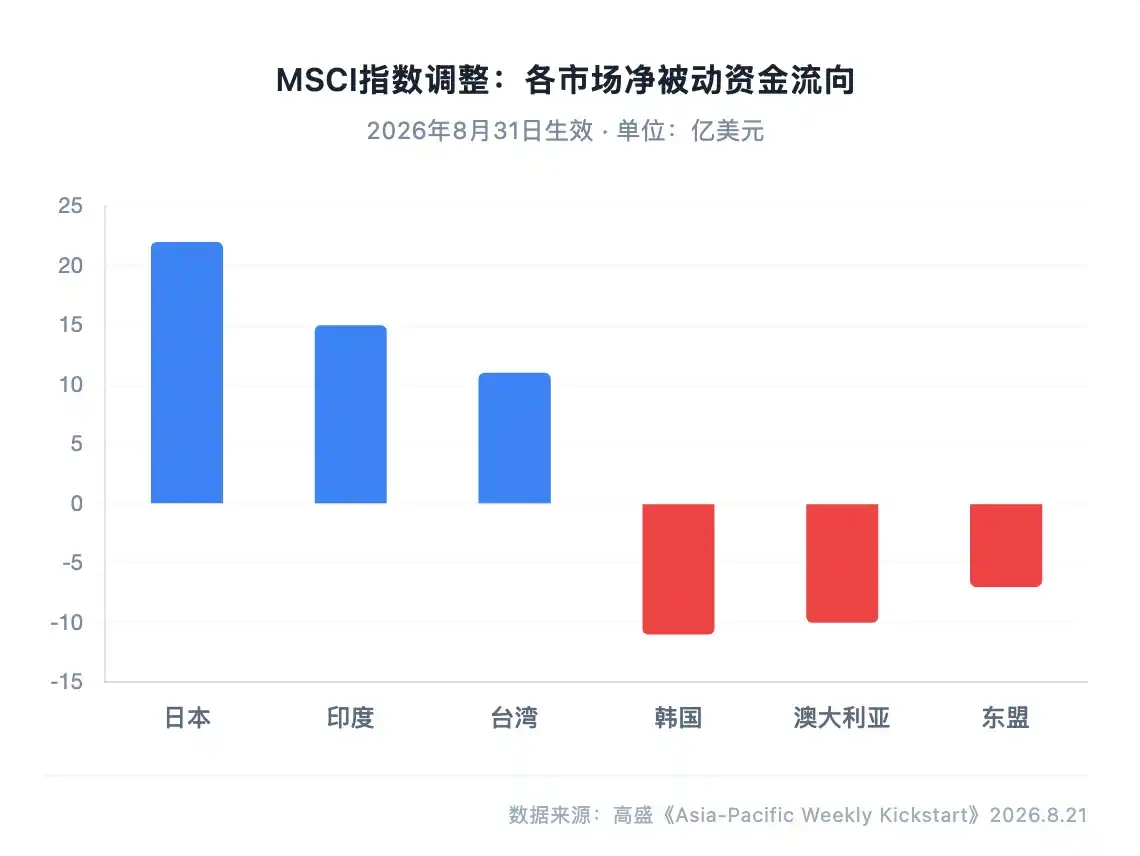
MSCI is scheduled to adjust index benchmarks after the close on Aug. 31. Goldman estimated that changes to core Asia-Pacific indexes would drive $34 billion in two-way passive flows. Adding another $8 billion from non-core indexes, including factor, ESG, and customized products, total two-way flows could reach about $42 billion.
Expected net inflows were estimated at $2.2 billion for Japan, $1.5 billion for India, and $1.1 billion for Taiwan. Expected net outflows were $1.1 billion for South Korea, $1.0 billion for Australia, and $700 million for ASEAN.
The bank also modeled passive flow effects at the single-stock level and listed the top 20 names that could see the largest net buying and net selling. It said the rebalance window could amplify volatility at month-end.
Leveraged money has started to pull back
Assets under management in South Korea leveraged ETFs recovered from a low of $16 billion to $25 billion. Goldman said the change was driven mainly by asset returns rather than new inflows. Since late July, those ETFs have posted continued mild outflows. Current leveraged positions are equivalent to 1.8% of market free float.
Taiwan leveraged ETF assets remained near a record high of $13 billion, equal to 0.7% of free-float market value. Since August, roughly $1 billion has left those products through profit-taking.
Goldman said the retreat in leveraged money means previously crowded long positions are being cleared, reducing structural downside risk in the market.
Goldman listed its overweight and underweight calls
On sector allocation, Goldman said it was overweight capital goods, banks in Australia and China, healthcare, energy, technology hardware and semiconductors, and insurance.
Its underweight list included autos, chemicals and other materials, software and services, transportation, internet, utilities, metals and mining, real estate, consumer durables retail, and telecom services.
The report also highlighted two core trade ideas: a long basket of stocks outperforming earnings revisions, launched in July 2021 with a cumulative return of 334%, and a long AI infrastructure hardware and semiconductor basket, launched in June 2023 with a cumulative return of 63%.
Three downside risks were identified in the report
Goldman listed three main downside risks: continued increases in long-end U.S. Treasury yields that weigh on valuations, rising geopolitical tensions, and a weaker-than-expected recovery in China.
The bank added that its geopolitical risk index and GSSRUSCN U.S.-China relations indicator had both moved higher recently and should continue to be monitored.
The original Chinese article said this piece was compiled and interpreted by Chaoxiang Research based on a third-party broker report from Goldman Sachs dated Aug. 21, 2026, together with public market information. It also said that the ratings, target prices, earnings forecasts, and related judgments cited in the article were the views of the broker’s analysts, represented only the institution’s position, did not represent Chaoxiang Research, and did not constitute investment advice.
The article also said markets carry risk and decisions should be made independently, and that the piece should not be used as a basis for buying or selling any security.