
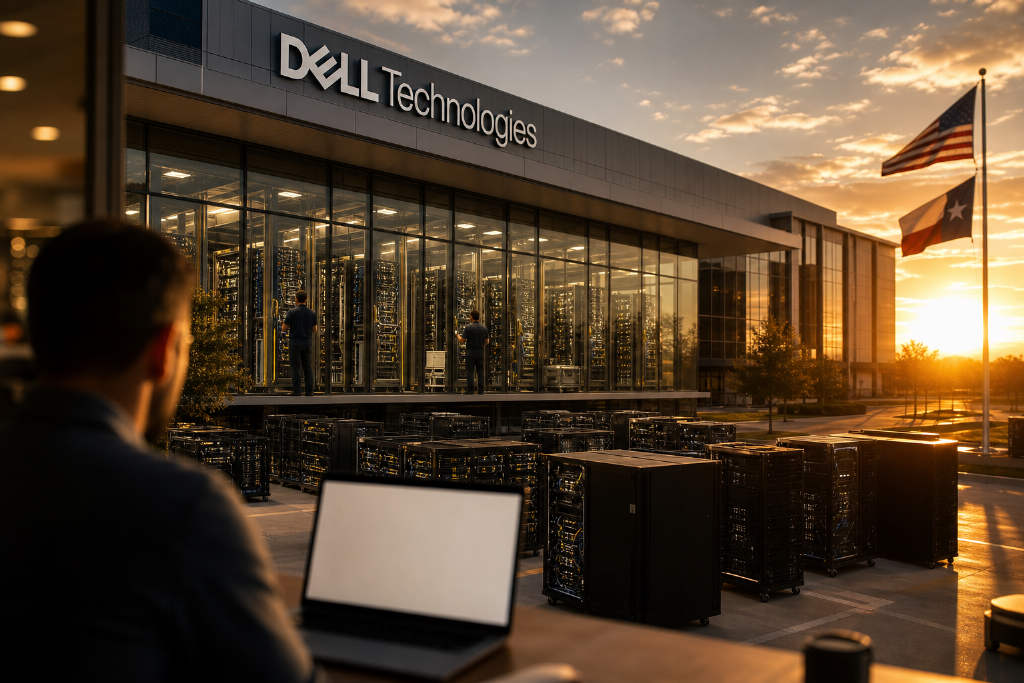
Dell's AI server orders exploded to $60.9 billion in the fiscal second quarter (F2Q27), a 154% jump from $24 billion in the prior quarter, while backlog climbed to $95 billion, according to a Goldman Sachs research note released on September 1. The company also lifted its full-year revenue guidance to $192 billion from $165-169 billion, and raised its non-GAAP EPS guidance to $25.50 from $17.90.
AI Server Orders Soar to $60.9B
Goldman Sachs said Dell's AI server orders in F2Q27 reached $60.9 billion, and backlog stood at $95 billion. Big number. The book-to-bill ratio was far above 1x. Full-year AI server revenue guidance moved up to $74 billion from $60 billion. The Infrastructure Solutions Group (ISG) reported revenue of $31.782 billion, up 89% year-over-year. Of that, AI-optimized servers delivered $16.4 billion, traditional servers and networking brought in $10.531 billion, and storage added $4.85 billion. All three subsegments came in ahead of Goldman's expectations. That kind of order momentum points to steady demand from hyperscalers and newer AI data centers buying GPU servers. Dell, one of the top server vendors, is getting a direct lift from the AI infrastructure spending boom. And the better-than-expected showing in traditional servers and networking hints that enterprise IT spending is coming back.
Margin Expansion Beats Expectations
ISG margin hit 15.0%, comfortably above the 11.7% Goldman Sachs had modeled, and it improved from the prior quarter. Goldman tied that margin gain to scale benefits from AI server production and a better product mix. More AI server revenue, along with growth in higher-margin storage and networking, pushed margins higher overall. CSG margin was 7.6%, also better than the 6.0% estimate. Commercial PC revenue came to $13.192 billion, while consumer PC revenue was $1.842 billion, with demand staying stable. Cost discipline and pricing power helped too. Overall operating margin reached 12.6%, up about 300 basis points from the prior quarter. Operating profit landed at $5.929 billion, which was 37% above Goldman's forecast.
Full-Year Guidance Raised to $192B
Dell lifted its F2027 full-year revenue guidance to $192 billion from $165-169 billion, roughly a $25 billion increase, with AI server revenue accounting for about $14 billion of that incremental amount. The non-GAAP EPS guidance rose to $25.50 from $17.65-18.15, or about $7.60 higher. F3Q27 guidance was strong too: revenue guidance of $49 billion (consensus $41.369 billion, 18% above), non-GAAP EPS of $6.50 (consensus $4.47, 45% above), and GAAP EPS of $6.10 (consensus $4.22, 44% above).
Conference Call to Focus on Three Areas
Goldman Sachs flagged three things to watch on the upcoming earnings call. First, whether AI server orders can keep going at this pace, since the market is asking if $60.9 billion was the top or if there is still room to run. Second, what really drove the margin beat—scale, product mix, or pricing power. Third, the second-half outlook for traditional servers and enterprise storage, because that will shape how much growth Dell's non-AI businesses can deliver.
Valuation and Risks
Goldman Sachs kept its buy rating and its 12-month price target of $510, based on 22x forward EPS. With the current share price at $456, that implies about 12% upside. Risks on the downside include soft PC demand, weaker-than-expected enterprise IT spending, macroeconomic headwinds, competitive pricing pressure, and a structural drop in AI server demand. Goldman thinks the large AI server order book gives Dell a visible route to growth. But investors are watching returns on AI spending more closely now, and that could cap any further expansion in the valuation multiple.
This article is based on a Goldman Sachs research report dated September 1, 2026, compiled by Chaoxiang Research. The ratings, price targets, earnings forecasts, and related judgments cited here are the views of the Goldman Sachs analyst. They do not represent the views of Chaoxiang Research, and they are not investment advice. Markets carry risk. Make decisions independently. This article should not be used as a basis for buying or selling any securities.
