
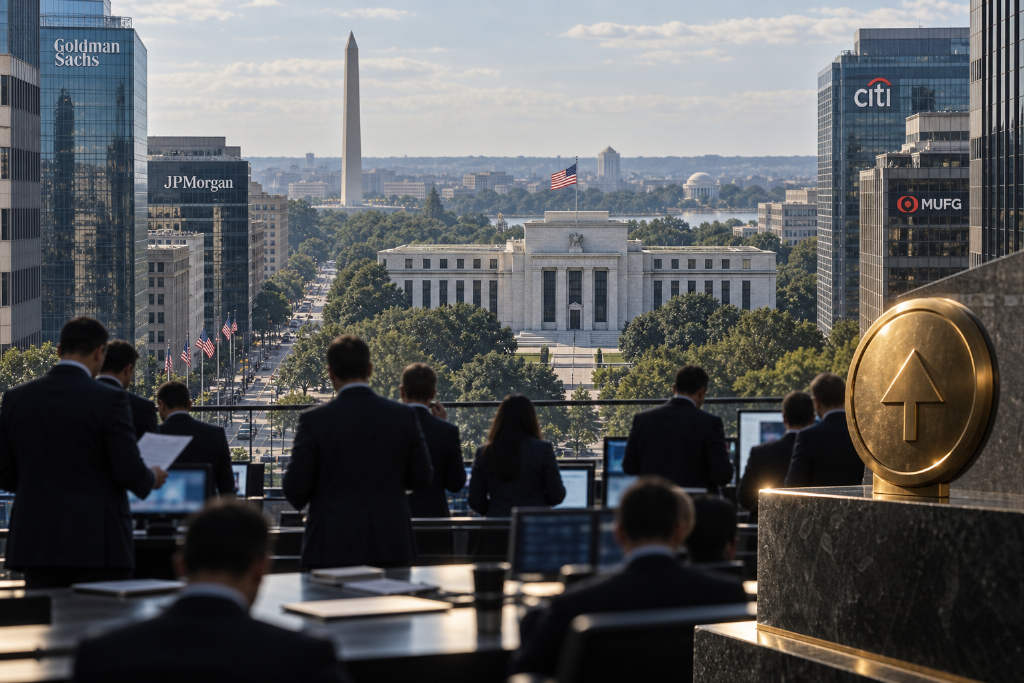
Goldman Sachs has joined the growing camp on Wall Street that now expects the Federal Reserve to raise rates next week, adding a 25-basis-point move in September to its baseline forecast. After the August CPI report, major banks have largely aligned around a September hike, even as their views diverge sharply on what comes after that.
In a Sept. 11 research note, Goldman Sachs chief U.S. economist David Mericle said the bank now expects the Fed to raise rates by 25 basis points at the two-day meeting ending Sept. 16. That marks a reversal from its earlier forecast for no change. The shift followed the latest U.S. August CPI data, which showed core CPI rising 0.3% month over month, above the 0.2% market expectation. The report pushed market pricing for a September hike to about 90%, with the latest pricing now around 85%.
Goldman says the change is about credibility more than fundamentals
Goldman’s report made clear that the new call does not reflect a fundamental change in its inflation outlook. Mericle wrote, “The August CPI report only raised our forecast for August core PCE slightly to 0.26% and did not change our basic view on inflation, but we think that with markets pricing the probability of a hike at nearly 90%, the Fed will be reluctant to stand pat and risk market turbulence.”
From a macro standpoint, Goldman said it still does not see a strong case for tightening right now. The bank continues to argue that the portion of inflation running above the 2% target can be fully attributed to one-off factors and that those effects should fade over time. It also pointed to core PCE inflation over the past three months improving to an annualized pace of about 2.5%, which it described as an early signal supporting that view.
Goldman added that the economy is not overheating, inflation expectations are not at immediate risk of becoming unanchored, and a limited rate increase would do little to offset the inflation effects of supply shocks.
What changed, in Goldman’s view, was the Fed’s communication setup. The bank said Fed Chair Warsh’s hawkish remarks at Jackson Hole had led markets to expect a hike if inflation data were anything short of perfect. August CPI was not alarming, but it was “not perfect.” Against that backdrop, a decision to hold rates steady could damage perceptions of policy credibility and trigger an immediate reaction in long-end Treasury yields.
Goldman also said higher oil prices may push some previously undecided FOMC voters toward supporting a hike. Even officials who share Goldman’s inflation view may choose not to resist tightening if they are tired of repeatedly explaining why elevated inflation does not necessarily signal overheating.
Wall Street banks moved quickly after the CPI report
Goldman is not alone. According to the Wallstreetcn article cited in the report, several major Wall Street institutions quickly revised their Fed rate forecasts after the August CPI release, and a September hike is becoming the base case for more firms.
JPMorgan dropped its earlier preference for waiting and now expects 25-basis-point hikes in both September and December. Michael Feroli, the bank’s chief U.S. economist, said the rationale is straightforward: core PCE inflation has remained above 3% in every month this year, and progress toward the 2% target has been extremely limited.
Citi economists Andrew Hollenhorst and Veronica Clark expect a 25-basis-point hike in September. They said stronger-than-expected core inflation in August, combined with a renewed rise in energy prices, would “likely be just enough to form a consensus.”
MUFG also abandoned its previous forecast that rates would remain unchanged in 2026 and now expects a 25-basis-point move in September.
The bigger split is over what happens after September
Even with September tightening now close to a Wall Street consensus, the expected path from October through 2027 is far less settled.
Goldman remains relatively cautious beyond September. Mericle said additional hikes at later meetings are possible, but not part of the bank’s baseline forecast. Goldman expects most FOMC members to lean against another move in October, partly because that meeting comes close to the midterm elections and partly because officials who doubt the need for more tightening may want to keep the pace more gradual. For December, Goldman expects inflation trends to improve further, with the effects of tariffs and the Iran war, which it identified as key inflation drivers, fading more over time. Under that view, the case for another hike would weaken materially.
Goldman also said that even a single 25-basis-point increase would have only a limited real-world impact on the economy.
TD Securities holds the most hawkish view among the firms mentioned. Strategists including Oscar Munoz and Gennadiy Goldberg expect the Fed to start this hiking cycle in September and deliver three increases in total: 25 basis points in September, another 25 basis points in October, and a third hike in January 2027. They argued that August CPI showed no further improvement in inflation and that the Fed needs to begin a new tightening cycle.
JPMorgan expects two hikes this year, but not at every meeting. Feroli said there is a reasonable case for pausing in October to allow time to assess how tighter policy is feeding through to the economy. The bank’s base path is a hike in September, a pause in October, and another hike in December. It does not expect the hiking cycle to extend into 2027.
MUFG sits between those views. The bank expects a hike in September followed by a pause in October and puts the probability of another increase in December at 55% to 60%. MUFG also said explicitly that this hike could itself turn out to be a “policy mistake.” At the same time, it raised its Treasury yield forecasts across most maturities by 25 to 50 basis points and now expects year-end yields of 4.25% for the 2-year Treasury, 4.625% for the 10-year, and 5% for the 30-year.
Citi is the most dovish on the path after September. It expects the Fed to hike in September and then stay on hold until June 2027, when easing would resume as inflation gradually retreats. Citi expects three rate cuts in total by the end of 2027.