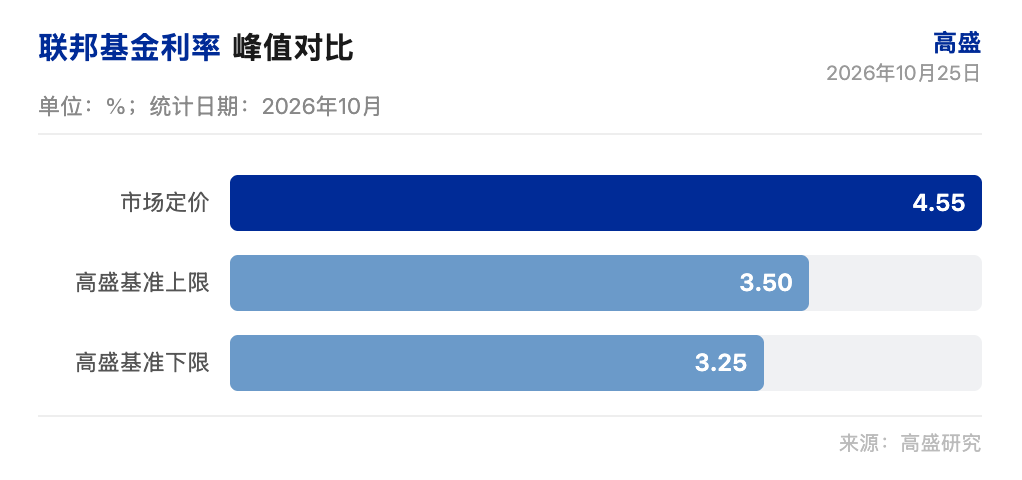
In a report dated Oct. 25, 2026, Goldman Sachs said the Federal Open Market Committee, or FOMC, will probably sit out October and then deliver one more rate hike in December. Goldman sees that December move as the second and final hike of this cycle. Markets are still leaning much tougher: fed funds futures imply a peak around 4.55% and three more hikes by autumn 2027, making four in all.

A TechFlowPost article by Rita said Goldman’s terminal range sits at 3.25% to 3.5%. In Goldman’s telling, the real split with market pricing is not about whether policy stays restrictive. It is about how quickly three temporary inflation drivers burn off.
October pause, December finish
Goldman’s base case begins with one simple point: the Fed already hiked in September. The report said recent remarks from FOMC participants suggest a compromise where hikes come every other meeting. Governor Waller was quoted saying rate increases do not have to happen at back-to-back meetings, but they do need to come within an acceptable window. So, an October pause and a second hike in December line up with Goldman’s main call.
The bank expects the October statement to tweak the wording used after the September hike. Goldman said the FOMC may borrow from Vice Chair Jefferson’s recent phrasing: "Any further adjustment to the federal funds target range, aimed at supporting a more timely return to the 2% goal, will depend on data trends, the evolving outlook, and the balance of risks." Goldman said that wording puts the emphasis on watching the trend and waiting for more data between meetings.
The report said the post-meeting press conference probably will not offer much that is new. Support for the every-other-meeting approach looks pretty firm. And the hurdle for breaking from that plan before year-end appears high. It also said Warsh gave no hint of a slowdown at the September press conference, and Goldman thinks he may rather have others deliver that message.
Markets price four hikes, Goldman sees two
Since late September, markets have removed one hike from pricing, but the peak is still near 4.55%, which still matches a total of four increases. Goldman’s base case calls for only two, with a terminal range of 3.25% to 3.5%. The report added that Goldman’s probability-weighted path is even more dovish than its base case because the bank expects the FOMC to start cutting once inflation gets close to 2%.
Goldman said its Financial Conditions Index, or FCI, has tightened by 30 basis points since September. The bank typically treats a 25-basis-point rate hike as equal to about 20 to 25 basis points of FCI tightening. So this move is a bit more than one hike. Not four. On that basis, Goldman said the FOMC is unlikely to see current financial conditions as too tight or use them as a stand-in for more rate increases.
That is where the main divide sits: the number of hikes. Market pricing says higher for longer. Goldman says two hikes, then stop, and rate cuts later on.
Three temporary factors behind the core PCE overshoot
Goldman tied that disagreement to three temporary inflation factors: tariff pass-through, the Iran energy shock, and the mismeasured share of AI-related price pressure. Core personal consumption expenditures, or core PCE, are now running 1.1 percentage points above the 2% target. Goldman said those three factors together account for the entire overshoot.
On tariffs, Goldman argued that the extra pass-through from earlier tariff rounds into consumer prices is nearly done. Year-over-year tariff rates should keep falling. Base effects should help too. Even if the White House brings back tariffs that a court had struck down, Goldman expects only a slight rise in the effective tariff rate. The report said the hit should stay limited because that increase would be small, and earlier tariff removals had only a small effect on consumer prices.
On energy, higher oil prices and wider refined product spreads have already pushed core PCE up by 0.3 percentage points. Goldman’s base case assumes another 0.1 to 0.15 percentage points. The report also said oil futures are running above Goldman’s forecast because of worries about a wider Middle East conflict. If spot prices track the futures curve, Goldman said its March forecast for core PCE would climb by another 0.1 percentage points, while headline PCE would rise by about 0.4 percentage points.
On AI-related price pressure, Goldman expects the effect on year-over-year core PCE to top out in the next few months and then fall back clearly in 2027. The bank pointed to slower growth in AI demand and investment in new storage capacity. The report added that storage prices have hit consumer prices unevenly from month to month this year, which leaves the next few months uncertain.
Goldman also flagged a sharp jump in prices received in manufacturing surveys, while services are still sitting at normal levels. The bank said that pattern still looks partly temporary. But if the pressure lasts longer, companies could pass those costs through in annual price resets, which would make the January effect bigger. One print matters a lot here: the report said the second-to-last inflation reading before the March meeting will be especially important.
Financial tightening equals roughly one hike
Goldman repeated its view that the 30-basis-point tightening in FCI is roughly equal to one rate hike. Under its usual framework, a 25-basis-point hike matches around 20 to 25 basis points of FCI tightening. That means current conditions are only a little above that band and still nowhere near what would usually fit four hikes.
For the October meeting, Goldman said the big issue is how the statement changes the language used after September, not whether rates move right away. Its base case is that the FOMC adopts Jefferson’s wording and ties any further adjustment to data trends, the evolving outlook, and the balance of risks. If Warsh thinks that language feels too much like older forward guidance, the backup option would be to say nothing at all about the policy path. Goldman thinks the first option is more likely.
The report also said the tightening in financial conditions has come mostly from higher rates, and those higher rates depend heavily on expectations for more hikes. Because of that, Goldman does not think the FOMC will treat tightening driven by expectations as a substitute for actual policy moves. Unless the data clearly weaken, a December hike is still on the track.
Goldman says the bar for a March hike is high
March 2027 is the next meeting where another hike could plausibly happen. If the FOMC sticks with every other meeting, policymakers will have five more months of inflation data by then. Goldman’s base case says no March hike, because the effects of tariffs, the energy shock, and AI-related price pressure should fade and allow the inflation trend to improve.
The report said some FOMC participants may agree with Goldman that the economy is not overheating and that inflation overshoots caused by earlier supply shocks should be allowed to fade instead of being countered with tighter policy. In that view, using monetary tightening to crush demand would come with too high an employment cost. Those officials may prefer to keep the full hiking cycle smaller.
Goldman also laid out conditions that could end the cycle sooner. Among them: growing concern about growth or employment, including energy prices eating into real income, softer consumer spending, or financial conditions tightening beyond where they are now.
Still, Goldman did not rule out a March hike. It said the case for one would require inflation data to run hotter than expected. The main risks are oil futures staying above forecast, a worsening Iran conflict, a more extreme and persistent energy shock, broader spillover into inflation, and a bigger January effect. Even so, Goldman left its base case unchanged: the hiking cycle ends in December, while market pricing for four hikes remains the more hawkish view.
Disclosure in the original article
The original article said it was a summary and interpretation by Chaoxiang Research of a third-party broker report from Goldman Sachs dated Oct. 25, 2026, together with public market information. It also said that any ratings, target prices, earnings forecasts, and related judgments mentioned in the piece reflect only the broker analyst’s views and that institution’s position, not the view of Chaoxiang Research, and do not amount to investment advice.
The article also said markets carry risk, decisions should be made independently, and the piece should not be used as a basis for buying or selling any security.