
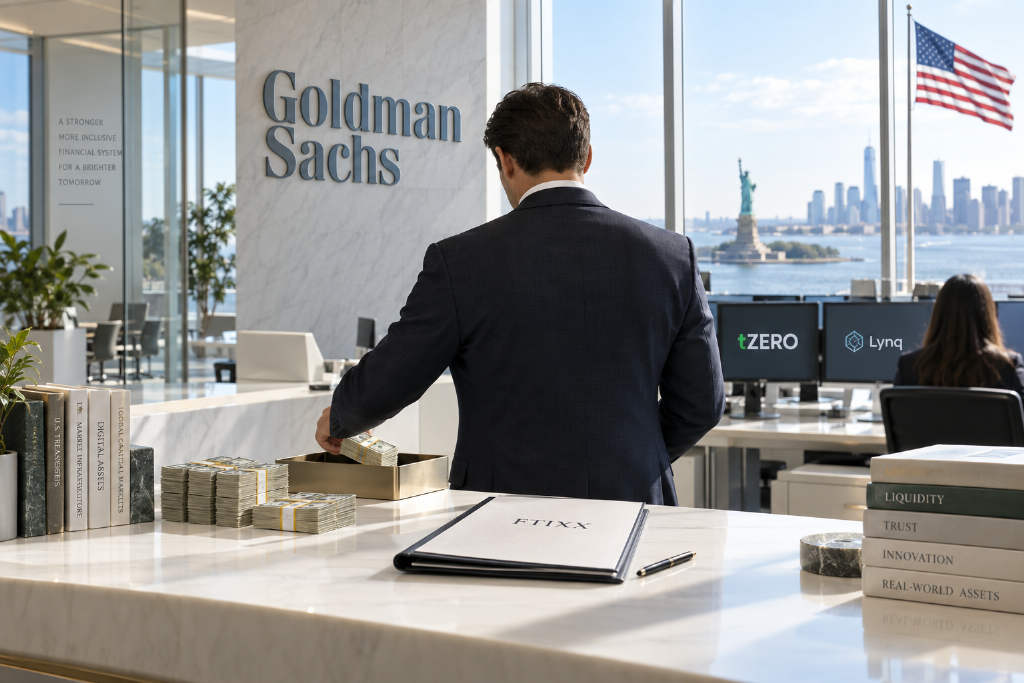
tZERO announced on Sept. 28 that Goldman Sachs Asset Management’s Treasury money market fund, FTIXX (Goldman Sachs Financial Square Treasury Instruments Fund), is now available on Lynq for eligible U.S. institutions. For crypto market makers and trading firms, the listing creates a way to place idle cash into a U.S. Treasury-backed fund between trades and earn yield before redeeming when funds are needed again.
The fund had about $105 billion in net assets at the end of August, according to the input, and it is the first external fund listed on Lynq.
Using trade downtime to park cash
Crypto trading firms often hold large cash balances for short periods after one trade closes and before the next begins. CoinDesk reported that, through this arrangement, Lynq clients can move that cash into FTIXX during those gaps, collect U.S. Treasury income, and redeem when liquidity is required.
Lynq is a settlement system designed for real-time transfers of funds and trade settlement between institutions. It was built by tZERO, Arca Labs, and Tassat, and runs on a private Avalanche blockchain that is not open to the public and requires permission to join.
CoinDesk said Lynq clients include B2C2, Wintermute, Galaxy Digital, FalconX, Crypto.com, and Fireblocks. Unchained reported that Lynq currently has more than 30 institutional clients and about $89 million in assets on the network.
Subscriptions and redemptions are handled by tZERO Securities, a broker-dealer registered with the U.S. Securities and Exchange Commission. Clients must first pass tZERO’s onboarding review and eligibility checks, and access is currently limited to U.S. customers.
Goldman chose not to tokenize this offering
One of the clearest features of the arrangement is what it does not do: it does not tokenize the fund shares offered through Lynq. The input notes that traditional finance firms entering crypto have often used tokenized fund structures, including BlackRock’s BUIDL and Franklin Templeton’s BENJI. It also mentions an earlier report that BlackRock worked with Ondo to bring a portfolio on-chain.
Goldman took a different route here by placing an existing traditional fund into a settlement system already used by crypto institutions. Unchained said Lynq is offering FTIXX’s regular institutional share class, which stood at about $97.3 billion at the end of August. FTIXX also has a tokenized share class, GDTXX, but that class had only $10,400 at the same time.
As described in the input, that gap suggests institutional clients are currently focused more on yield and operational convenience than on tokenization itself.
What Lynq and tZERO said
Lynq CEO Jerald David told Unchained, 「We need to prove there is real customer demand.」 He said clients wanted a Treasury asset on the platform with return characteristics different from another product already available there.
David also told CoinDesk that Lynq 「now supports multiple assets.」 In its statement, tZERO said, 「Accessing familiar products through a new settlement network is an important step.」
What the listing means
For crypto trading firms, the change adds a new place to hold idle cash inside a system they already use, with exposure to a product managed by a major Wall Street asset manager and invested in U.S. Treasuries.
For Goldman Sachs, CoinDesk said the structure avoids the need to build a separate blockchain-native product. Lynq serves as a distribution channel that places an existing fund into the day-to-day treasury workflow of crypto institutions.
The input also makes one point explicit: the $105 billion figure refers to the total size of the fund, not money that has flowed into crypto markets. Assets currently on Lynq remain in the tens of millions of dollars. Whether this type of arrangement expands will depend on whether more crypto institutions complete onboarding and move capital onto the network.
From Citi working with Coinbase on stablecoin payments to Goldman making a Treasury fund available to crypto trading firms, capital links between traditional finance and the crypto sector are becoming more routine.