
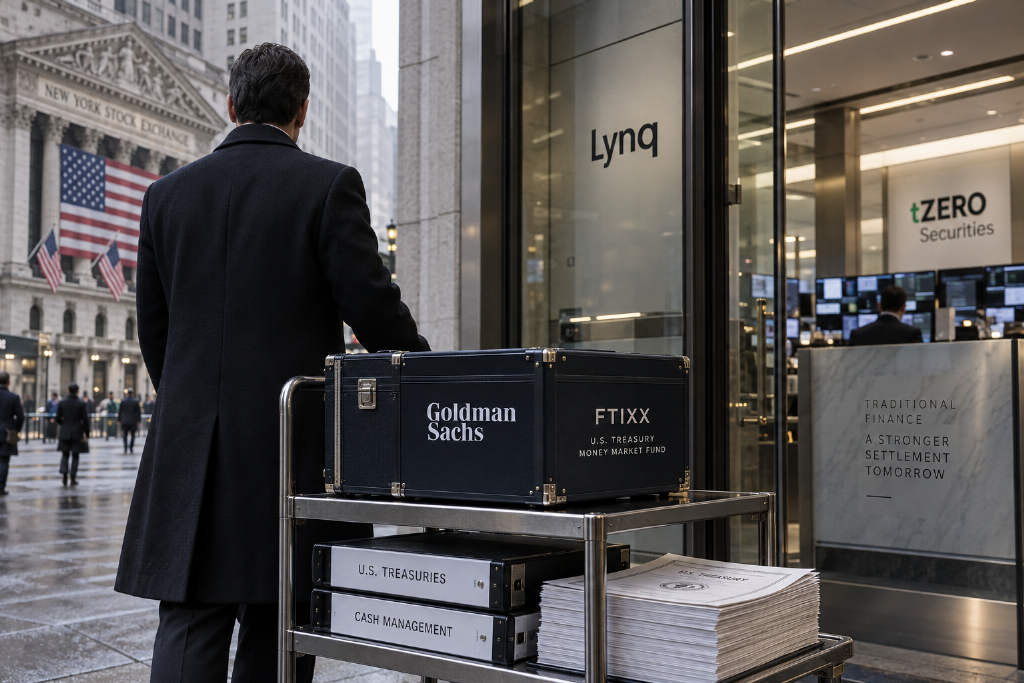
Goldman Sachs is bringing its roughly $100 billion Treasury fund, FTIXX, to institutional crypto firms without creating a tokenized version of the product.
The fund will be offered through Lynq, a settlement network used by digital-asset companies, with trades handled by SEC-registered broker-dealer tZERO Securities. FTIXX is the first outside fund available on Lynq. Before this, the network had only one investment product.
The setup differs from other Wall Street efforts tied to blockchain-based funds. BlackRock built BUIDL as a tokenized fund, while Franklin Templeton offers tokenized shares of its money market fund through BENJI. Goldman is taking another route: FTIXX remains the same traditional fund, and Lynq serves as an added access point for digital-asset firms.
A traditional fund enters crypto workflows without a new on-chain wrapper
The key distinction is that Goldman Sachs does not need to build a separate blockchain fund to reach crypto-native institutions. Instead, Lynq is trying to place an established Wall Street Treasury product into the same money-movement workflow those firms already use.
"There’s a convergence now that you’re seeing between traditional market participants and digital asset market participants as well," Lynq CEO Jerald David said in an interview with CoinDesk TV.
For firms on Lynq, FTIXX offers a place to park cash between trades instead of leaving it idle. They can earn yield on that money and pull it back out when they need to deploy it elsewhere.
Lynq says clients had been asking for a Treasury option
David said that was a product Lynq’s clients had been requesting. The network works with firms including B2C2, Wintermute, Galaxy (GLXY), FalconX, Crypto.com and Fireblocks. Their businesses can require moving large amounts of money between trades, and they wanted another way to put that cash to work in the meantime.
"We needed to demonstrate that there was client demand," David said. "Our clients were looking for a treasury asset on the platform that may have had a different yield profile than the other instrument that’s on there right now."
Adding FTIXX required changes to the network and onboarding checks
Getting FTIXX onto Lynq required technical and operational work, David said. Lynq had to modify its technology, limit access to U.S. clients and integrate with Mosaic. Customers also need a relationship with tZERO Securities and must complete the required onboarding and eligibility checks.
Lynq runs on a private Avalanche Layer 1
Lynq itself runs on a private, permissioned Avalanche (AVAX) Layer 1 blockchain. According to the company, the network has onboarded more than 30 institutional digital-asset firms and holds more than $89 million in assets.
"The Link platform itself now is multi-asset capable," David said. "We’re really excited that FTIXX, Goldman Sachs's flagship treasury fund, is the second asset now available for institutional clients."