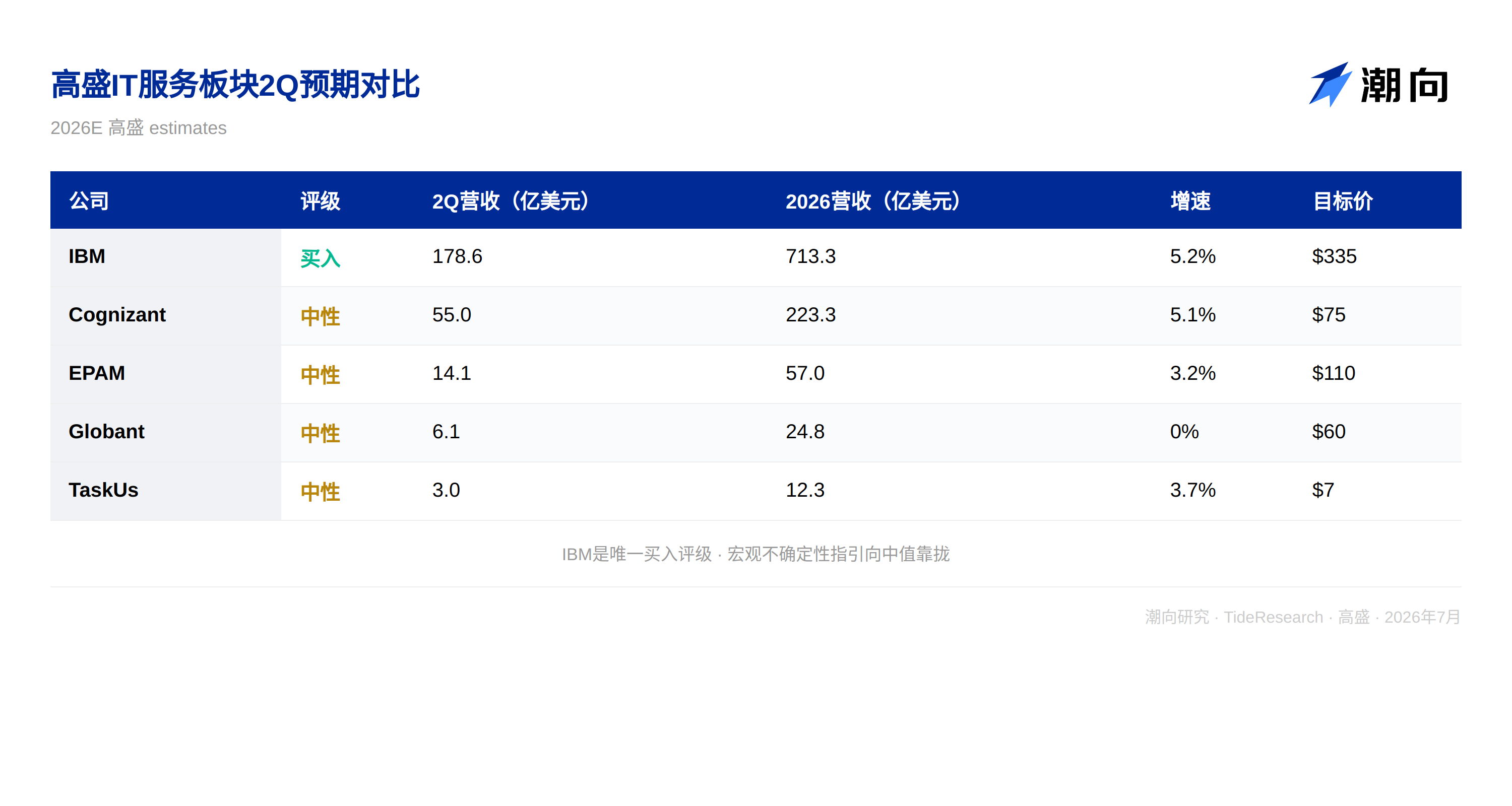
Goldman says guidance ranges are getting tighter across IT services
Goldman Sachs on July 10 published its 2Q26 earnings preview for the Americas technology IT services sector, covering IBM, Cognizant, EPAM, Globant, and TaskUs. Its main call was straightforward: second-quarter results should largely match expectations, but macro uncertainty has been affecting client decisions since April and May, pushing companies to lower the upper end of guidance and center expectations around the midpoint.

The piece was written by Rita. In Goldman’s view, IBM is the relative beneficiary inside the group because of software resilience and enterprise AI demand, while names with heavier exposure to discretionary spending, including EPAM, carry more downside risk.
Client spending decisions turned more cautious in April and May
Goldman said macro uncertainty has already started to alter the pace of decision-making among IT services customers. CIOs are becoming more cautious on spending, and consulting as well as discretionary projects are taking the first hit.
The report tied that view to two factors: continued volatility in macro data and a shift in enterprise budget priorities toward AI, which is squeezing traditional IT services spending. Goldman argued this is not just one quarter’s noise. It could run through all of 2026. On that basis, the bank expects all five covered companies to reduce the top end of guidance when they report second-quarter results.
IBM is the only Buy-rated name in the group
IBM was the only company in Goldman’s coverage universe here to receive a Buy rating, with a $335 price target. Goldman pointed to IBM’s software business as the company’s main source of resilience.
The bank forecast IBM’s second-quarter software revenue at $8.16 billion, roughly in line with consensus, and full-year software revenue at $33.2 billion. It also said Red Hat is expected to post double-digit growth in 2026, while the integration of Confluent continues. In a tighter enterprise spending environment, Goldman sees stability in core software as a scarce quality.
Enterprise AI demand was the other differentiator. Goldman said IBM’s blended consulting-and-software model is being repriced by the market because the company has both AI consulting implementation capabilities and AI platform products such as WatsonX. The bank said IBM is increasingly being viewed as a net beneficiary of enterprise AI demand.
Goldman forecast IBM’s second-quarter revenue at $17.86 billion, slightly above the market expectation of $17.84 billion. For the full year, it projected revenue of $71.3 billion, implying growth of about 5.2% year over year. It also said IBM’s 2026 free cash flow guidance could land around $16 billion, above the market expectation of $15.9 billion.
EPAM faces the biggest drag from discretionary spending
Goldman was most cautious on EPAM’s near-term setup and kept the stock at Neutral. The report said EPAM is concentrated in application implementation and consulting, the areas seeing the greatest pressure in the current macro backdrop.
Goldman forecast EPAM’s second-quarter revenue at $1.41 billion, broadly in line with market expectations. For the full year, it projected revenue of $5.7 billion and organic growth of about 3.2%, below the top end of prior guidance.
The bank also expects EPAM to narrow its full-year organic growth guidance to 2.5%-4.0% from 2.5%-5.0%. Until macro uncertainty eases, Goldman said, the company’s core business lacks a near-term catalyst.
Other covered names remain Neutral
Goldman assigned Neutral ratings to the rest of the group.
- Cognizant: Neutral, with a $75 price target. Goldman expects full-year revenue of $22.3 billion and growth of about 5.1%. It said ongoing demand for cost optimization should continue to support outsourcing demand even if discretionary spending stays weak.
- Globant: Neutral, with a $60 price target. Goldman expects full-year revenue of $2.48 billion, broadly flat, citing pressure from Middle East geopolitical tensions and weakness in consumer-linked verticals including media and entertainment as well as travel and hospitality.
- TaskUs: Neutral, with a $7 price target. Goldman expects full-year revenue of $1.23 billion and growth of 3.7%. The report said the company is the most exposed to AI-driven disruption in business process outsourcing.
Goldman frames the split as an AI budget reset
Beyond the numbers, the report highlighted a structural split within the industry. Under the same macro uncertainty, IBM and EPAM are moving in opposite directions in Goldman’s framework: IBM benefits from sticky software and a concentration of enterprise AI budgets, while EPAM is being hurt by the crowding-out effect on discretionary spending.
Goldman described that shift as an “AI budget reset” in IT services. Companies are cutting traditional consulting and systems integration spending and redirecting budgets toward AI-related software and implementation projects. In Goldman’s view, that supports IBM and weighs on EPAM.
Valuation snapshot and disclosure
According to the figures cited in the article, IBM is trading around $241, equal to about 25x forward earnings, against Goldman’s $335 target. EPAM is trading around $130, or about 8x forward earnings, compared with a $110 target. The article said the market’s low valuation on EPAM already reflects expectations for weak performance, and Goldman does not see a near-term trigger for a reversal in those expectations.
The original piece stated that it was Chaoxiang Research’s summary and interpretation of a third-party broker report from Goldman Sachs dated July 10, 2026. Ratings, price targets, earnings forecasts, and related judgments cited in the article are the views of the broker’s analysts and represent only the position of that institution, not Chaoxiang Research. It also said the content does not constitute investment advice and should not be used as the basis for buying or selling any securities.