
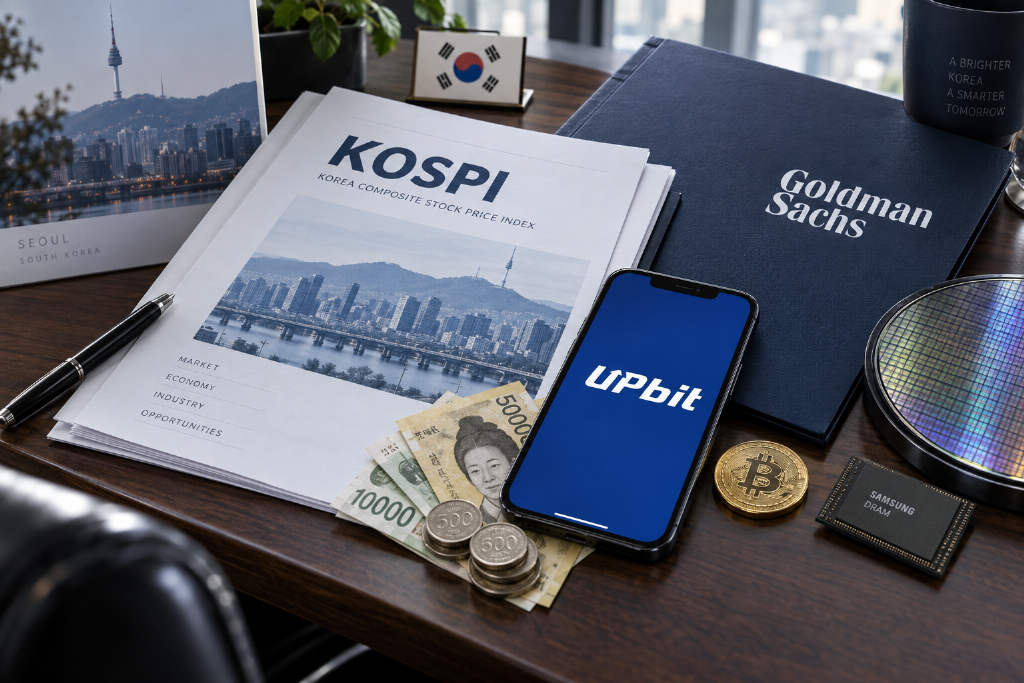
Goldman Sachs said in a Sept. 23 report that South Korea’s KOSPI has the conditions for a short-term tactical breakout, but continued retail liquidity moving into crypto could make the index’s next leg higher more dependent on foreign investors and domestic institutional reallocation.
KOSPI setup tied to chips, buybacks and investor positioning
Chris Cha, a Korea equity analyst at Goldman Sachs Global Investment Research, said market concerns over U.S. Federal Reserve rates have been partly absorbed, while risk appetite has shifted toward agentic AI themes. The report added that Korean memory-chip names still have fundamental support. Fourth-quarter DRAM contract prices are expected to post a double-digit quarter-on-quarter increase, and the ramp-up in HBM4 capacity is expected to keep limiting supply of standard server DRAM.
Goldman said large shareholder returns from Samsung Electronics, continued institutional buying and a turn to net buying by foreign investors could push the KOSPI toward the 7000 to 7200 resistance zone.
Crypto trading heats up as local retail absorption weakens
The report also said the ability of Korean local retail investors to absorb equities is weakening. After Bitcoin returned to $85,000, crypto trading activity in Korea picked up.
Citing DefiLlama data, the report said Upbit’s daily spot trading volume was about $770 million on June 13 and rose to $1.817 billion on Sept. 22, up roughly 136%. Based on combined trading volume of $3.27 billion across South Korea’s five major exchanges on that day, Upbit alone accounted for more than half.
October seen as the key test window
Goldman said that with more Korean retail liquidity flowing into crypto, the KOSPI’s follow-through will depend more on foreign and institutional buying. The bank described October as the key window for testing whether foreign investors continue adding exposure to Korean semiconductor and AI assets.