
Goldman Sachs said in a Sept. 9 meeting-notes report that it maintained a Buy rating on Sandisk and set a 12-month price target of $2,200. Based on the current share price of $1,738 cited in the report, that points to implied upside of 26.6%.
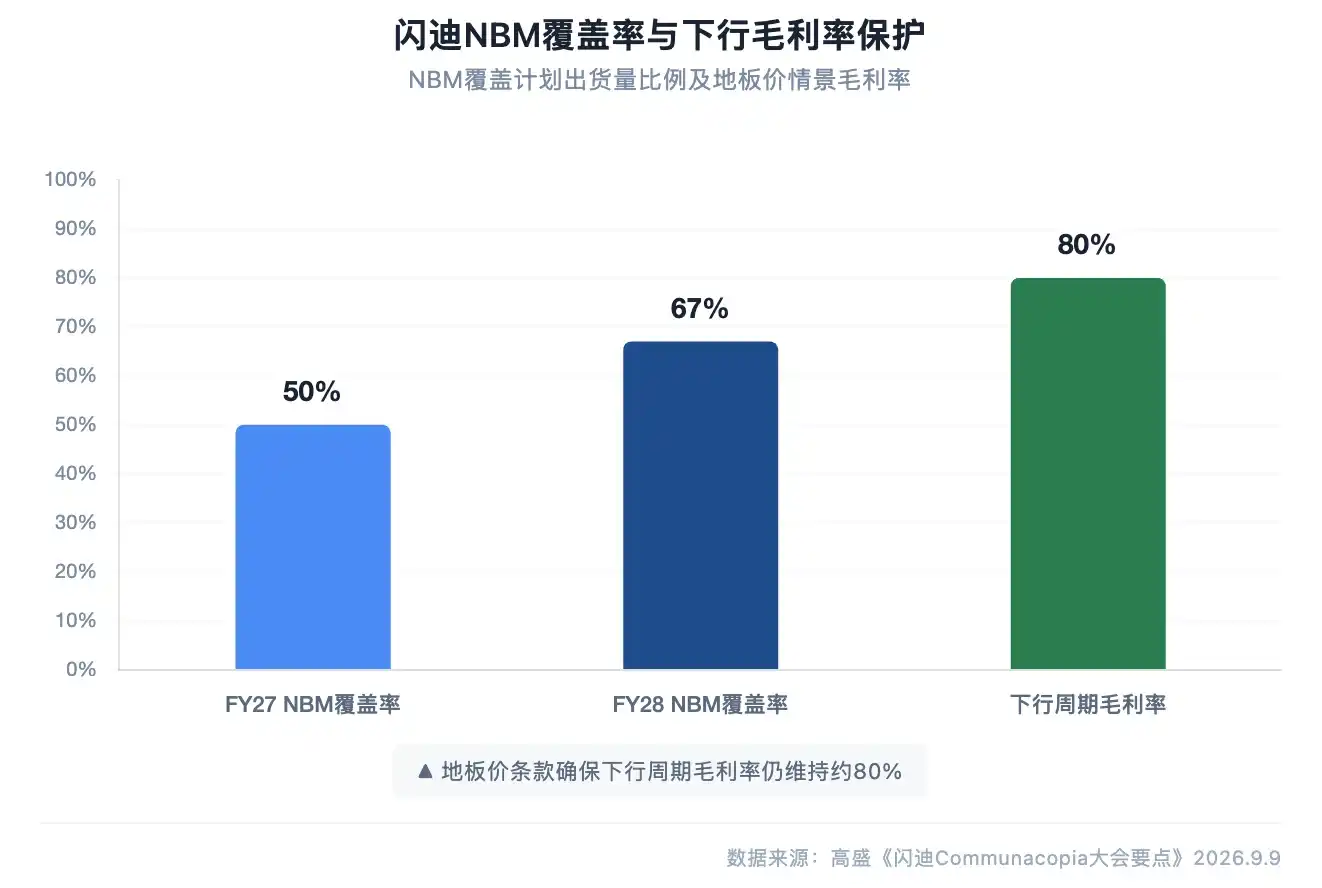
At the Communacopia conference, Sandisk management said long-term NBM agreements now cover 50% of planned FY27 shipments and 67% of planned FY28 shipments. The company also said floor-price provisions in those agreements could support gross margins of about 80% even in a bearish NAND price-downside case.
Goldman says the thesis is moving from cycle exposure to structural change
Goldman’s view is that the core Sandisk story is shifting away from a cyclical trade and toward a structural upgrade. In the report, the bank said the NAND market is moving from short-term spot pricing to long-term agreements, with data center demand taking a larger role as the primary growth driver.
It also said supply growth remains constrained while demand continues to expand on the back of AI inference. Goldman argued that Sandisk’s joint venture platform with Kioxia and its lower capital intensity give the company stronger earnings visibility in this cycle.
NBM floor-price terms are central to the margin case
Sandisk management gave a more detailed explanation of NBM economics at the conference. The key feature, according to the company, is the floor-price clause. In an extreme scenario where NAND prices fall sharply, gross margin on most of the business could still hold at about 80%.
That protection changes the company’s earnings profile because it is no longer fully exposed to sharp swings in spot pricing. Management said 50% of planned FY27 shipments and 67% of planned FY28 shipments are already covered by NBM, and Goldman said that level of coverage materially improves revenue visibility over the next two years.
Supply outlook stays tight, with added China capacity seen as locally absorbed
On the supply side, Sandisk management said NAND supply growth is likely to stay subdued for the foreseeable future, while wider adoption of AI inference is pushing demand higher. In management’s view, that setup supports pricing.
Asked about capacity expansion by Chinese competitors, Sandisk said most of the added supply is being absorbed by the local market, limiting the impact on the global market. Goldman added that YMTC roadmap execution remains a potential risk, but its current assessment is that the impact is manageable.
HBF and KV Cache are part of the long-term growth case
Sandisk management also expressed optimism about the long-term outlook for HBF and KV Cache. HBF was described as a possible answer to the AI “memory wall” problem because higher density can address both bandwidth and capacity requirements in AI computing.
KV Cache was described as critical to AI inference. Goldman, citing management’s estimate, said KV Cache will account for about 35% of a 1.2 ZB AI data center memory TAM by 2032. The implication in the report is that Sandisk’s long-term growth opportunity in AI storage extends beyond traditional NAND demand.
Joint venture with Kioxia runs through 2034, capital intensity at about 5%
Sandisk’s joint venture agreement with Kioxia has been extended through 2034. Management said the arrangement, combined with IP ownership and R&D investment, gives the venture efficient manufacturing capability, with bit growth share disproportionate to capital spending.
Sandisk said its capital intensity is about 5%, below the industry average. Management also said the BiCS platform gives the company visibility into its technology path over the next several years and supports additional bit growth at the same low capital intensity. Goldman said this cost advantage is a key differentiator versus peers.
Share buybacks remain the main capital return tool
Sandisk reiterated that stock repurchases are still its main method of returning excess capital to shareholders. The company said it has executed about $4.5 billion in buybacks. Management said it remains open to introducing a dividend in the future, but buybacks remain the primary tool at this stage.
Valuation framework and downside risks
Goldman’s $2,200 target price is based on a 20x earnings multiple applied to normalized EPS of $110. Using the cited current share price of $1,738, the report said that implies 26.6% upside.
Goldman said the valuation is supported by the earnings stability tied to NBM, a supply-constrained industry setup, and Sandisk’s low capital intensity. The report listed three downside risks: a long-term structural shift in NAND pricing does not materialize, YMTC continues to advance its technology roadmap, and Sandisk fails to gain share in eSSD.
Disclosure in the source article
The original article said it was a整理与解读 of a third-party brokerage report from Goldman Sachs dated Sept. 9, 2026, combined with public market information. It also said the ratings, target price, earnings forecasts, and related judgments cited in the piece were the views of the brokerage analysts and represented only the institution’s position, not the view of the publisher, and did not constitute investment advice.
The source article also said markets involve risk, decisions should be made independently, and the article should not be used as a basis for buying or selling any security.