
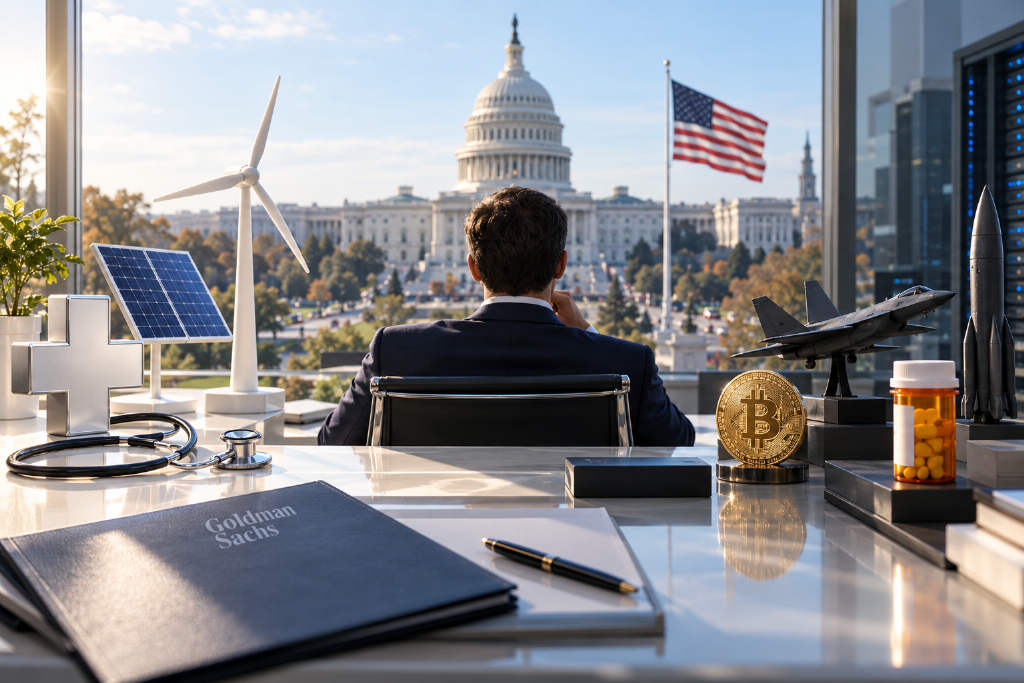
As the U.S. midterm election draws closer, prediction markets are assigning higher odds to a Democratic sweep, and Goldman Sachs has prepared a trading guide around that scenario.
According to the article by Bu Shuqing published by Wallstreetcn and cited in the source material, betting-market data currently prices the probability of Democrats winning both chambers at 67%. Goldman’s core setup is to go long healthcare and renewable energy, short large pharmaceutical companies, defense and cryptocurrencies, and stay cautious on AI infrastructure. The bank’s reasoning is not mainly about what legislation Democrats could pass. It is about which industries could suddenly become regulatory targets in Washington.
At the broader market level, investors are also watching whether the Nasdaq 100 Index, or NDX, can use the election outcome to break out of a trading range that has lasted for months. Analyst King Callahan described the index as being in a state of "running desperately while standing still."
AI infrastructure: power bills turn into a political issue
Goldman says the AI trade is facing a new political variable: electricity costs. Democrats want to shield households from surging power bills, a stance that could force data centers to absorb more of the cost of building out infrastructure.
In Goldman’s view, the debate is no longer whether the U.S. needs more AI infrastructure. The question is who will pay for it. Its trade recommendation is to go long renewable energy and grid infrastructure, while buying protection on hyperscale cloud service providers and data-center equipment.
Healthcare: long ACA beneficiaries, short drugmakers
In healthcare, Goldman argues that Democrats want to revive Affordable Care Act, or ACA, subsidies. That could lift patient volumes and reduce uncompensated care burdens for healthcare providers, creating a favorable setup for the sector.
The other side of that trade is a more aggressive drug-pricing negotiation policy. Goldman says large pharmaceutical companies would be first in line to feel the pressure. Its recommendation is straightforward: long ACA beneficiaries, short pharmaceutical companies.
Government spending: non-defense names seen benefiting more
Goldman notes that Democrats have historically supported expanding domestic spending alongside a larger defense budget. On that basis, the bank sees upside in names tied to government contractors, research institutions and healthcare-related spending.
Stocks with heavier defense exposure, by contrast, could face relative pressure. Goldman’s trade is to go long beneficiaries of non-defense government spending and short defense beneficiaries.
Washington pressure returns: big tech, banks and crypto in focus
Goldman says a Democratic victory would mean a tougher Washington stance toward business, with regulatory pressure returning across several areas.
For large-cap technology companies, antitrust enforcement would move back up the agenda. For investment banks and cryptocurrencies, the bank expects more regulators and fewer friendly faces. For tariff-sensitive stocks, Goldman says investors should not expect Democrats to provide relief. In fact, it expects more upside than downside for tariffs through early 2027.
Homebuilders: housing affordability offers policy support
Housing affordability remains a political priority for both parties. Goldman says expanded housing tax credits and incentives for first-time homebuyers could support the homebuilder sector.
Based on the performance comparison between the homebuilder index and the equal-weight S&P 500, Goldman sees relative strength in the group and recommends going long homebuilders.
Corporate tax rate: limited near-term hit, longer-term risk remains
On taxes, Goldman takes a relatively mild view. Because Trump retains veto power and the 21% corporate tax rate has become a permanent provision, the bank believes the immediate risk to corporate earnings in 2027 and 2028 is limited.
Over a longer horizon, however, companies facing higher tax rates could trade in a less friendly valuation environment. Goldman’s conclusion is simple: tax legislation can wait, but the market does not have to.



