
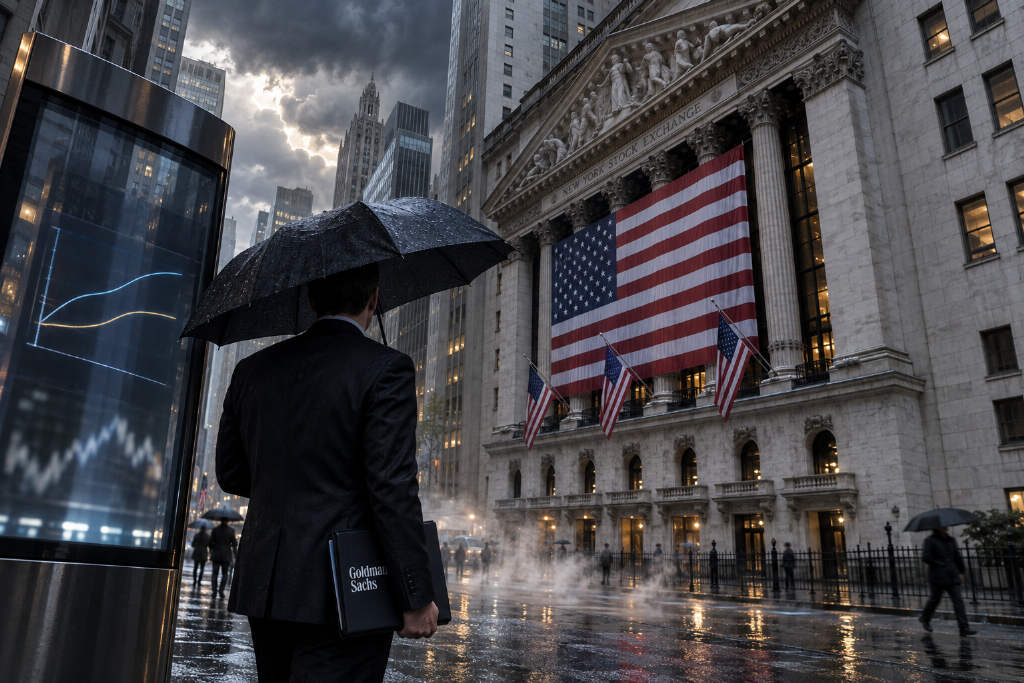
Goldman Sachs said in its U.S. Weekly Kickstart report dated Sept. 11, 2026 that rising interest rates are weighing on equity valuations, while earnings remain the most important driver for stocks. The call came as the 30-year U.S. Treasury yield rose to 5.3%, the highest level in nearly 20 years, and the 10-year Treasury yield climbed to nearly 5% this week, its highest since October 2023.
The TechFlowPost article, written by Rita, said the S&P 500 forward price-to-earnings ratio has fallen from 22x at the start of the year to 19x, even as the index remains within 2% of its all-time high.
Seven takeaways from Goldman’s report
Goldman economists expect the Federal Reserve to raise rates by 25 basis points next week. The report said recent conversations with companies and portfolio managers have centered on how higher rates are affecting equities. Goldman analyst Ben Snider laid out seven key conclusions across valuation, hiking cycles, sensitivity to rates, corporate balance sheets and sector dispersion.
Lower multiples, but little change versus bonds
Goldman said the S&P 500 forward P/E has dropped from 22x to 19x since the beginning of the year. The report linked that move to a mix of factors, including uncertainty tied to AI, questions about earnings durability and the rise in rates. It also said the S&P 500 earnings yield stands at 5.2%, compared with a 2.6% real 10-year Treasury yield, leaving a gap of 270 basis points.
According to Goldman, that spread has been broadly stable over the past two years, and the market-implied equity risk premium has also held near 3%. The report described the equity risk premium as the extra return investors require to own stocks instead of bonds. Goldman added that, regardless of the level of rates, greater rate volatility is also a challenge for equities.
Stocks often struggle early in a hiking cycle, then recover
Goldman reviewed seven hiking cycles over the past several decades. On average, the S&P 500 posted a negative 2% return in the three months after the first rate hike. Over the following 12 months, the average return was a positive 9%, and every cycle except 2022 ended with gains.
The report cited 1997 as an example. During a Fed tightening cycle of 25-basis-point hikes, the S&P 500 fell 10%. Once the market stopped pricing in additional tightening, stocks bottomed and reached a fresh high within three months.
Goldman said rate markets are now pricing in more than three additional 25-basis-point hikes by mid-2027. In its view, that raises the threshold for another hawkish surprise from policymakers. The report added that the medium-term impact of Fed tightening on equities depends on how that tightening affects earnings growth.
Equities are more sensitive to long-end yields
Goldman’s dividend discount model suggests that roughly 75% of the present value of the S&P 500 reflects cash flows that arrive more than 10 years in the future. On that basis, the report said stock returns show the strongest relationship with moves in long-dated bond yields. Inflation can lift the nominal value of future cash flows, which is why equity valuations are more sensitive to higher real rates.
The firm also said the pace of rate moves matters. Over the past few decades, stocks have usually still generated positive returns during periods of rising rates unless the increase was faster than 2 standard deviations. At current levels, a 2-standard-deviation monthly move in the 10-year Treasury yield is about 50 basis points, while a two-week move is about 30 basis points. Goldman said the speed of recent yield moves helps explain why stocks have struggled to absorb them.
Balance sheets and sector splits
Large-cap balance sheet risk remains limited
Goldman said borrowing costs for the S&P 500 have risen only moderately in recent years. Most companies carry fixed-rate debt with long maturities, and interest expense remains relatively small compared with still-strong profits.
The report said interest coverage ratios for the S&P 500 as a whole and for the median stock rank in the 99th and 68th percentiles, respectively, over the past 20 years. Smaller companies look more exposed because their balance sheets are weaker and a larger share of their debt carries floating rates.
Homebuilders lag as rates rise, financials tend to outperform
Goldman said homebuilding stocks are among the most sensitive parts of the equity market to long-term rates. Since June, homebuilders have underperformed the equal-weighted S&P 500 by 16 percentage points. Financial stocks typically outperform when rates move higher, while AI stocks show only a modest negative correlation with real yields.
The report added that companies can support valuations either by lowering their risk premium or by lifting their growth rate. To fully offset the effect of a 1-percentage-point rise in the cost of equity, expected long-term growth would need to increase by 2 percentage points. Goldman pointed to capital spending and research and development as one route, while mergers, acquisitions and breakups offer another.
The article said announced U.S. M&A deals have reached $1.4 trillion so far this year, while global deal volume is up 36% year over year.
Goldman’s earnings and index targets
For the S&P 500, Goldman forecasts earnings per share of $340 in 2026, up 24% year over year, and $385 in 2027, up 13%. It set a year-end target of 8,000 for the index and a 12-month target of 8,300.
The original article noted that it was a整理与解读 of a third-party broker research report from Goldman Sachs dated Sept. 11, 2026, combined with public market information. It also said that the ratings, price targets, earnings forecasts and related views cited in the piece are those of Goldman analysts, represent only the position of their institution, and do not represent the view of Chaoxiang Research or constitute investment advice.
The article ended with a reminder that markets involve risk, decisions should be made independently, and the piece should not be used as the basis for buying or selling any security.
