
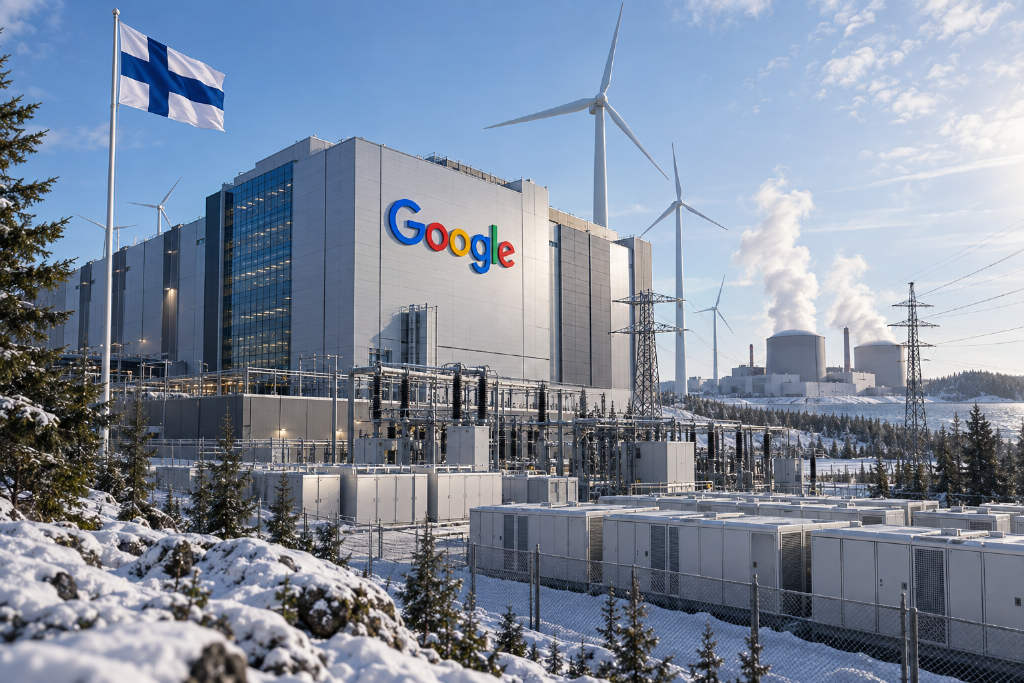
Google expands AI infrastructure in Finland and signs a 22-year nuclear power deal
Google said it will invest at least €13 billion in Finland over the next two years to build new data centers and related digital and energy infrastructure. The investment is described as Google’s largest single investment in Europe so far, with projects spread across Hamina, Kajaani, Muhos and Vaala. The capacity is meant to support rising compute demand from services including Gemini, Search and Maps.
Alongside the data center buildout, Google plans to add 629 MW of onshore wind power and a 94 MW battery energy storage system.
The more closely watched part of the announcement was a 22-year power purchase agreement with Finnish energy company Fortum. The contract can cover up to 50% of the generating capacity of the Loviisa nuclear power plant. According to the report, the long-term agreement will provide revenue support for extending the plant’s operating life through 2050. Fortum said that if the contract covers 50% of capacity, comparable return on net assets, or RONA, would rise by about 1.4 percentage points. After the news, Fortum shares were at one point up about 15.5%.
The report’s takeaway was direct: power demand from AI data centers is no longer only about higher electricity consumption. It is also starting to reshape the long-term income profile and return metrics of nuclear assets.
Brent stays above $100 as long-dated Treasury yields rise
On the macro side, Brent crude remained above $100 a barrel, with conflict in the Middle East continuing to raise supply risk.
At the same time, the U.S. 10-year Treasury yield touched 4.85%, its highest level since November 2023. The 30-year yield also climbed to about 5.30%, a level last seen in 2007. The report said higher oil prices are reviving inflation concerns, while the U.S. fiscal deficit and pressure from long-term Treasury supply are still weighing on bond prices.
The U.S. Treasury also said it would buy back as much as $6 billion of 10- to 20-year Treasuries on Sept. 10, triple the size of the previous long-duration buyback operation. Even so, that amount came in below some investors’ expectations. After the announcement, long-end yields did not fall. The 10-year yield moved higher instead.
The report said the buybacks are mainly aimed at improving liquidity in older issues. But in a U.S. Treasury market of roughly $32 trillion, pressure tied to inflation, fiscal deficits and new supply cannot be changed directly by buybacks worth only several billion dollars.
It also noted that if producer price index data that night and consumer price index data the following day both come in strong, Treasury yields could face more upward pressure.
DOJ reportedly examines Nvidia’s roughly $17 billion deal with Groq
According to The New York Times and Reuters, the U.S. Department of Justice is examining Nvidia’s roughly $17 billion transaction last year with AI inference chip startup Groq. The focus is whether Nvidia used the structure of the deal to avoid the antitrust review normally required in a traditional acquisition.
Groq develops specialized chips for AI inference and is seen as one of Nvidia’s potential rivals in inference computing. Instead of a direct acquisition, Nvidia obtained a “non-exclusive license” to Groq’s chip technology, while Groq founder Jonathan Ross and several other senior executives joined Nvidia. Reuters said the Justice Department sent Nvidia a formal request for information shortly after the deal was announced.
Reuters added that even if regulators ultimately find violations, a full unwinding of the transaction is still viewed as unlikely, though Nvidia could face fines or other restrictions.
The report’s interpretation was that if regulators eventually treat a structure combining technology licensing and core team transfers as a de facto merger, Nvidia will have less room to use similar arrangements to absorb competing technology and talent quickly.
OpenAI says it is working with Samsung on next-generation chips
Harrison Kim, OpenAI’s South Korea lead, said the company is deepening cooperation with Samsung Electronics, and that one of the clearest areas of progress is joint development and production of OpenAI’s next-generation chips.
Samsung Electronics is one of the world’s major memory chip and foundry companies. It is also a large enterprise user of ChatGPT Enterprise and has deployed related products across departments including research and development, marketing and sales.
Before this, OpenAI had already been working with Broadcom on in-house AI chip development. Samsung and SK Hynix had also signed memorandums related to supplying memory chips for the Stargate project. The new disclosure extends Samsung’s involvement to the next-generation chip itself.
Still, OpenAI has not disclosed the chip architecture, manufacturing process, order value or production timeline. That means it is still not possible to tell whether Samsung will ultimately handle design, memory, foundry work, or more than one part of the stack.
Main thread of the day
The daily report framed the session around two parallel moves. AI infrastructure is still expanding, with Google locking in long-term nuclear power supply and OpenAI broadening work on next-generation chips. At the same time, constraints are rising as Nvidia’s way of acquiring a rival’s technology and key talent starts drawing antitrust scrutiny.
On the macro side, oil has moved back above $100 and the U.S. 10-year yield has climbed to about 4.85%. The next PPI and CPI releases, according to the report, will help determine whether higher energy prices feed more directly into rate pressure.