
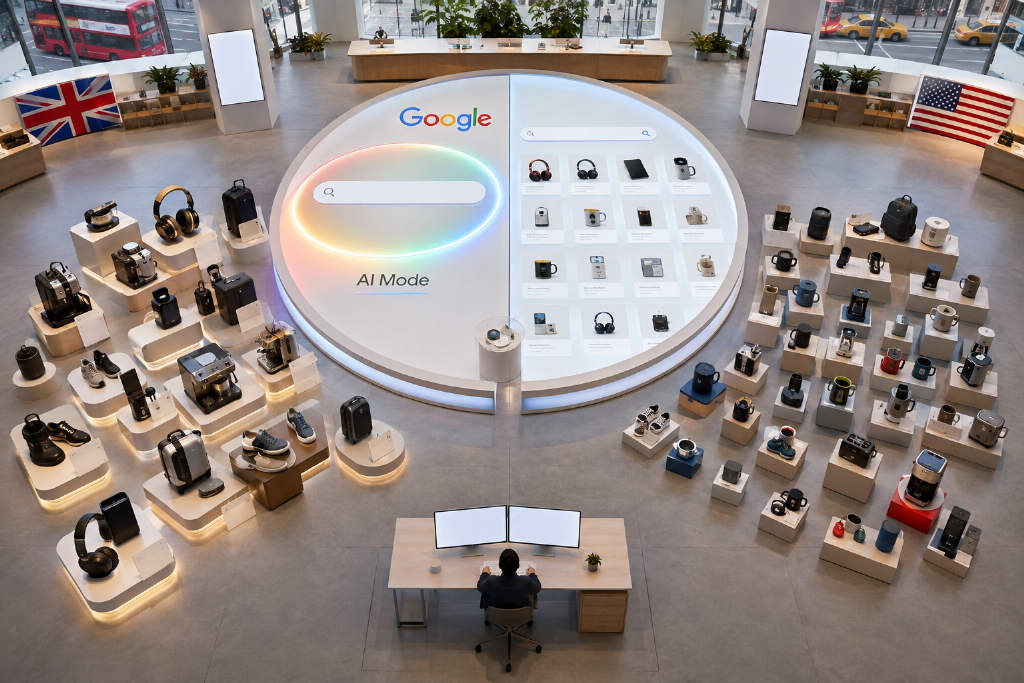
Productrise, a SaaS provider that tracks organic Google shopping rankings, said a 23-day test found that Google AI Mode and traditional search behave almost like two separate product recommendation systems. In matched product comparisons, prices shown in AI Mode were 21.6% higher on average than those in traditional search.
The study was based on more than 2 million product listings and 100,000 search engine results pages. Productrise said it ran the same shopping queries through Google AI Mode and traditional search on the same day, then used Google product identifiers to match the same item on both sides and compare the top-listed offer for each result.
Minimal overlap between the two result sets
Price was only part of the gap. According to the study, the product mix surfaced by the two systems was also dramatically different. Of the products that ranked in traditional search, only 1.28% appeared in AI Mode on the same day for the same query.
The number of displayed items was also much lower in AI Mode. For the same shopping query, traditional search showed an average of 27.8 products, while AI Mode showed 3.9. The average overlap was just 0.94 products. Across the full tracked set, AI Mode accounted for only 12.3% of visibility.
Looking at all observed listings, the median price in AI Mode was $149, compared with $100 in traditional search, a gap of about 49%.
When prices diverged, AI Mode was usually higher
Among products that could be matched one to one, 38.1% showed different prices between the two systems. In those mismatched cases, AI Mode was more expensive 68.4% of the time.
The size of those price gaps was uneven as well. When AI Mode showed the higher price, the median difference was 22.2%, while the average was lifted to 88.5% by a small number of outliers, such as cases where a used item was matched against a new one. When AI Mode was cheaper, the median difference was 7.8% and the average was 11.9%.
Sellers often changed too. Productrise said that even when the same product was successfully matched across both systems, the primary seller differed in 49.6% of cases.
Methodological limits noted in the study
Productrise also listed several limitations in its methodology. First, it compared only the top-listed offer on each side, not every available offer for a product. Second, the AI Mode sample was small by design, representing just 12.3% of all tracked products and showing an average of 3.9 items, far below the 27.8 shown in traditional search.
Third, the study did not measure which merchant users actually clicked on or what they ultimately bought, meaning a price difference on the page does not prove consumers paid more. Fourth, the sample covered only the United States and the United Kingdom, and prices in U.S. dollars and British pounds were not converted into a single currency. Asian markets were not included.
Productrise said the research showed the phenomenon of higher prices in AI Mode, but did not explain why Google’s ranking logic would produce that outcome. Google had not responded, according to the report.
SEO consultant offers a different interpretation
Independent SEO consultant Brodie Clark offered a counterpoint. He said the higher prices visible in AI Mode may reflect the grid-style results shown on the page, which makes top-level comparisons less precise. In his observation, the retailer that users eventually click through to is often still the one with the lowest price.
Put simply, the first price a user sees may not be the final transaction price.
Three Google entry points can shift users into AI Mode
The report said there are three Google entry points that may move users into AI Mode without making that shift obvious: the AI Mode button in the search box, the AI Mode button in the Chrome address bar, and the AI Mode tab on the search results page.
All three routes carry over the same query, but the underlying recommendation logic changes. The side knowledge panel can still show other merchants and prices, though that requires one more click, which many users may not make.
Productrise also cited a July 2026 study saying AI Mode returned about 95% fewer product listings than traditional search. As Google pushes AI Mode deeper into the core search experience, the item seen first may matter more than the item with the lowest price.