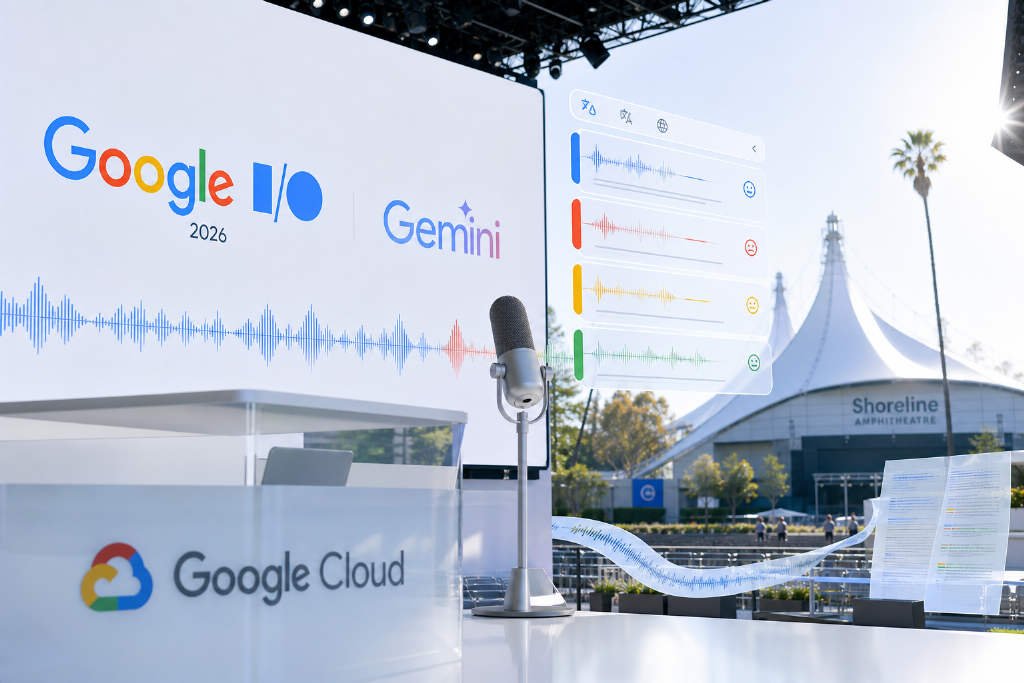
Google introduced Gemini 3.5 Transcribe at its 2026 I/O conference, adding a new speech-to-text model with several built-in features aimed at handling richer audio transcription tasks. According to Techub, the model supports emotion detection, speaker identification, timestamp tagging, and translation, putting it in a position for use cases that require more than plain text conversion.
Google said the model comes with a 96K-token context window, allowing it to process long audio files. The company positioned it for scenarios such as meeting transcription and legal evidence collection, where longer-form audio handling and structured output matter.
At the same time, Google drew a line between this model and live transcription products. It explicitly recommended Cloud Speech-to-Text API for real-time transcription instead of Gemini 3.5 Transcribe. That distinction suggests the new model is designed for longer, post-processing-oriented workloads rather than low-latency streaming use.
Google introduced Gemini 3.5 Transcribe at its 2026 I/O conference, according to Techub. The speech-to-text model supports emotion detection, speaker identification, timestamp tagging, and translation.
The model has a 96K-token context window, which allows it to handle long audio files. Google said it is suited to use cases such as meeting records and legal evidence collection.
Google also said real-time transcription should use the Cloud Speech-to-Text API rather than Gemini 3.5 Transcribe.
This article was originally published by Bit.Fan. For more cryptocurrency news and market insights, visit www.bit.fan. Disclaimer:
The market information, project data, and third-party content displayed on this platform are for industry information sharing only and do not constitute any form of investment advice or return commitment.
Cryptocurrency trading carries high risks. Users should fully assess their risk tolerance and make independent decisions. All profits, losses, and legal responsibilities are borne by the users themselves.