
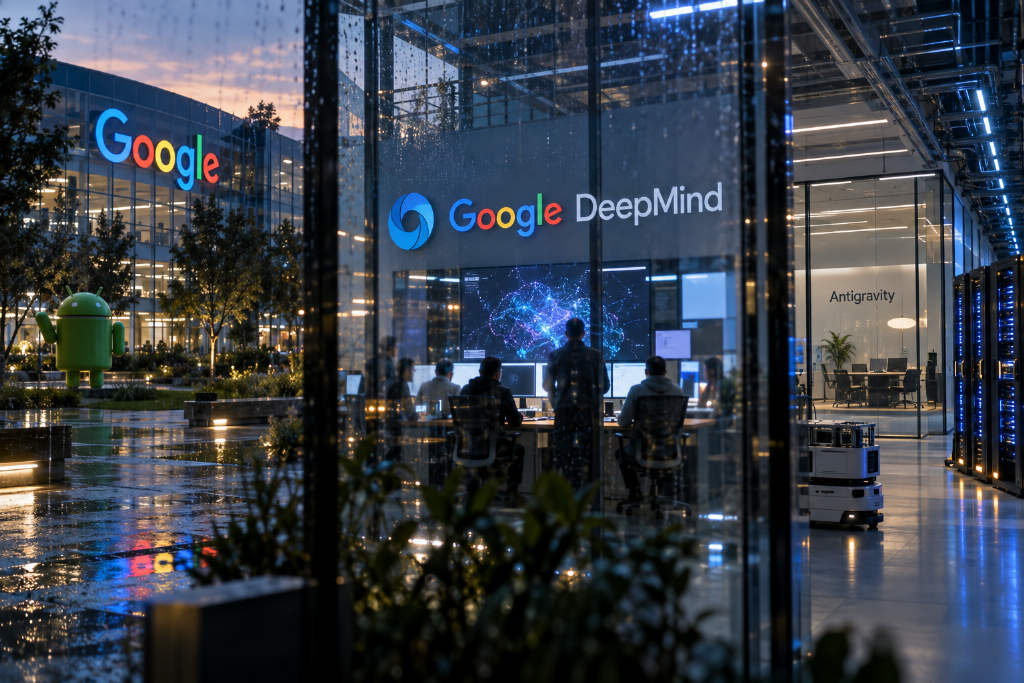
Google DeepMind executive Koray Kavukcuoglu has offered the first public update on Gemini 4, saying the model is now in post-training and is already being tested inside Google’s internal software development platform, Antigravity. He said Google plans to ship it well before the end of 2026. That is the company’s clearest answer yet after roughly ten months without a new flagship model.
At The Information’s AI Agenda Live summit, Kavukcuoglu said Gemini 4 had reached post-training, the phase after core training when a model gets fine-tuned and aligned using human feedback. And he said the model has already gone through internal testing in Antigravity.
His timeline left little room for doubt on one point: Google is not planning to wait until the end of 2026. It wants the release much sooner.
First direct response after a ten-month flagship gap
Google has gone ten months without releasing a new flagship model. In that same window, OpenAI rolled out GPT-6 and Anthropic launched the Mythos series. According to the source report, the new models from both companies have significantly outperformed Gemini 3, which Google released in November 2025.
So attention has stayed locked on Gemini 4. Kavukcuoglu’s comments were Google’s first direct public signal about where the model stands and when it could show up.
Leadership reshuffle put Kavukcuoglu in charge of Gemini
The product drought happened alongside a major management reshuffle at Google. On Aug. 5, 2026, Sundar Pichai and Demis Hassabis said in a joint post on Google’s official blog that Hassabis would step back from day-to-day DeepMind operations and take on the roles of chairman of Google DeepMind and chief scientist at Alphabet. His attention would move toward AGI, or artificial general intelligence, and Isomorphic Labs, the company’s AI drug discovery business.
Kavukcuoglu, a 13-year DeepMind veteran, was promoted to senior vice president and now reports straight to Pichai. His responsibilities cover Gemini model development, frontier AI research, and the Gemini app team.
In that blog post, Hassabis wrote: "I’ve always felt confident leaving the Gemini models in Koray’s and the team’s hands, and I’m excited by the progress we’re making on new models such as Gemini 4."
Gemini 3.5 Pro missed multiple targets
Gemini 3.5 Pro has been delayed more than once. At Google I/O in May 2026, Pichai said publicly that an upgraded Gemini 3.5 Pro would arrive in June to help close the gap with rivals. But that target slipped in June, then again in July and August, and the model still has not appeared.
Kavukcuoglu said the team had "stepped back a little" and shifted resources toward the smaller, faster Flash models. At the time, the team decided it made more sense to maximize learning speed than to force out a flagship model that still was not ready.
That call also shaped the Gemini 4 rollout plan. Kavukcuoglu said Google wants to put out early post-training results as quickly as possible because "we saw the results, and we are excited," and he added that the company plans to keep iterating fast.
AGI debate is not the focus, he says
Questions also came up in the interview about whether Google has fallen behind and whether it will follow Hassabis more closely toward an AGI-centered path. Kavukcuoglu rejected that framing. He said: "Whether we have achieved AGI is not really the point. The real question is whether we can build trustworthy intelligent agents."
Asked whether he worries about falling behind competitors, he said he is "100% confident" and added, "In my view, we are always at the frontier. That is a certain fact."
Usage metrics remain solid, but the flagship is still pending
Even with the flagship delay, Google’s disclosed business metrics are still large. Antigravity has more than 2.4 million weekly active users, and the company’s model APIs handle about 22 billion tokens per minute, according to the report.
Those numbers suggest Google still has a big user base. But one thing is still missing, at least in public: a flagship model that can go head-to-head with GPT-6 and Mythos. Until Gemini 4 actually ships, Google’s case still leans on progress reports and promises that have not yet been fulfilled.