
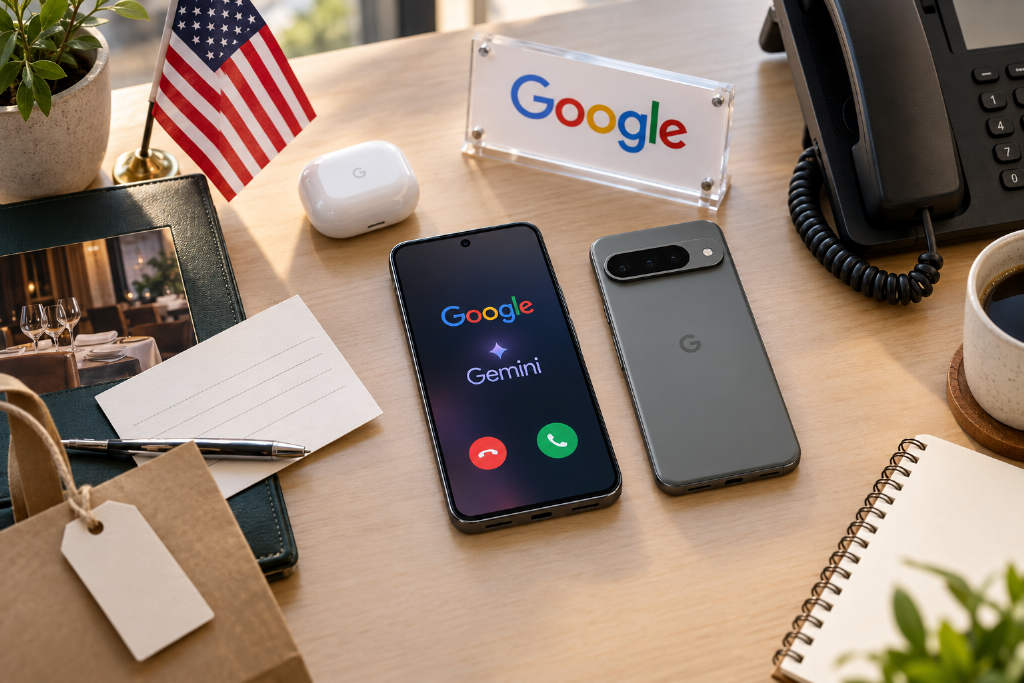
Google has rolled out Call for Me, a new feature that allows Gemini to place calls to businesses using the user’s own phone number. At the start of every call, Gemini states that it is a Google AI assistant, says the call is being made on a recorded line on the user’s behalf, and identifies the user by name.
The launch revisits a controversy Google faced eight years ago. At its I/O conference, the company played a recording in which Google Assistant called a hair salon to make an appointment, while the employee on the other end appeared unaware that the caller was a machine. The backlash came quickly, and Google changed course within two days, promising that AI-powered calls would disclose their identity.
Limited rollout for U.S. Pixel 11 users
Call for Me, introduced earlier this week, is Google’s latest version of that promise. For now, the feature is available only to U.S. users on the Pixel 11 series, including the Pro, Pro XL and Pro Fold. Users also need a paid Google AI subscription and the beta version of Phone by Google.
Google has described the release as a small-scale experiment, saying that real-world conversations are nuanced.
From asking questions to getting things done
The setup is straightforward. A user tells Gemini what needs to be handled, and Gemini places the call with the user’s own number, so the business sees the user’s caller ID. Once connected, Gemini introduces itself, gives the user’s name, and then handles the task at hand, such as checking whether an item is in stock, booking a restaurant, changing an appointment date, or asking a merchant to hold a product.
In Google’s official example, Gemini opens with: “Hi, I’m Gemini, an AI assistant calling on behalf of Kristine M. to update her order.”
That marks a step beyond Ask for Me, which launched last year and could only ask questions. Call for Me can now act on user-approved personal details to complete tasks such as changing appointments, making reservations and holding merchandise, turning the AI from a query tool into an agent that can carry out actions.
Calls are recorded and users can take over
The user is not completely out of the loop. Calls are recorded from start to finish, and recordings and transcripts can be reviewed in the Phone app. If Gemini gets stuck or says something incorrect, the user can step in at any point. Gemini will announce that the user is taking over and then leave the call.
Google sets clear limits
Google has also listed what the feature cannot do. Call for Me cannot call 911, cannot complete payments or provide credit card numbers, and cannot disclose sensitive personal information such as Social Security numbers or passwords.
A contrast with Meta’s Muse
The release arrived in the same week that Meta’s Muse drew renewed attention. According to BlockTempo’s earlier reporting, many businesses hung up once they realized Muse was an AI caller. Reports also said Meta had quietly tested the use of outsourced human callers without disclosing that to users or merchants.
A Meta vice president later acknowledged that testing without proper disclosure was a mistake, and said the effort had been halted and followed by an apology.
Google has taken a different route. Gemini places every call on a recorded line, identifies itself immediately as AI, names the user, and operates within a published set of restrictions.
The trust problem remains central
The different approaches point to the same issue: how AI agents build trust. Meta was reported to have switched to human callers behind the scenes without telling either side, then stopped after the backlash. Google has chosen to disclose the AI identity at the start of the call, keep the interaction recorded, and draw firm boundaries around what the assistant cannot handle. For products like these, the real test is not just whether the AI can place a call, but whether the stranger on the other end is willing to stay on the line after hearing the introduction.