
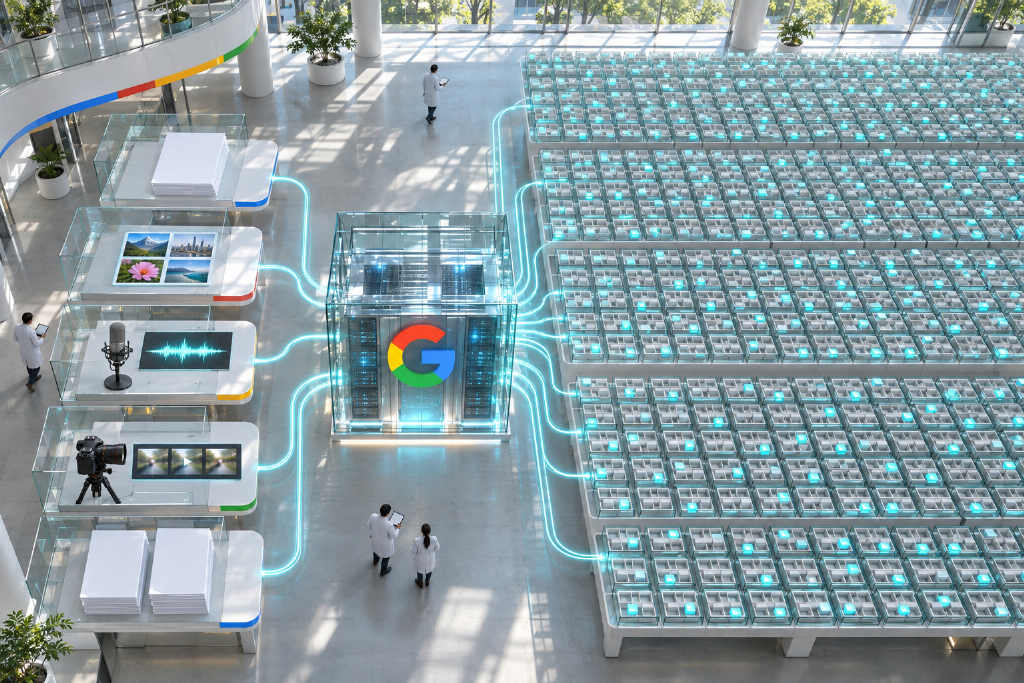
Google has launched Gemini Decision 1, its first decision model, along with the Gemini Decisions API in Google AI Studio. Unlike a conventional generative model that decodes an answer one token at a time, Gemini Decision 1 evaluates predefined choices through a single forward pass.

Sundar Pichai, Google’s CEO, introduced the release in a post on X. He said the API can score as many as 1,000 questions in one processing run across text, images, audio, video and PDF files. Google’s internal teams have already started using the technology.
The model is built to choose among existing options rather than compose a full answer. A developer assessing whether an email is spam or deciding which Agent should handle a task would traditionally call a generative model and extract a result from its output. Gemini Decision 1 removes that decoding step.
Developers provide the input, the question to be evaluated and the available choices. The model returns the decision, probabilities and a confidence score. For tasks that only require classification, scoring or selection, the system does not need to run a complete text-generation process.
Three decision modes
Google’s technical description lists three core capabilities. They can also be combined in one request.
- Yes-or-no decisions: The model can assess whether an image contains a safety risk or whether text violates a specified rule, while returning the probability that the condition is true.
- Multiple choice: Developers can define from two to 255 candidate answers. The model selects the best match and returns normalized probabilities for each option.
- Ordered rubric scoring: Developers define ranked criteria, allowing the model to evaluate an input and return a continuous weighted score along with the probability for each level.
Google’s example uses a photo of an office pantry counter and a written description. The model is asked to determine whether liquid has spilled, what cleanup action should be taken and how serious the situation is. A traditional implementation could require several classifiers or separate prompt-based calls to a generative model. Gemini Decision 1 handles the judgments in one request.
The model supports a multimodal context of up to 256K tokens. In enterprise settings, developers can analyze a call recording alongside customer information, or combine insurance claim documents with photos from an incident. Every decision includes a confidence value from 0 to 1, allowing a system to send uncertain cases to another model or a human reviewer.
Up to 1,000 questions per request
Google says Gemini Decision 1 supports multimodal inputs including text, images, audio, video and PDFs. A single request can contain up to 1,000 independent questions, with end-to-end latency of 150 to 250 milliseconds. Input is priced at $0.10 per million tokens, while output tokens carry no charge. Google places the cost at about one-fifth that of Gemini 3.5 Flash-Lite.

In tests with contexts of no more than 16K tokens, median model-computation latency stayed between 50 and 100 milliseconds, while end-to-end latency remained around 150 to 250 milliseconds. Latency was broadly stable as the number of questions in a request rose from one to 100.
Google says Gemini Decision 1 led benchmarks covering Agent routing, reasoning, ranking and multimodal understanding, and recorded the lowest calibration error. On the same benchmark set published by Google, the Gemini Decisions API cost nearly five times less than calling Gemini 3.5 Flash-Lite through the Interactions API.
Seven first-place finishes in nine tests
Google compared Gemini Decision 1 with OpenAI’s GPT-6 Luna, TypeSafe Jev 1.14, a model focused on classification decisions, and Google’s Gemini 3.5 Flash-Lite. Gemini Decision 1 ranked first in seven of nine benchmark tests and led the probability-calibration comparison. Competitors performed better in the other two tests and in total calling cost.
On JevBench, Gemini Decision 1 posted 92.2% accuracy, ahead of GPT-6 Luna at 90.9%, TypeSafe Jev 1.14 at 90.0% and Gemini 3.5 Flash-Lite at 86.6%.
On the Amazon ESCI product-search relevance test, Gemini Decision 1 recorded a 58.7% Macro-F1 score. That was four percentage points above GPT-6 Luna and 11.5 points above Flash-Lite. On the New Yorker Caption test, Gemini Decision 1 scored 79.7%, compared with 68.4% for GPT-6 Luna, a gap of 11.3 percentage points. The test evaluates understanding and selection of captions for cartoons.
Gemini Decision 1 also ranked first on the PubMedQA medical-question-answering test, with 79.8% against 74.4% for GPT-6 Luna. On the multilingual Global-MMLU-Lite test, it scored 86.0%, while GPT-6 Luna scored 79.6%, a difference of 6.4 percentage points.
Google did not lead every comparison. TypeSafe Jev 1.14 ranked first on Mind2Web Multimodal with 86.8%, narrowly ahead of Gemini Decision 1 at 86.2%. The specialized model also led When2Call, a test of tool-use decisions, with 82.0% against 79.9% for Gemini Decision 1. Tool selection and the timing of tool calls are among the Agent applications Google has highlighted for its model.
Gemini Decision 1 scored 71.8% on MMAU, an audio-understanding test, and 69.1% on Video-MME, a video-understanding test. Both results were higher than Flash-Lite.

Calibration is a central metric
Google placed particular emphasis on probability calibration rather than accuracy alone. In the Top-1 ECE, or Expected Calibration Error, test, Gemini Decision 1 recorded an error of 0.0250. GPT-6 Luna recorded 0.0721, TypeSafe Jev 1.14 recorded 0.0494 and Gemini 3.5 Flash-Lite recorded 0.2104.
Based on Google’s figures, Gemini Decision 1’s calibration error was about 65% lower than GPT-6 Luna’s and about 88% lower than Flash-Lite’s. For an Agent system, the output is not limited to a binary result. A probability value can also show how closely the model’s confidence corresponds to its actual accuracy, allowing the system to choose between an automatic action and human review.
Google uses the API for routing and security checks
Google also disclosed internal product applications for Gemini Decisions API. Gemini Notebook uses the API as a real-time model router, selecting a model tier and reasoning intensity based on the complexity of a user request. A routine question can be sent to a faster, lower-cost model, while a complex reasoning task can be routed to a more capable model. Google said this dynamic routing can reduce latency for routine queries by as much as 40%.
Agents repeatedly make decisions while completing a task, including which tool to select, which model to call and whether a human should intervene. Google’s design sends relatively simple decisions with clear options to a low-latency decision model and leaves complex work to a general-purpose model.
Google listed three other application areas. In Google Stitch, an experimental Rapid Canvas feature uses Decisions API to create an interactive product-flow wireframe within seconds and respond to changes made through voice or clicks. Google showed the Stitch demonstration at normal one-times playback speed. Once a user confirms the design direction, the page can move into the full Stitch workflow for further development.
In a Google Labs product called CC, Decisions API is used to select an appropriate reaction from more than 200 emoji options. Inside Google Search, the API is being used to build a security layer for MCP tools that identifies potential adversarial behavior and content.
Source: TechFlowPost. Author: Dongmei, AI Frontline.




