
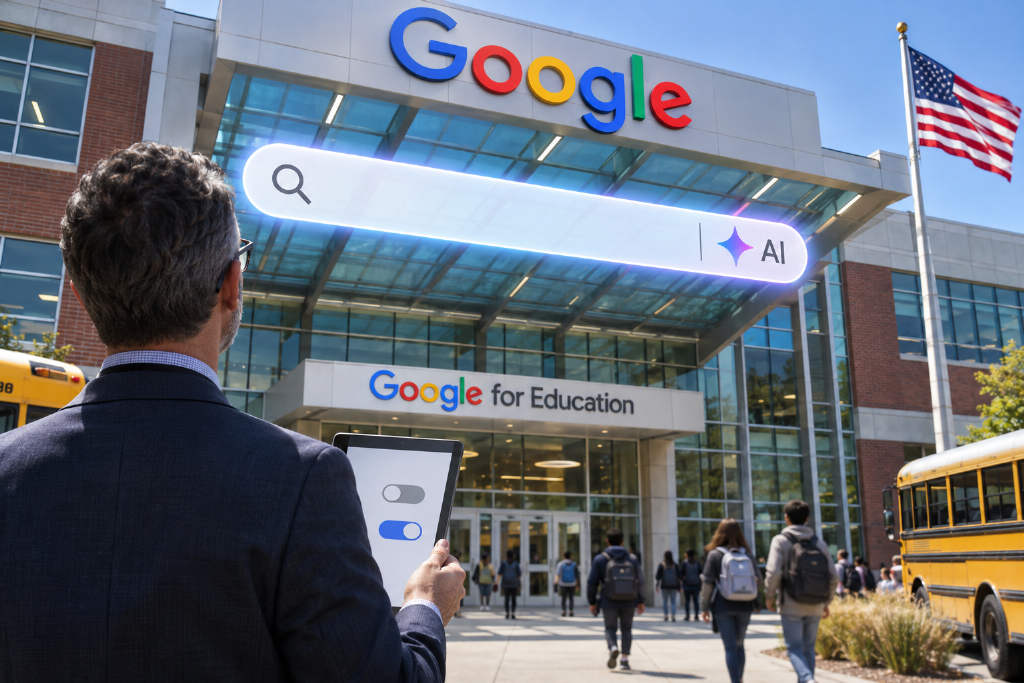
Google said Tuesday that its AI products will be turned off by default for K-12 student accounts unless school administrators actively enable them.
For schools that want to avoid AI entirely, the choice is more limited. Under Google’s setup, they would also need to disable Google Search, a tool used by millions of students for everyday research.
Schools can manage some AI tools separately, but not remove AI from Search
Chris Phillips, Google’s vice president and general manager for education, said in meetings with educators that search and AI are now deeply integrated, and schools that are uneasy about AI can choose not to enable search at all.
Google said administrators can separately turn Gemini, Gemini Notebook, Gemini in Classroom, and Search on or off. That means schools can block standalone chatbot products while keeping search, but they cannot remove AI from search itself.
The New York Times says traditional search without generative AI will not be offered from early 2027
According to The New York Times, starting in early 2027, schools that enable search will receive one of two options: a version that includes standard AI features such as AI Overviews and AI Mode, or an education-focused Guided Learning experience.
Neither option offers a traditional search experience without generative AI.
Criticism comes from New York and beyond
The announcement has already drawn criticism. New York City Mayor Zohran Mamdani accused Google of trying to use its monopoly power to force AI into public schools. Former Federal Trade Commission Chair Lina Khan also criticized Google, saying it was using its dominance in search to push schools toward AI adoption.
New York City currently has a one-year ban on generative AI for students in eighth grade and below, covering nearly 600,000 students. Los Angeles has also restricted the technology, and local officials had hoped to keep Google Search while removing AI summaries.
Antitrust ruling forms part of the backdrop
The dispute comes against a broader antitrust backdrop for Google’s search business. In 2024, a federal court ruled that Google had illegally monopolized the U.S. search market.



