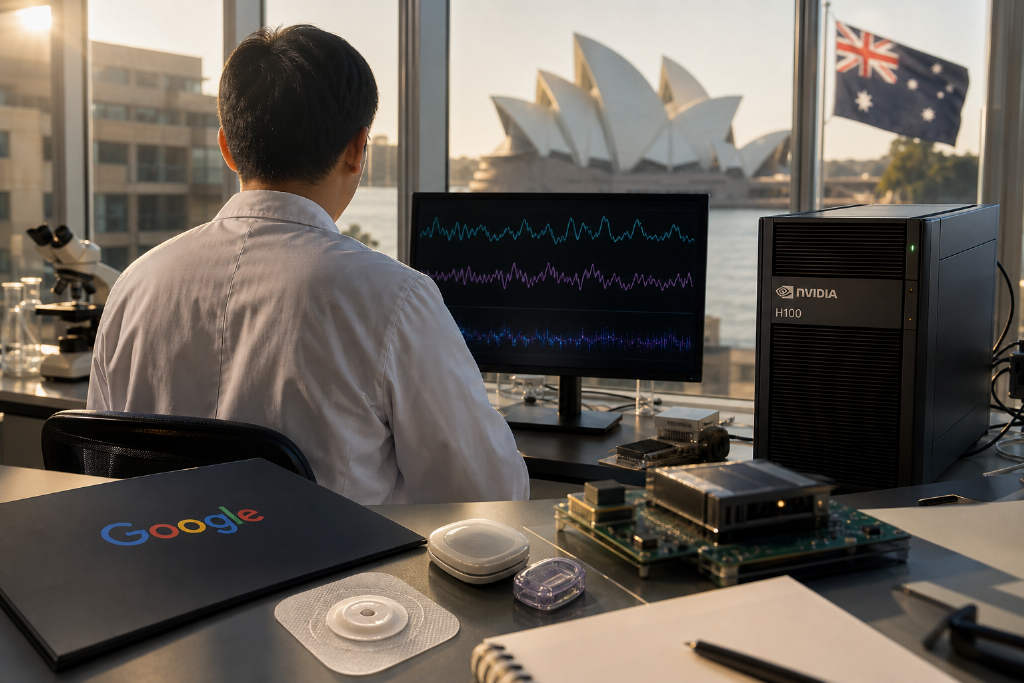
Google Research and the University of New South Wales in Sydney have introduced GlucoFM, a self-supervised foundation model built for continuous glucose monitoring. The model processes glucose signals through a dual-stream setup that separates slower physiological "state" signals from transient "event" signals. According to the release, GlucoFM has just 720,000 parameters and was pretrained on a single NVIDIA H100 GPU, pointing to a relatively lightweight training footprint compared with larger deep learning systems.
In evaluations spanning 14 cohort-task settings, the model posted an average PR-AUC of 58.8 and outperformed baseline models. The research team said GlucoFM remains a research prototype and has not been cleared by any regulator. It is not intended for disease diagnosis or treatment. The team also said it plans to release the code and reproduction scripts, allowing groups with glucose monitoring datasets to run inference on CPUs or on-device systems using the same approach. Techub cited MarkTechPost as the source for the update.
Google Research and the University of New South Wales in Sydney have released GlucoFM, a self-supervised foundation model designed for continuous glucose monitoring.
How the model handles glucose signals
GlucoFM uses a dual-stream architecture that splits glucose signals into a slow physiological "state" stream and a transient "event" stream for separate processing.
Model size and pretraining setup
The model has 720,000 parameters and was pretrained on a single NVIDIA H100 GPU.
Benchmark results
Across 14 cohort-task evaluations, GlucoFM recorded an average PR-AUC of 58.8, outperforming baseline models.
Research-only status and release plan
The team said GlucoFM is currently a research prototype. It has not been approved by any regulator and is not for disease diagnosis or treatment. The code and reproduction scripts will be released, and teams with glucose monitoring datasets will be able to use the approach for inference on CPUs or on-device hardware.
Techub attributed the report to MarkTechPost.
This article was originally published by Bit.Fan. For more cryptocurrency news and market insights, visit www.bit.fan. Disclaimer:
The market information, project data, and third-party content displayed on this platform are for industry information sharing only and do not constitute any form of investment advice or return commitment.
Cryptocurrency trading carries high risks. Users should fully assess their risk tolerance and make independent decisions. All profits, losses, and legal responsibilities are borne by the users themselves.