
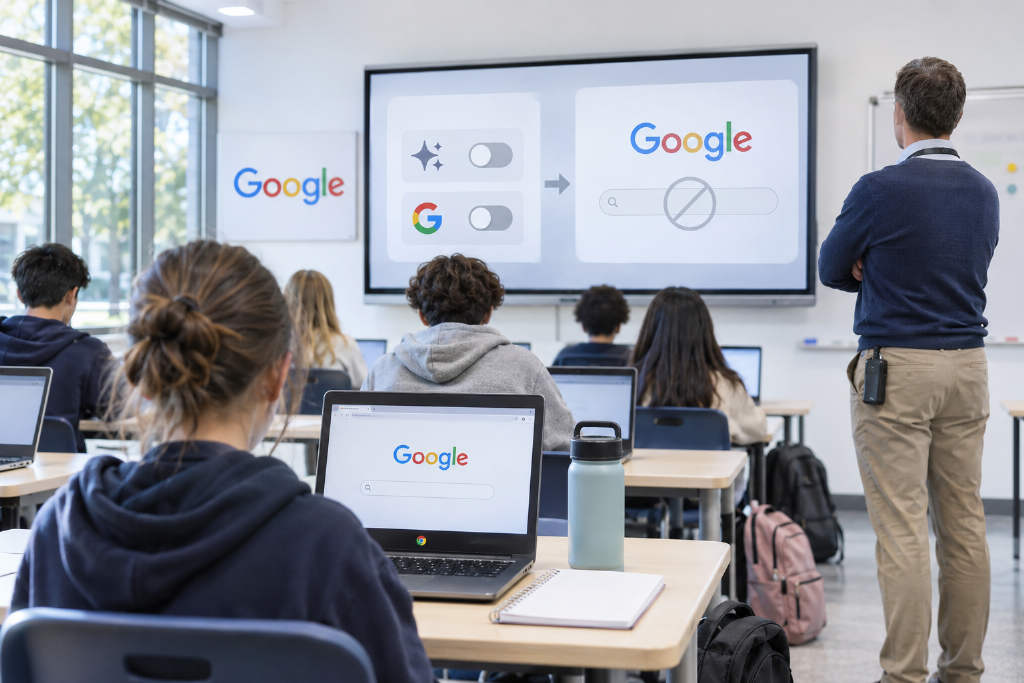
Google says K-12 student accounts will have its AI products turned off by default unless school administrators explicitly switch them on. But schools that want to reject AI altogether will also have to give up Google Search.
The company said Tuesday that administrators will be able to control Gemini, Gemini Notebook, Gemini in Classroom, and Search on an individual basis. That means a school can block standalone chatbot tools and still keep Search available. What it cannot do is remove AI from Search itself.
Search stays tied to AI
Chris Phillips, Google’s vice president and general manager of education, defended the approach in a meeting with educators. According to Education Week, Phillips said Search and AI are “deeply integrated.” Schools that are not comfortable with AI can choose not to enable Search at all.
For teachers who want students to research sources without being served AI-generated answers, the practical choice is narrow: accept Google’s AI-powered search experience or use a different search engine.
Google says the changes are meant to answer concerns that AI chatbots can weaken learning by giving students finished answers instead of pushing them to work through problems on their own.
Schools will get new controls in early 2027
According to The New York Times, schools that enable Search beginning in early 2027 will be offered either versions with standard AI features, including AI Overviews and AI Mode, or an education-focused Guided Learning experience.
Neither option offers the older search experience without generative AI.
Administrators are expected to receive the new controls in early 2027. They will be able to decide which AI products students can access and apply different settings by grade level. A Google Search option without AI is not part of the menu.
Critics say Google is using its leverage in education
The announcement has already drawn accusations that Google is using its position in education to push a technology many schools are still trying to understand, regulate, or restrict.
According to CBS News, New York City Mayor Zohran Mamdani accused Google of “trying to use its monopoly power to force AI into our public schools.” Former Federal Trade Commission Chair Lina Khan also criticized the company, saying Google was using its search monopoly to pressure schools into adopting AI.
The backlash comes as some of the largest school districts in the United States are actively limiting generative AI. New York City, for example, imposed a one-year moratorium on student-facing generative AI through eighth grade, covering nearly 600,000 students. Los Angeles has also restricted the technology.
Los Angeles officials had specifically hoped to preserve Google Search while removing AI-generated summaries. Under Google’s newly announced controls, that is not possible.
Antitrust pressure remains in the background
Google’s position lands while the company is still under antitrust scrutiny. A federal court ruled in 2024 that Google unlawfully monopolized the U.S. search market. The company has also faced separate legal challenges over its decision to integrate AI summaries into search results.



