
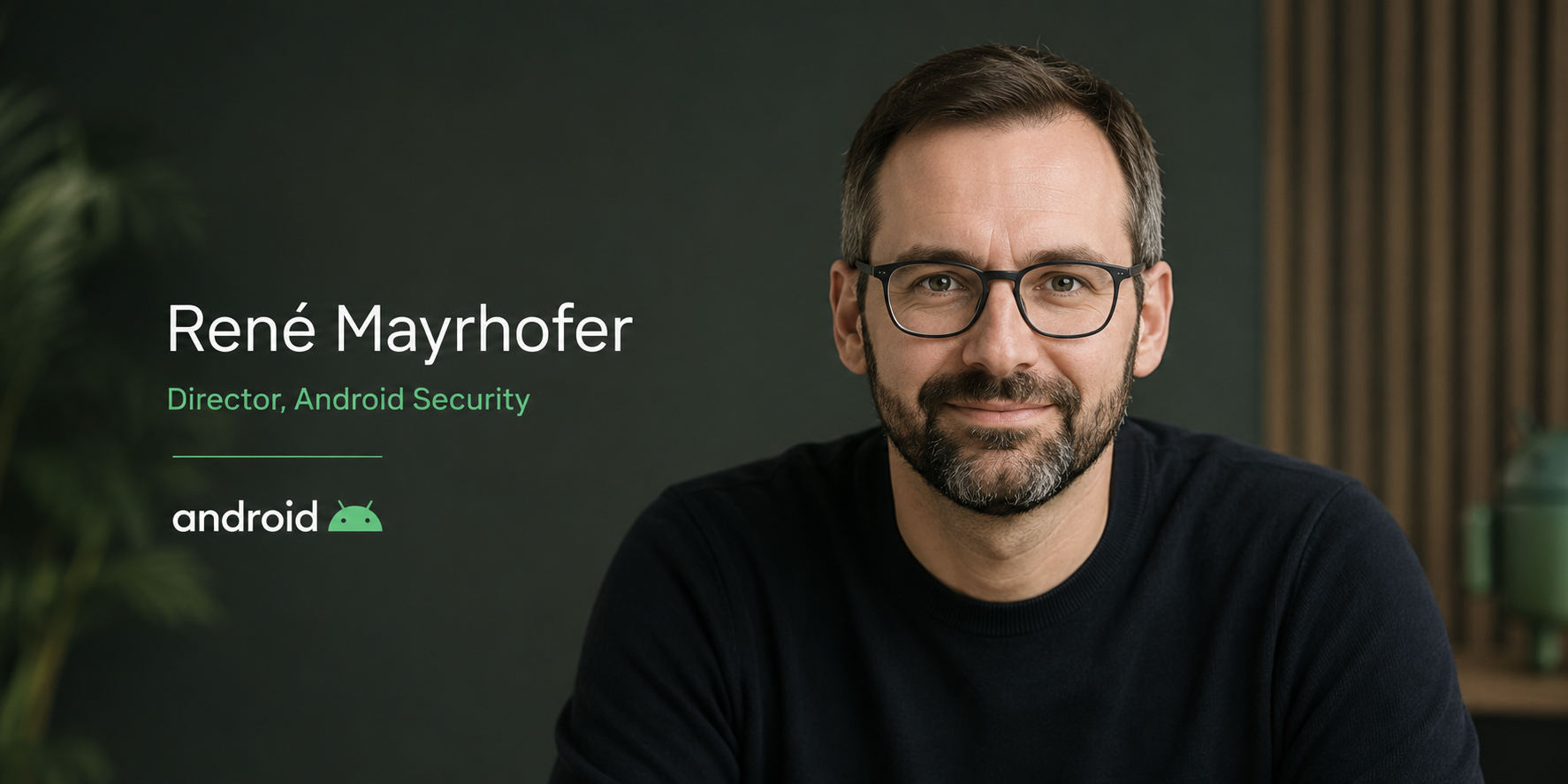
René Mayrhofer, Google’s Android platform security director, said he will leave the company at the end of August 2026. The executive, who has spent nine years at Google, said his decision was driven by two issues: management’s retreat from carbon neutrality commitments and a classified AI contract with the U.S. Department of Defense that, in his account, was handled without meaningful internal discussion.
Mayrhofer took over the Android security leadership role in 2017, when Android had just passed 2 billion users. At the time, Google’s 2018 AI principles explicitly listed applications it would not pursue, including weapons technology, surveillance that violates international law, and systems whose primary purpose is to injure people. Those principles were widely seen as a public ethical commitment rather than a routine corporate document.
Security work built around encryption and device protection
During his tenure, Mayrhofer helped drive several major Android security measures. They included making full-device encryption the default in Android 10, launching end-to-end encrypted Android backups, and advancing Insider Attack Resistance, ARM MTE memory tagging, and privacy-first digital credential architecture. In his public blog post, he described his guiding principle as building systems “that even we ourselves cannot break,” whether the device costs $1,000 or $100, and whether the user is a celebrity or a refugee.
He framed that approach as an equal standard for security and privacy, one that helped keep him at Google for years. The issue now, he said, is not the underlying technology but the company’s shift in governance and ethics.
Emissions up 50% and concern over closed-door decisions
Mayrhofer wrote that Google leadership had quietly abandoned its carbon neutrality target. He pointed to the heavy energy demands of AI models, saying the company’s carbon emissions had risen 50% over the past five years. He also said the more direct reason for his resignation was a classified AI contract with the U.S. “war department,” adding that he was unaware of it through internal channels even though he sat within the management chain.
That, in his view, showed more than a communication failure. He said major ethical decisions were being made inside a closed loop that excluded senior technical leadership, raising questions about transparency inside a company long associated with engineering-driven debate and publicly stated principles.
What “any lawful government purpose” could mean
The Guardian reported in late April that Google had signed an amendment to a classified AI contract with the U.S. Department of Defense, allowing the Pentagon to use Google AI models for “any lawful government purpose.” The report also said OpenAI, xAI, Nvidia, Microsoft, and Amazon had entered similar agreements.
Mayrhofer argued that the phrase may sound neutral in legal language, but its scope is broad. He said it could allow Google’s AI products to be used for surveillance targeting EU citizens or for military applications he believes would violate international law. For him, that was not a theoretical ethics debate. He described it as a matter that could affect his family, the open-source communities he has served, and the broader social groups around him.
Employee petitions failed to shift the outcome
There was internal opposition. Earlier this year, more than 600 employees from Google DeepMind and Cloud signed an open letter to CEO Sundar Pichai calling on the company to reject classified military AI work, but the effort did not change management’s position. The episode drew comparisons with the earlier Project Maven controversy.
In 2019, Google declined to renew Project Maven, a Pentagon program that used AI to analyze drone imagery for military target detection. At that time, about 4,000 employees signed a petition in protest, and at least 12 people left the company over the issue. This time, a similar ethical dispute surfaced, but employee pressure no longer produced the same result.
Mayrhofer said his notice period runs until August 31, 2026, but that he will immediately stop work on any AI systems that could fall within the scope of the Defense Department contract. After leaving Google, he plans to continue working on end-to-end encryption, privacy-first digital identity, and operating system security.