
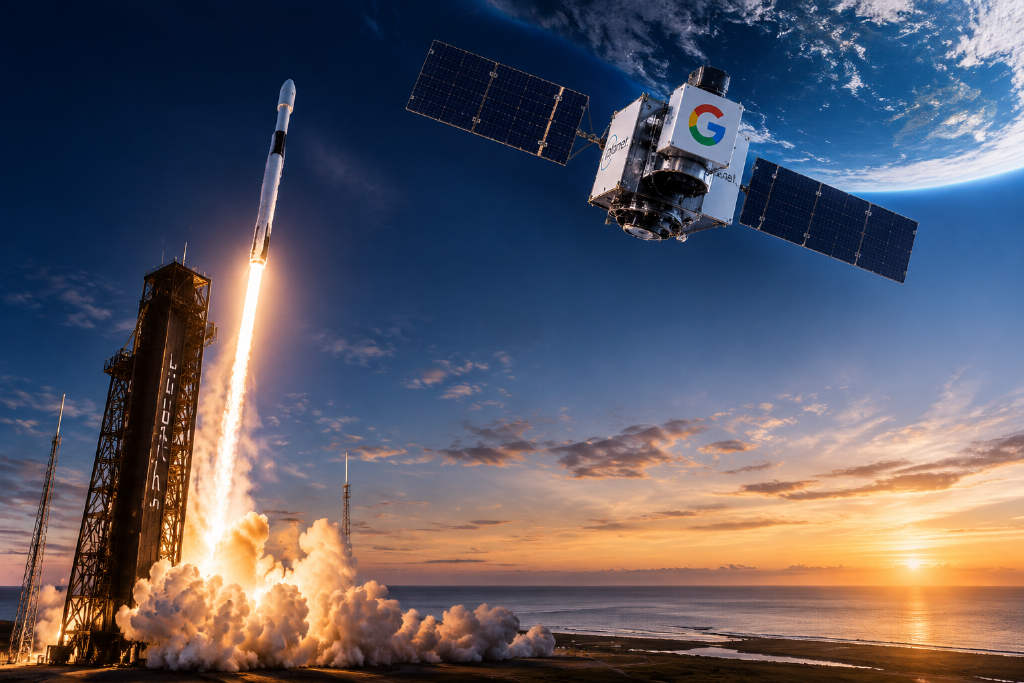
Google said on Oct. 1 in an official blog post that the prototype satellite for Project Suncatcher, developed with satellite company Planet, has entered orbit aboard SpaceX’s Transporter-18 rideshare mission. The company said its team has established contact with the satellite and that it is operating normally.
Google is testing its in-house TPU in orbit
The prototype satellite carries Google’s in-house AI chip, the TPU. Travis Beals, a senior director at Google, wrote that the mission marks the first step in a long-term research effort focused on whether space could eventually support scalable machine learning infrastructure.
Over the next few weeks, the team plans to collect data on the TPU in orbit to understand how the chip handles the physical stress of spaceflight, along with radiation and extreme temperatures in space.
Earlier testing was done on the ground
According to CNBC, Google had previously tested TPU AI workloads at a facility run by the University of California, Davis, but it was still unclear how the chip would perform in the harsh conditions of low Earth orbit. Google has also published a peer-reviewed paper on the mission in the academic journal Joule.
Project Suncatcher targets solar-powered AI computing in space
Project Suncatcher is a long-term initiative that Google first disclosed in November 2025. Its goal is to build AI computing infrastructure powered by solar energy and capable of operating continuously in space.
CNBC, citing Alphabet, reported that satellites in low Earth orbit can receive sunlight almost continuously and generate as much as eight times more solar power than systems on the ground. Alphabet hopes to connect multiple satellite constellations in the future to process larger AI workloads in orbit.
Chain News had previously reported that Google was planning to work with SpaceX on Project Suncatcher.
CNBC also said Alphabet is a major investor in SpaceX, with its stake now worth more than $82 billion, and that SpaceX went public in June.
SpaceX has its own orbital data center plan
SpaceX has also said it wants to build and launch its own orbital data center. The system is expected to consist of satellite clusters developed in Redmond, Washington, equipped with GPUs and solar panels that are planned to be produced with Tesla.
Earlier this year, Elon Musk said space-based data centers would be the cheapest way to train AI and said, 「Two years at the earliest, three years at the latest.」 In September, SpaceX COO Gwynne Shotwell said at an event that the company would deploy 「space supercomputing」 in 2027.
Experts cited by CNBC see major obstacles
CNBC also cited industry experts who said orbital data centers remain a distant goal. The issues they pointed to included limited and expensive launch capacity, the need for cooling systems and chips that can withstand extreme temperatures, the need for radiation shielding, and the possibility that orbital debris and space junk could affect feasibility.