
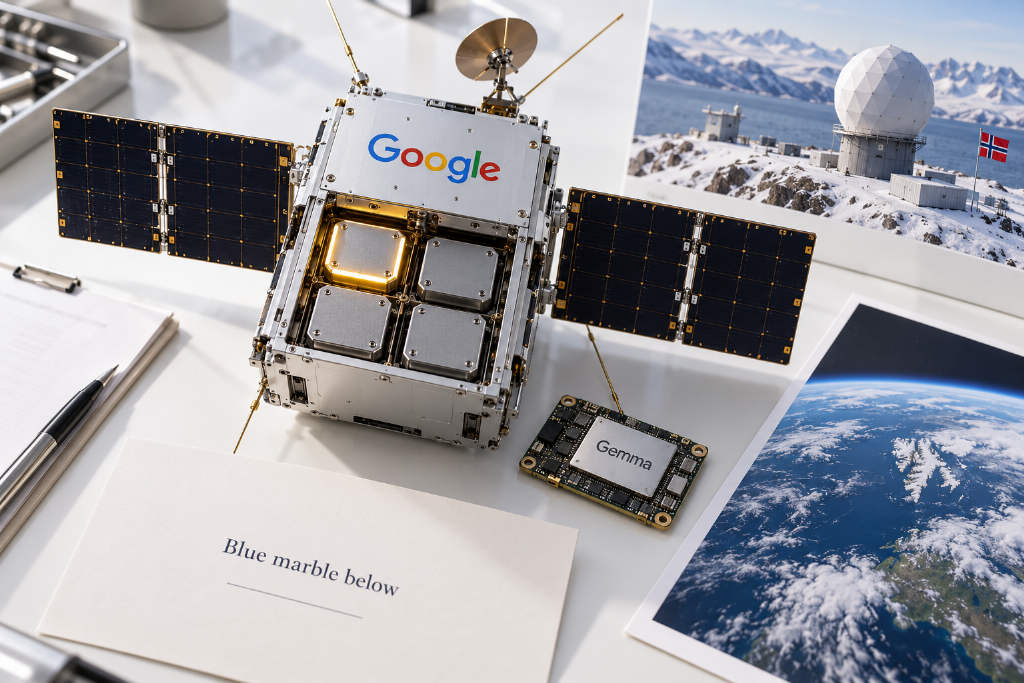
Google’s Project Suncatcher prototype satellite generated an AI response in orbit for the first time this week, with the first prompt asking the onboard Gemma 4 model to write a haiku about being in space.
In a company blog post dated Oct. 30 in the U.S., Google said a ground station uploaded the first prompt while the satellite was passing overhead. The spacecraft sent the completed response back to Earth as it flew over Svalbard, Norway.
The first answer sent back from orbit was a haiku
The haiku read: "Blue marble below / Data streams in silent grace / Starlight feeds my core." Google noted that "Blue marble" is a common English nickname for Earth.
Google described the result as a "Hello World" milestone, saying it was the first time a data-center-class TPU had produced an AI response in orbit. In engineering, "Hello World" is the standard first output used to confirm that a system works end to end. Gemma 4 is an open model from Google DeepMind, while TPU is Google’s in-house AI computing chip.
Google CEO Sundar Pichai also posted on X at 1 a.m. Taiwan time on Oct. 31, saying the team had sent instructions to orbit, powered on the TPU, run the prompt, and received the first complete response on the ground.
The satellite launched on Oct. 1 and carries four TPUs
The prototype satellite launched on Oct. 1 aboard a SpaceX Falcon 9 rocket. The same mission also carried more than 100 other spacecraft. Over roughly three weeks after launch, the team tested the satellite’s subsystems one by one. Google said it powered on the host system and TPU module during that period and also ran early machine learning tests.
The satellite carries four TPUs and can generate up to 1 kilowatt of power. Because TPUs consume significant power, only one can be turned on at a time, and each operating window lasts about 20 minutes. That means each compute task has to fit into a startup window of roughly 20 minutes.
After the haiku, Google also asked the model to write a space-themed limerick. The team used telemetry prompts as well, asking the model to report the technical status of the payload system. A Google spokesperson told TechCrunch that the satellite is operating normally.
Next tests will focus on thermal stress and radiation
Google said the next step is to test how the TPU performs in orbit under thermal stress and radiation. TechCrunch added that space radiation can cause "bit flips," meaning values stored in memory are altered. Errors of that kind can corrupt data, and standard monitoring tools may not always detect them.
Google has previously tested TPUs extensively on the ground using particle accelerators. Those ground tests showed that radiation had a limited effect on inference, meaning generating answers with a trained model, while the impact on model training was greater. This mission is intended to verify those findings in an actual orbital environment.
Google is targeting a two-satellite mission in 2027
Google said that once it confirms TPUs can operate reliably in space, the next step will be the launch of two interconnected satellites in 2027. TechCrunch reported that those satellites are expected to have higher power generation and will also demonstrate optical links between spacecraft.
The current test involves a single TPU running one open model. Google’s broader idea of distributed computing across multiple satellites will not be tested until the two-satellite linked mission planned for 2027.
Key details disclosed so far
- Project Suncatcher’s prototype satellite launched on Oct. 1.
- It produced its first AI response in orbit this week.
- The first prompt asked Gemma 4 to write a space haiku.
- The response was sent back while the satellite passed over Svalbard, Norway.
- The spacecraft carries four TPUs and can generate up to 1 kilowatt of power.
- Only one TPU can run at a time, for about 20 minutes per session.
- Google’s next phase will test thermal stress and radiation effects.
- The company plans to launch two interconnected satellites in 2027.



