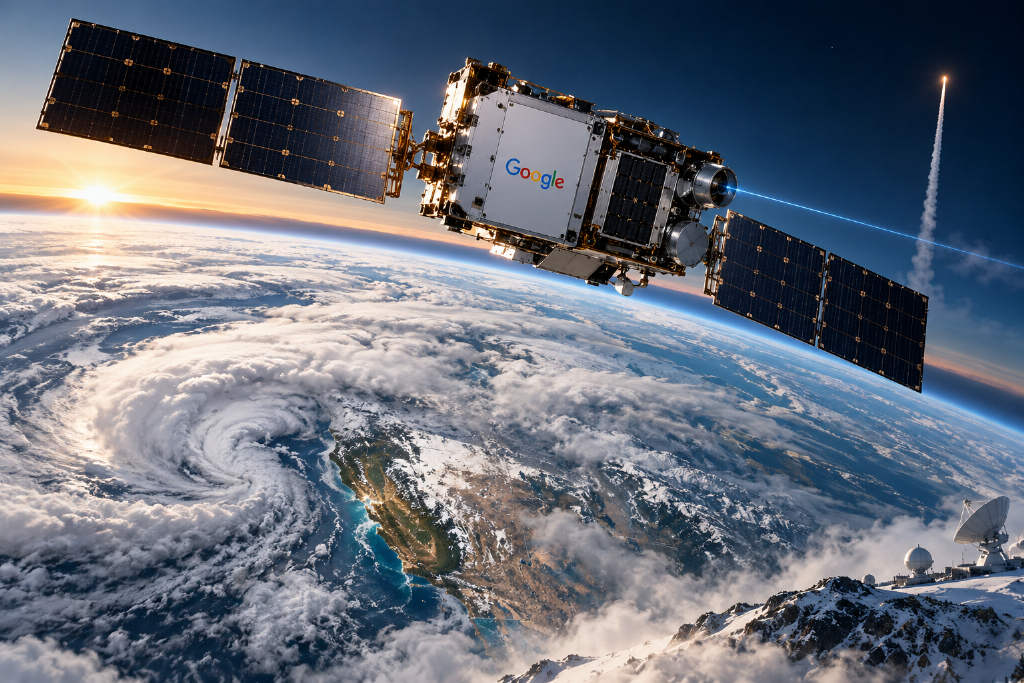
Google said its Suncatcher prototype space data center satellite is now online and has established communications with the ground, marking an early operational step for the company’s orbital computing experiment. The satellite was launched into orbit aboard a SpaceX Falcon 9 and carries a single Google Tensor Processing Unit, or TPU. Its maximum power generation is 1 kilowatt, though power constraints limit each run to roughly 20 minutes.
According to Google, ground operators have already used the satellite’s preloaded Gemma 4 model to generate haiku and report on orbital conditions. The company also said it plans to launch two more satellites in a later phase. Those additions are intended to support higher power generation and optical inter-satellite links. The update was cited by Techub, which referenced TechCrunch.
Google said its Suncatcher prototype space data center satellite is now online and has established communications with the ground.
The satellite was launched into orbit on a SpaceX Falcon 9 and carries one Google TPU. It can generate up to 1 kilowatt of power, but power limits mean each run lasts only about 20 minutes.
Google said ground teams have already used the satellite’s preloaded Gemma 4 model to generate haiku and report orbital conditions. The company plans to launch two more satellites later, with support for higher power generation and optical inter-satellite links.
The report cited TechCrunch.
This article was originally published by Bit.Fan. For more cryptocurrency news and market insights, visit www.bit.fan. Disclaimer:
The market information, project data, and third-party content displayed on this platform are for industry information sharing only and do not constitute any form of investment advice or return commitment.
Cryptocurrency trading carries high risks. Users should fully assess their risk tolerance and make independent decisions. All profits, losses, and legal responsibilities are borne by the users themselves.