
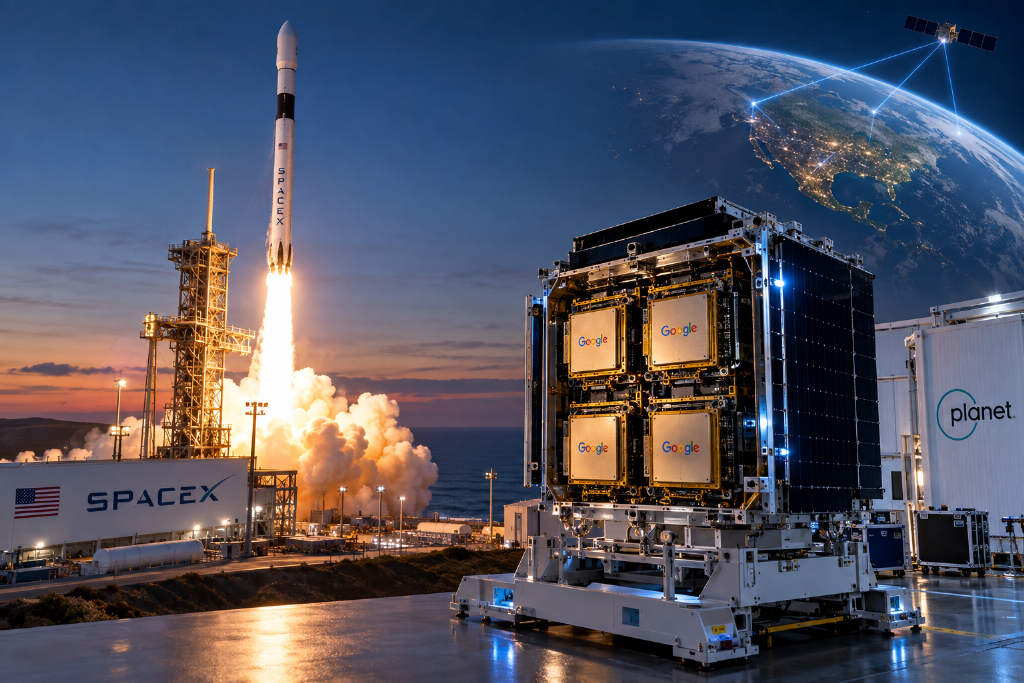
Google plans to launch its first Project Suncatcher prototype satellite on Oct. 1, sending four Trillium TPUs into orbit to test whether the company’s AI hardware can survive launch stress, space radiation and heat dissipation in a vacuum.
According to Google’s official blog, the satellite will fly on SpaceX’s Transporter-18 rideshare mission aboard a Falcon 9 rocket from Vandenberg Space Force Base in California. Google built the spacecraft with satellite imaging company Planet. The mission is designed to test the viability of Google’s in-house AI chips in orbit.
Launch shock and radiation come first
Google said a rocket reaches low Earth orbit in about 10 minutes, with the vehicle exposed to intense vibration along the way and acceleration peaking at 10 g. Individual components such as TPU chips face a higher tolerance threshold, in the 50 g to 100 g range. The team shook the satellite across three axes to simulate launch vibration frequencies. Google said tests like these rarely go exactly as planned, and added that the hardware surviving the process came as something of a surprise to the team.
Radiation is another major hurdle. Solar events and cosmic rays can interfere with electronic components, so the team sent the TPUs to the proton beam facility at the Crocker Nuclear Laboratory at the University of California, Davis. There, the chips were irradiated while running AI workloads so engineers could monitor how bit flips affected computation.
Early results showed Trillium performed better than expected. Google said the chips tolerated a total ionizing dose above what a five-year space mission would typically encounter. The report cited a paper from last year estimating that Trillium’s high-bandwidth memory would not begin to show anomalies until cumulative exposure reached 2,000 rad, close to three times the expected dose for a five-year mission with shielding. Testing went as high as 15,000 rad. Even so, the report noted that the final answer can only come from operating in space itself.
Heat dissipation and inter-satellite links remain hard problems
Compared with launch and radiation, heat management is presented as the bigger concern for any orbital data center concept. TPUs generate large amounts of heat in a small area, but space offers no air convection. In a vacuum, heat must be rejected through radiative cooling panels, which makes the design very different from a terrestrial data center.
Google is testing several approaches, including a heat-pipe-plus-radiator-panel design, and said those systems have already been validated in thermal vacuum chambers that simulate space temperatures and vacuum conditions. This mission is meant to show how the newer setup behaves in actual orbit. The report also cited a former NASA engineer who called space data centers "the worst idea I’ve ever heard," pointing to heat rejection as the key issue because radiator size and mass directly affect whether the system makes economic sense.
Interconnects are another challenge. Google’s longer-term plan calls for each satellite to carry dozens of TPUs and operate in clusters around Earth. Those satellites would need laser communications to maintain bandwidth, and each spacecraft would also need precise awareness of its position relative to neighboring satellites.
Existing space laser communication systems are mostly built for long distance and lower bandwidth. Google, by contrast, needs very short range and very high bandwidth. The report described the required precision as comparable to hitting a coin-sized target from miles away while both sides are moving. In ground testing last year, a single pair of optical transceivers reached 800 Gbps in one direction and 1.6 Tbps combined bidirectional bandwidth.
The paper cited in the report outlined a notional configuration of 81 satellites flying in a cluster with a 1-kilometer radius, with neighboring spacecraft spaced about 100 to 200 meters apart at an average orbital altitude of 650 kilometers. The design uses a dawn-dusk sun-synchronous orbit so the satellites can remain in sunlight for most of the time. Google expects to test this part in orbit in 2027, when two satellites are scheduled to fly together.
Google and SpaceX are pursuing different paths
The report said Google is not alone in betting on orbital data centers. In February this year, SpaceX filed an application with the U.S. Federal Communications Commission seeking permission to launch as many as 1 million satellites for a solar-powered data center network. In August, Elon Musk said a custom AI chip developed with Nvidia would be sent to space in the fourth quarter of next year, with large-scale deployment targeted for 2028.
There were also reports in May that Google and SpaceX had discussed cooperation on an orbital AI data center. Google’s prototype satellite is now set to ride to space on a SpaceX rocket. Google had originally planned to launch two prototype satellites with Planet before early 2027 for dual-satellite testing. It is now sending one prototype first, while the two-satellite interconnect test remains scheduled for 2027.
The report said the longer-term outcome will still depend on three constraints: heat dissipation, radiation and launch cost. A paper from last year estimated that launch costs would need to fall below $200 per kilogram by the mid-2030s for the launch and operating costs of a space data center to approach the energy costs of a terrestrial one.