
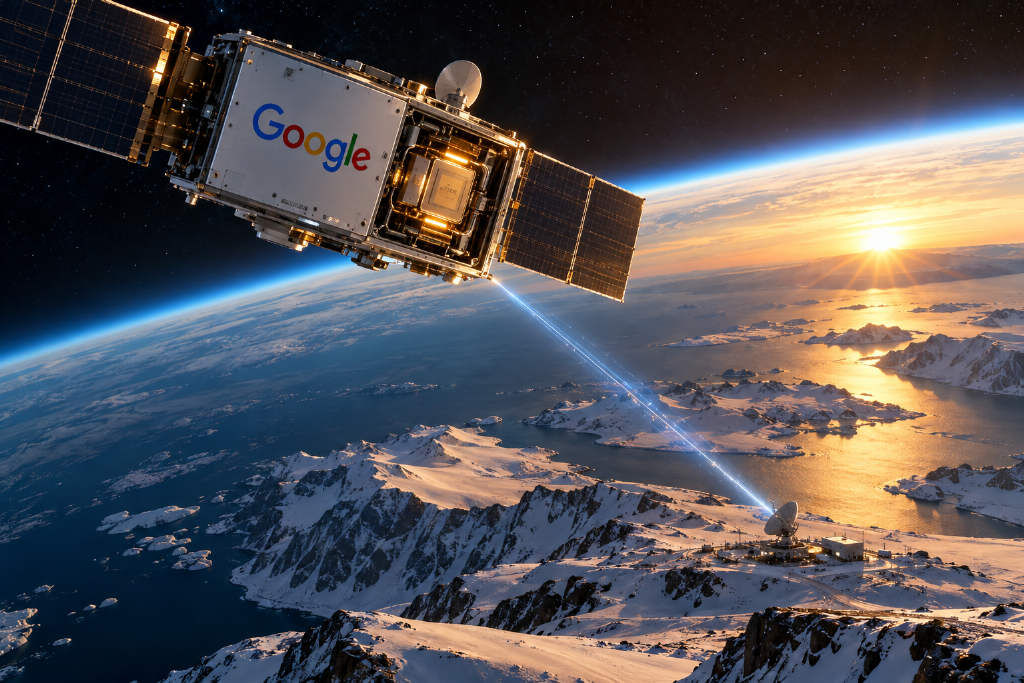
Google has received a poem from orbit after sending a prompt to a satellite carrying its TPU hardware, marking what the company described as the first complete AI response generated and returned from space by a data-center-class TPU.
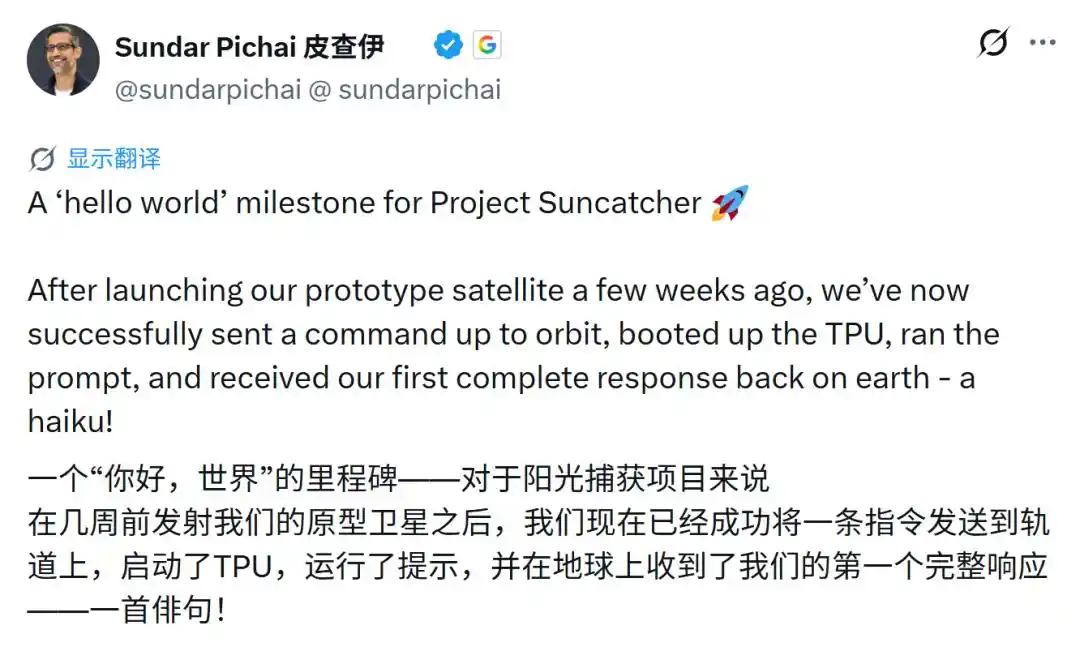
A few days ago, Google engineers sent a prompt from a ground station to a satellite operating in Earth orbit: 「Write a haiku about being in space.」 After the command arrived, the satellite’s onboard TPU powered up and a pre-deployed Gemma 4 model began an inference task. Later, as the spacecraft passed near Svalbard, Norway, the ground station received the reply:
Blue marble below
Data streams in silent grace
Starlight feeds my core.
Google CEO Sundar Pichai later shared the result and called it Project Suncatcher’s “Hello World” moment. The test turned a plan Google had discussed last year — sending AI compute into space — into an operational milestone, with an orbital system producing a generative AI output and transmitting it back to Earth.
Prototype satellite completes its first generative AI task in orbit
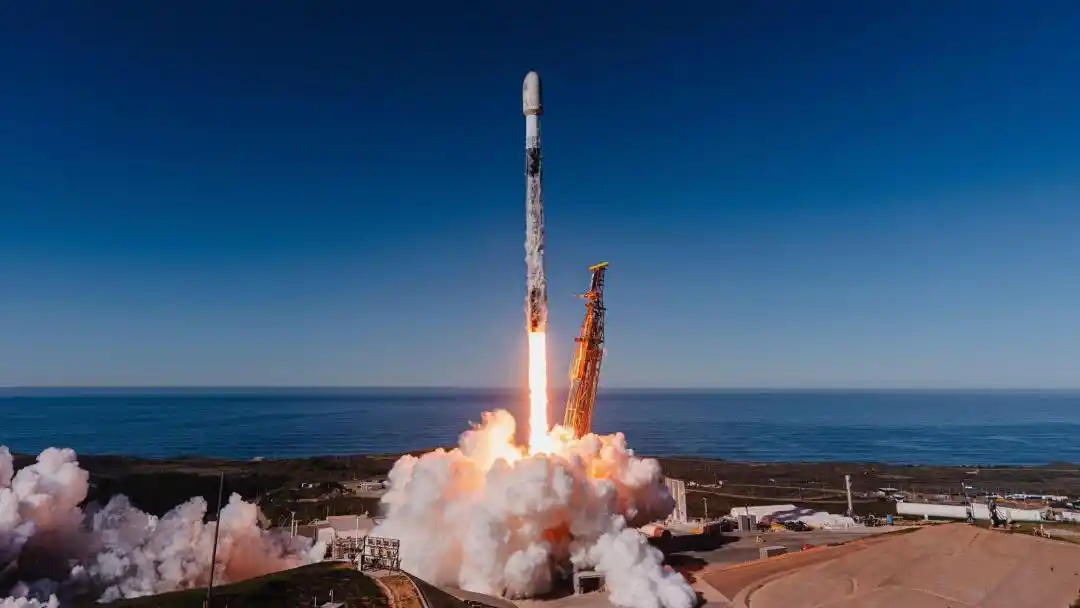
The current phase began a month ago. On Oct. 1, a Project Suncatcher prototype satellite developed by Google and satellite company Planet was launched into Earth orbit on SpaceX’s Transporter-18 rideshare mission.
Over the following weeks, the engineering team brought up the satellite’s systems, activated the host computer and TPU compute hardware, and ran early machine learning tests. This week, the team moved on to a full generative AI task.
After the first response came back, the team also asked the model to generate other space-themed poems and used natural-language prompts to query the technical status of the compute payload. Google said later experiments will move toward more practical system tests to observe how the TPU behaves under orbital thermal stress and radiation.
According to TechCrunch, the prototype satellite carries four Google TPUs and can provide roughly 1 kW of power. Current system power limits mean only one TPU can be turned on at a time, and only for about 20 minutes.
The result also ties back to Google’s earlier roadmap. Under the original plan, Google said it would work with Planet to launch two prototype satellites in early 2027 to test orbital TPU operations and inter-satellite optical communications. The company later adjusted the schedule, using Planet’s satellite platform to begin an earlier first-stage validation and successfully placing a TPU in orbit this October.
Google is not alone in pushing AI compute into space
Google is not the first company to bring large-model computing into orbit.
In November last year, startup Starcloud sent the Starcloud-1 satellite into orbit with an Nvidia H100 GPU onboard, then completed large language model runs and small-model training experiments based on nanoGPT. In August this year, SpaceX and Nvidia announced work on Starmind AI1, a larger satellite compute payload planned around Rubin GPUs and Vera CPUs.
From Nvidia GPUs to Google TPUs, space-based AI compute is drawing in more technology companies.
From one TPU to a space-based data center network
Why send AI chips into space at all? In Google’s earlier research, the central argument was power supply.
Google said that under suitable orbital conditions, solar panels in space can generate as much as about eight times the power available under terrestrial conditions. If satellites operate in a dawn-dusk sun-synchronous orbit, they can receive near-continuous sunlight and rely less on large battery systems.

Project Suncatcher is not built around the idea of one large space-station-style data center. Instead, Google’s concept uses a tightly coordinated formation of many smaller satellites. Each would carry solar panels and TPUs, and the group would be linked through free-space optical communications.
In a Google research paper that has now been published in Joule, the team presented an example design built around a formation of 81 satellites. Those satellites would operate in low Earth orbit at an average altitude of about 650 km. The cluster would span a radius of about 1 km, and some neighboring satellites would vary between roughly 100 and 200 meters apart.
The reason for flying them that close is communication. In terrestrial data centers, large-model training is usually distributed across many accelerators, and those chips must exchange intermediate results frequently. If bandwidth is too low or latency too high, system performance can suffer even when enough compute hardware is available.
Google wants to move a similar distributed computing model into space. That means links between satellites would need far more bandwidth than traditional satellite communications. According to the team’s research, future systems would need inter-satellite transfer rates of 10 Tbps to approach the compute capability of terrestrial data centers.
To get closer to that target, Google is studying dense wavelength-division multiplexing and spatial multiplexing to raise laser communication bandwidth while keeping satellites in relatively tight formation. In earlier ground tests, the team used a pair of optical communication transceivers to reach 800 Gbps in one direction and 1.6 Tbps combined bidirectional throughput.
That is a large number, but it still falls short of the inter-satellite capacity Google says would be needed later on. And there is a major difference between communication links on the ground and maintaining stable, high-speed links among multiple satellites moving continuously in orbit.
To keep dozens or even hundreds of satellites in the right relative positions over long periods, Google also has to account for Earth’s non-spherical gravity field, atmospheric drag, and orbital perturbations, while using physical models and machine learning methods to support formation control.

Data exchange between satellites is only part of the challenge. Moving data between the ground and orbit is harder. For workloads that need frequent access to large volumes of terrestrial data, model parameter updates, or user-facing responses, the balance among communication windows, bandwidth, and latency will shape real operating efficiency.
By contrast, onboard processing of Earth observation data offers a clearer near-term use case. If image analysis can be completed in orbit and only the results, rather than all raw data, are sent back to Earth, downlink demand could be reduced. That is one of the areas where space computing may hold a stronger advantage. Google’s stated ambition, though, goes beyond that. The company wants to test whether a truly scalable AI compute cluster can eventually exist in space.
Heat, radiation, and cost remain central obstacles
The idea has drawn skepticism. In Reddit’s r/space community, one user asked why anyone would build a data center in space if construction and maintenance are so difficult, instead of putting one under the sea. The question has some practical grounding. Microsoft’s Project Natick explored the feasibility of underwater data centers, and building facilities in cold regions such as Iceland and Northern Europe is already one way to reduce part of the cooling burden.
After the Oct. 30 announcement, debate over the feasibility of orbital data centers resurfaced on X. User Luke Leisher wrote sarcastically: 「How can this be? Didn’t the smartest people on the internet tell me the laws of physics had already decided orbital data centers were completely impossible?」 Another user, Robert de Negro, raised a more specific point: scale may be the real difficulty. Managing the heat from dozens or hundreds of chips on one satellite is very different from managing a small number of processors.
At the center of that discussion is heat rejection. On Earth, computing systems can remove heat through airflow and liquid cooling, then dump it into the surrounding environment through supporting infrastructure. In near-vacuum conditions in space, there is no useful air convection. Waste heat from chips must be released mainly through thermal radiation.
That means a space-based data center would need conductive structures and cooling media to move heat from compute hardware to radiators with enough surface area, which would then emit that heat as electromagnetic radiation. Google has previously described a cooling approach that combines heat pipes and radiators, and said it has tested the setup in a thermal vacuum chamber designed to simulate the space thermal environment. The general engineering path is familiar in aerospace, but as compute power rises, radiator area, mass, and structural integration with other satellite systems all have to be redesigned.

Project Suncatcher’s current prototype carries four TPUs, yet can only run one at a time for about 20 minutes. That alone shows how far present power delivery and thermal management still are from supporting large-scale continuous compute.
Heat rejection also feeds directly into cost. In discussion threads on Hacker News, some users argued that the debate is not about whether humans know how to radiate heat away, but how many radiators, thermal conduits, and supporting systems would be needed to remove enough of it. Once that extra mass is included, launch costs rise with it.
Radiation is another issue that needs long-term validation. Satellites powered by solar energy depend on sunlight, but high-energy solar particles and galactic cosmic rays can also affect electronics. When energetic particles interact with sensitive regions in a chip, they can flip bits in memory, turning a 0 into a 1, or introduce errors into computation.
Google has already run dedicated ground tests on that front. The research team used a 67 MeV proton beam to test the sixth-generation Trillium TPU and observe the effects of total ionizing dose and single-event effects. The results showed that the high-bandwidth memory system was a relatively sensitive component, but related anomalies did not begin to appear until the accumulated dose reached about 2 krad (Si), close to three times the expected five-year mission dose under shielded conditions. At a maximum test dose of 15 krad (Si) per chip, the team said it did not observe permanent hard failures attributable to total ionizing dose.
Those findings made Google more optimistic about the space tolerance of its current TPU hardware. Even so, particle-beam tests on the ground cannot fully reproduce long-term radiation exposure, thermal cycling, and other complex conditions in real orbit. One purpose of the current satellite mission is to keep testing how the chips behave in the actual environment.
Even if heat and radiation can be handled in engineering terms, Google still faces the problem of maintenance and hardware refresh cycles. Terrestrial data centers can replace aging chips over time while keeping power, networking, and cooling infrastructure in place. On satellites, by contrast, chips, solar panels, radiators, and communications systems are often tightly integrated. If the compute hardware fails or falls behind, making continued use of the remaining infrastructure becomes much more complicated.
Some commenters on Hacker News also noted that space computing may face a different depreciation logic from terrestrial data centers. If a satellite’s GPU or TPU is no longer competitive, its solar panels and thermal systems may still function, but that does not mean they can easily retain the same value. That is before accounting for orbital debris, micrometeoroids, station-keeping requirements, and eventual deorbiting.
Google calls it a long-term “moonshot”
In the end, the debate over space-based data centers keeps returning to one issue: cost.
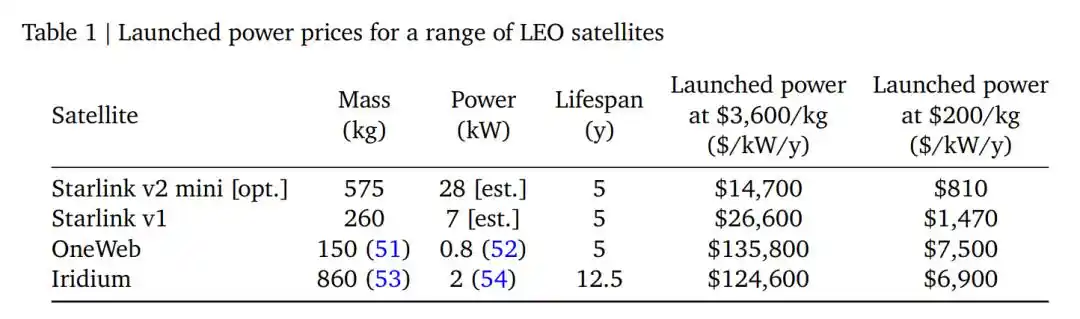
In its earlier research paper, Google analyzed future launch economics and offered one reference figure: $200 per kilogram. Under that assumption, if launch costs are amortized over equipment lifetime and power output, the result could be about $810 per kW per year. For comparison, the paper cited energy spending for U.S. terrestrial data centers at roughly $570 to $3,000 per kW per year.
That estimate depends on a major assumption: that rocket reusability and launch scale continue to improve and preserve the historical trend of falling costs. According to the paper, reaching $200 per kilogram around 2035 could require roughly 180 Starship launches per year.
Google itself has not framed space data centers as a near-term commercial business. In an Oct. 1 interview with NPR, Project Suncatcher lead Travis Beals said he does not believe space-based data centers will become cheaper than terrestrial ones within the next five years, and that real economic competitiveness will likely take longer.
Google describes Project Suncatcher as a long-term “moonshot.” Under the roadmap it has disclosed, the company plans to launch two satellites with high-speed optical communications capability in 2027 to further test inter-satellite networking and the technical conditions needed for distributed machine learning tasks. Turning that system into a commercially competitive space-based data center would require more time, along with progress in launch costs, hardware reliability, and system architecture.
For Google’s attempt to build an AI compute network in space, this poem is only the first reply.



