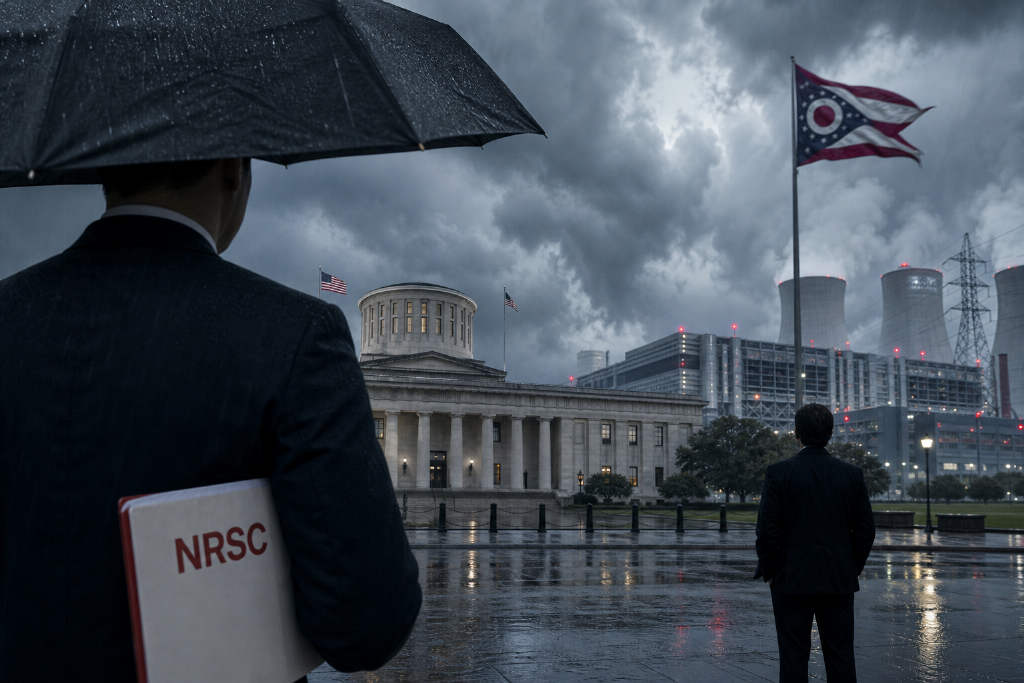
The National Republican Senatorial Committee has privately warned top AI companies that data centers have become a major election issue in several states. Axios obtained an internal memo titled “Ohio Data Center Risk,” which says Democrats are using the issue against Republican Sen. Jon Husted in Ohio, where Sherrod Brown has been spending millions on summer ads. Fox News polling shows Brown leading by 8 points. The memo urges AI firms to explain who benefits, who pays, and why communities should welcome data centers. Its warning lands as Embold Research shows opposition to nearby data centers rising from 42% to 75% in a year. Chamath Palihapitiya says the backlash reflects a long public-relations failure by AI companies and could weigh on US GDP if it spreads. He blames weak public messaging, poor local compensation, and a policy strategy that looks like trying to influence or mislead regulators. Protest pressure has also surfaced in Texas and Pennsylvania, where Gov. Josh Shapiro signed an executive order for strict limits on data center development. The article says more than 4,000 data centers are operating across the US, with over 3,000 more planned or under construction.
The National Republican Senatorial Committee has privately warned top AI companies that data centers have become a major election risk in several states.
Axios obtained an internal NRSC memo titled “Ohio Data Center Risk.” It says Democrats have turned the issue into a “major weapon” against Republican Sen. Jon Husted in Ohio, and that the strategy is working. Husted’s opponent, former Democratic Sen. Sherrod Brown, has spent millions of dollars on summer ads portraying Husted as “the spokesman for data centers in Ohio.” Fox News polling shows Brown ahead by 8 points.
The memo says that if Husted loses and data centers are seen as the reason, politicians across the country will take notice and may avoid the next data center project. Ohio currently has large data center plans from Nvidia, OpenAI and Meta.
NRSC told AI companies to explain to the public “who benefits, who pays, and why communities should welcome data centers.”
The warning comes as Embold Research polling shows opposition to data centers near homes rising from 42% to 75% in one year. In August 2025, opinion was almost evenly split. By February 2026, opposition had climbed to 51%. By August 2026, the combined share of people who said they “somewhat oppose” or “strongly oppose” had reached 75%.
Silicon Valley investor Chamath Palihapitiya said the backlash reflects a long-running public-relations failure by the AI industry. He called the situation “a ticking time bomb” and said a broad backlash could shave 200 to 300 basis points off US GDP each year.
Palihapitiya said the industry has failed in three ways: it has not built a positive public narrative, leaving media coverage filled with doom, infighting and technical jargon; local residents have not received clear benefits from data center projects; and AI companies have held an information advantage over regulators, making their policy efforts look like an attempt to influence or deceive the government.
He said data centers have become a symbol of “a very small number of tech elites capturing asymmetric gains,” and that the resistance will likely keep growing because those figures are hard to trust.
The memo also warns that if public opinion does not improve quickly, the backlash could spread nationwide. Protests have already surfaced in Texas and Pennsylvania this year.
In Pennsylvania, Democratic Gov. Josh Shapiro, who previously backed data center development, signed an executive order this week setting “strict limits” on data center development.
The article says more than 4,000 data centers are operating across the US, with more than 3,000 more under construction or in planning. For many residents, the facilities have become a flashpoint because of their heavy power use, potential impact on household electricity bills, large industrial water demand, warehouse-like size and limited local job creation.
For many people, data centers have also become the most concrete symbol of AI taking jobs. VanEck digital assets research head Matthew Sigel recently said it was remarkable that NIMBYism could become the thing that ends US tech dominance. The broader point, the article says, is that the expansion of US AI infrastructure may be getting stuck not on engineering, capital or China, but on America’s own democratic system and the industry’s failure to manage its public image.

This article was originally published by Bit.Fan. For more cryptocurrency news and market insights, visit www.bit.fan. Disclaimer:
The market information, project data, and third-party content displayed on this platform are for industry information sharing only and do not constitute any form of investment advice or return commitment.
Cryptocurrency trading carries high risks. Users should fully assess their risk tolerance and make independent decisions. All profits, losses, and legal responsibilities are borne by the users themselves.