
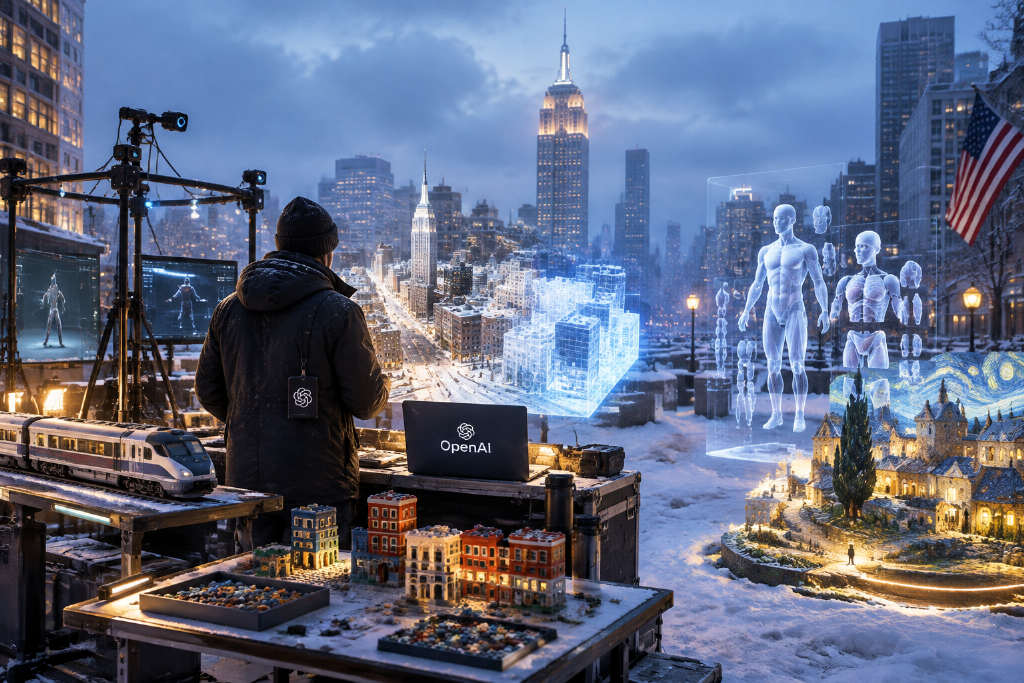
GPT-6 Astra’s launch has triggered a wave of projects across OpenAI’s developer community, with builders showing off work in 3D modeling, game creation, interactive environments, and design tools. ABMedia, citing a roundup compiled by OpenAI Developers, said Astra’s coding ability is moving past helping write software and into building complete interactive worlds.
The report listed examples that range from 3D human anatomy and a Manhattan rebuild in Unreal Engine to a Van Gogh-inspired virtual town, an AR vacuum coverage tool, a Blender steam train model, browser games, a mixed-reality air traffic simulator, and even a C++ ray tracer ported to the iPhone GPU. In tools such as Blender, Three.js, Unity, and Unreal Engine, the article said Astra is doing more than producing code: it is also handling space, geometry, interaction logic, and visual outcomes.
A 3D anatomy site split into 2,234 parts
Developer Ashe presented a 3D anatomy website built with GPT-6 Astra. The project breaks the male anatomy into 2,234 separately modeled components inside an interactive 3D web environment, allowing users to rotate, separate, and inspect different structures.
In a post quoted by the article, Ashe wrote: 「since you guys loved the exploding tesla.. I used GPT-6 Astra to create a 3D website that pulls apart the male anatomy into 2,234 modeled pieces! we are in a renaissance of learning」. Ashe described the result as a “renaissance of learning.”
ABMedia said tools of this kind, if they keep improving, could change how educational prototypes are made. Work that previously required specialist 3D artists, frontend engineers, and medical reference material could be prototyped by a much smaller group of developers working with a coding agent.
A week-long Manhattan build in Unreal Engine
AI founder Matt Shumer used GPT-6 Astra to build a Manhattan city environment in Unreal Engine. According to his account, Astra spent a week constructing the city street by street. What it produced was not a single image of Manhattan or a generated video clip, but a virtual world inside Unreal Engine that could still be edited, interacted with, and developed further.
Shumer wrote: 「GPT-6 Astra built this Manhattan world in Unreal Engine over the course of a week. It was literally able to go street by street to make each one perfect.」
That street-by-street process, the article said, points to a key distinction from conventional image or video generation. A picture is an output. A project in Unreal Engine, Blender, or Three.js is a structured world that remains open to revision.
Six Van Gogh paintings turned into a walkable town
Peter Gostev’s experiment took a more artistic direction. Using GPT-6 Astra Max with Three.js, he turned six paintings by Vincent van Gogh into a walkable “Van Gogh Town.” Buildings, roads, and scenery that originally existed only on flat canvases were remapped into a 3D space that could be explored in a browser.
Gostev wrote: 「GPT-6-Astra (Max): Van Gogh Town in three.js. I want people to experience this, so I've now hosted it as well. It is pretty magical turning 6 paintings by Van Gogh into a single walkable town, I love this.」
ABMedia said the example also showed Astra’s multimodal reasoning. The task is not only to identify what appears in a painting, but to understand spatial relationships between visual elements and map them into a three-dimensional scene. The article contrasted that with earlier image-generation prompts built around producing a Van Gogh-style city image.
A steam train drawing became 3,295 editable Blender objects
Tom Krcha fed an old steam train drawing into GPT-6 Astra and asked it to reconstruct the design in Blender. Minutes later, according to the report, Astra had created 3,295 fully editable objects. The output was not a flattened 3D asset. Users could still modify individual parts, alter geometry, and adjust details.
Krcha wrote: 「So how good really is GPT-6 Astra at 3D modeling? I took an old drawing of a steam train, gave it to Astra to reconstruct it in Blender. After few minutes it crafted 3,295 fully editable detailed objects with beautiful geometry.」
That matters in a 3D workflow, ABMedia said, because many generative 3D tools are strong at producing quick meshes but not always at generating outputs suitable for engineering or professional production. A coding agent that can operate directly inside Blender workflows and return structured projects with layers and editable objects could be useful in game development, product design, architectural visualization, animation, and industrial design.
Backrooms in Blender, with VHS effects and sound
Comedian Duncan Trussell shared another example centered on the internet urban-legend setting known as the Backrooms. He asked GPT-6 Astra to build the scene in Blender. The report said Astra handled not only the modeling but also VHS-style visual effects and audio. The build reportedly took about 30 minutes, with another roughly 20 minutes for export, and used about five prompts.
Trussell wrote: 「GPT 6 Astra is INSANE. It built the backrooms in blender and then added VHS effects etc. Took 30 minutes to make it and another 20 to export. This isn't AI generated video it's all in blender. It did the sound effects too. aprox 5 prompts.」
He stressed that this was not AI-generated video. The scenes existed inside Blender as a 3D environment. The article said that difference is central: a generated video can be watched, while a Blender scene can be relit, shot from a different camera angle, assigned different materials, expanded with characters, or turned into a game environment.
Browser games and buildable LEGO designs
Game development has also become part of the discussion. Theo Browne showed an underwater browser game made with Astra and Blender, saying Astra had reached a very high level in Blender work and 3D reasoning.
He wrote: 「GPT-6 Astra is world class at Blender and 3 dimensional reasoning. This was a 1-shot game it created, all running in browser.」 The article added that Browne described the first version as nearly a one-shot success.
Another developer, BubuAi, used Astra Pro to build a browser racing game in the style of “Bakusou Kyoudai Let’s & Go!!” According to the report, the first version was built directly in the browser, after which the work was moved locally and refined with Astra High. The stack used Three.js.
BubuAi wrote: 「Built a Bakusou Kyoudai Let’s & Go!! game with GPT-6 Astra—one of my childhood favorites animate. Astra Pro’s first browser build blew past my expectations, so I pulled it locally and kept polishing with Astra High. stack: Three.js」
Outside games, Emmanuel showed a prototype that turns an image, or even a short text idea, into a LEGO model design. The system uses official LEGO parts that already exist and can be ordered online, optimizes the structure so the model can actually be assembled, and can export the result as an .ldr file.
Emmanuel wrote: 「GPT-6 Astra helped me build something I wish I'd had as a kid so badly. Input just an image (or an idea in a few words) and get a fully buildable LEGO set 100% customized to your prompt or image, using official @LEGO_Group parts you can order online!」
Across the examples collected in the report, ABMedia’s framing is that GPT-6 Astra is being used not just to generate outputs, but to construct editable, iterative, and interactive digital worlds inside established 3D development pipelines.