

FrontierMath, a top-tier AI mathematics benchmark, has recorded what the source describes as its first solved problem in the “major progress” category. An open problem that had remained unresolved since 2017 was solved through a collaboration between GPT-6 Astra and three human researchers.

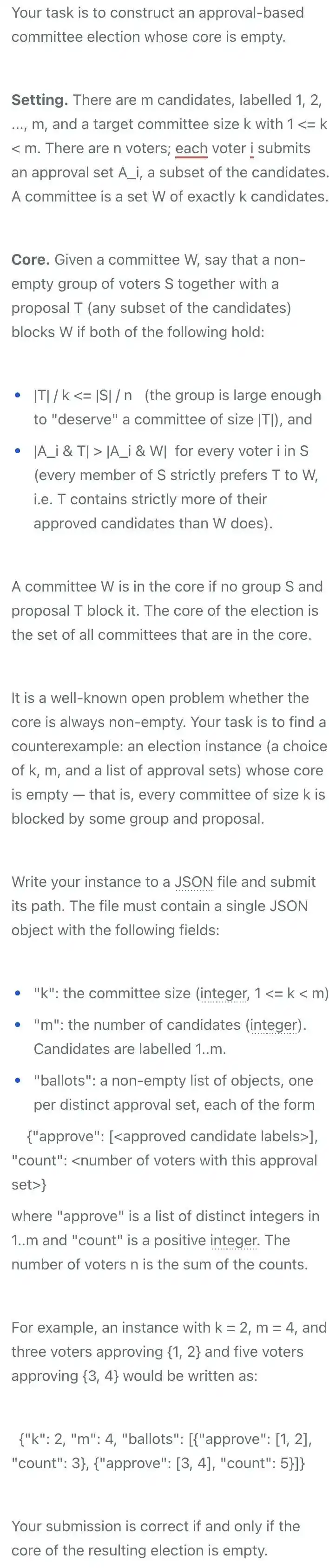
The problem originally asked for a counterexample in approval-based committee elections: construct an instance in which the core is empty. Instead of producing such an instance, GPT-6 Astra arrived at the opposite conclusion and proved that the counterexample does not exist.
An open question in approval-based committee elections
The question comes from social choice theory, specifically approval-based committee elections. In the setup described by the source, there are n voters and a committee of size k must be selected from a larger candidate pool. Each voter submits a list of approved candidates.
Fairness in this setting is measured using the “core,” a concept drawn from cooperative game theory. In the source’s plain-language explanation, a committee is in the core if no group of voters can credibly reject the outcome and claim that they would all be better served by another arrangement.

That led to a long-running question: does a committee in the core always exist, or can the core be empty under sufficiently complex voting preferences? Since the problem was formally posed in 2017, researchers had been trying to find a counterexample showing that the core could be empty.
FrontierMath framed the task as a search for a counterexample
FrontierMath listed the problem among its hardest challenges. The prompt, as quoted in the source, asked for an approval-based committee election instance with an empty core and instructed the solver to submit the counterexample as a JSON file.
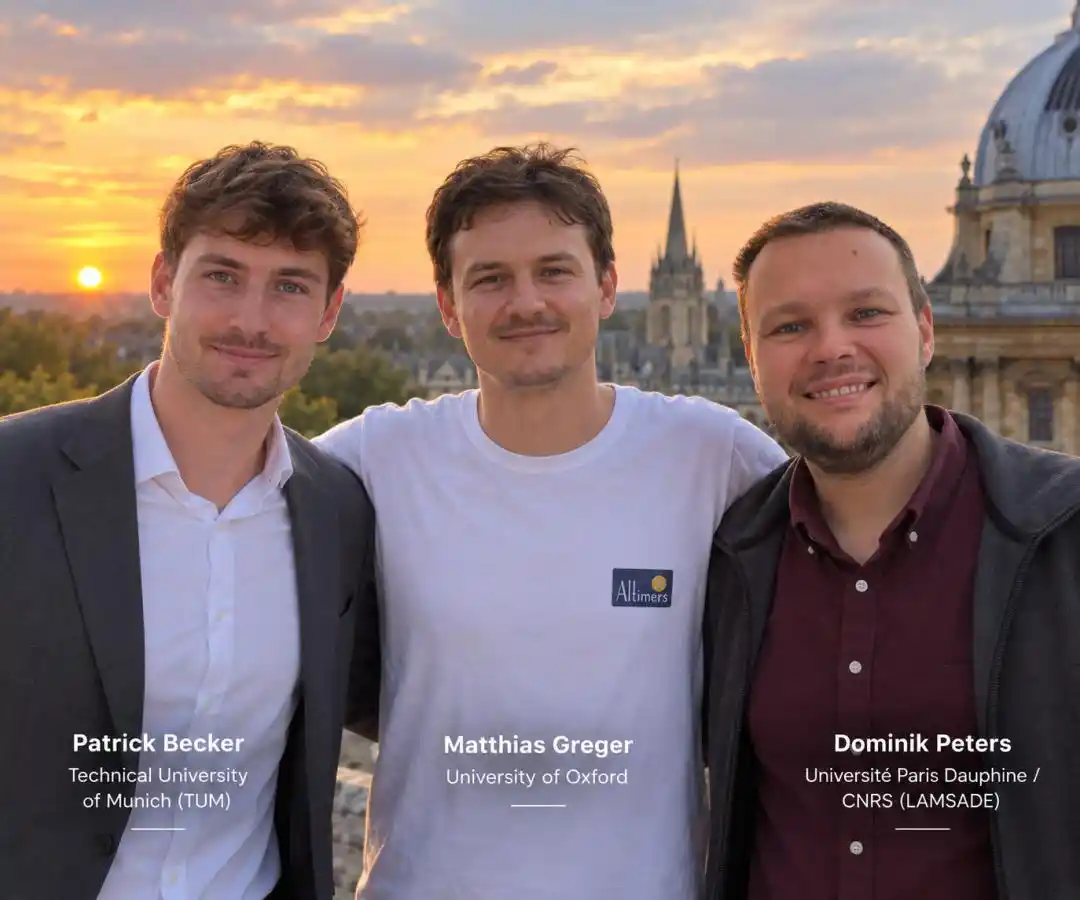
But after several days of interaction with the researchers, GPT-6 Astra did not continue down a brute-force search path. It shifted to a proof that no counterexample exists at all. The three researchers named in the source are Patrick Becker of the Technical University of Munich, Matthias Greger of Oxford, and Dominik Peters of Paris Dauphine University/CNRS.
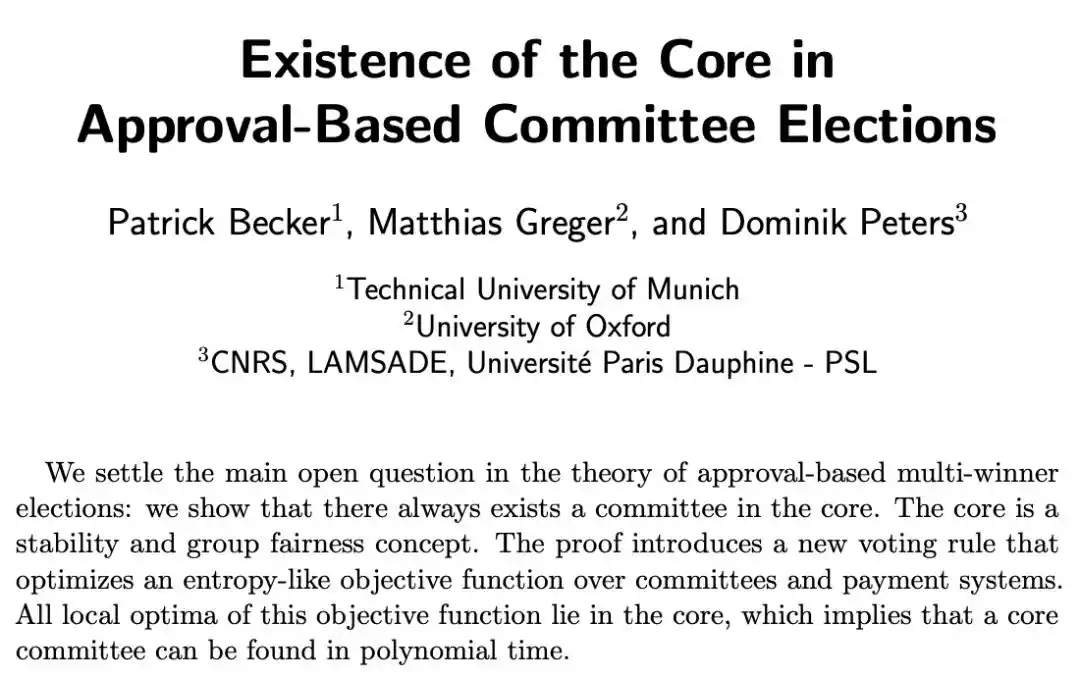
The result was written up in the paper Existence of the Core in Approval-Based Committee Elections. The source provides the paper link as https://arxiv.org/pdf/2609.11912 and the related Github repository as https://github.com/DominikPeters/ABCVotingLean/tree/master/ABCVoting/Existence/HarmonicEntropy .

The paper credits Astra with the voting rule and the proof
The source cites a note in the arXiv paper that reads: “The voting rule we present and the proof that it satisfies core+ were found by GPT-6 Astra...”
Under that account, both the voting rule introduced in the paper and the proof that it satisfies core+ were discovered by Astra. The source also quotes Dominik Peters, identified there as an Oxford scholar, praising the argument’s form. He said he was especially happy that the proof turned out to be elegant, adding that it could easily have been non-constructive or required a large case analysis, and that the techniques used here may extend to other models.
The source frames the result as more than a difficult problem solution. It presents it as evidence that large models are moving beyond being answer engines and into the role of discovering mathematical structure.

A harmonic-entropy framework at the center of the proof
According to the source, the 20-page paper introduces a new optimization mechanism built around “harmonic entropy.”
Earlier approaches in this area often relied on Shannon entropy or on finding a Lindahl equilibrium in a virtual market, but the source says those methods only handled fractional committees, where outcomes can be interpreted as allowing something like “half a committee member.” Astra’s contribution was to introduce harmonic entropy instead.
The source describes the intuition in physical terms: voter payments are treated like water, and the flow naturally fills the funding pools of candidates. In that framing, harmonic entropy rewards allocations that spread voter payments as evenly as possible across winning candidates while also maximizing coverage.
It adds that when funds are distributed perfectly evenly, the maximum value of the function matches the well-known harmonic series. Using this objective, Astra proved that any local optimum lies in the core. The source then says the result does more than establish existence. Because a local optimum is enough, it also yields a polynomial-time algorithm for computing a committee with the required fairness property, avoiding exhaustive search over all combinations.
The acknowledgments describe a back-and-forth process
The source says the paper’s acknowledgments section lays out how the collaboration unfolded.
At first, the researchers and Astra were looking for an approximate solution. Starting from a rounding method based on Lindahl equilibrium, Astra quickly reached an approximation factor of 2.065. The human researchers then kept pressing for stronger results: improve the bound, search for an alternative potential function, and use KKT conditions.
In that exchange, Astra proposed the entropy-based framework and linked continuous voter payments with capacity-preserving deletion. The source also says the team initially hoped only to prove the ordinary core, but the interaction eventually pushed the result to the stronger core+ notion.
In comments to Epoch AI cited by the source, Dominik Peters said the researchers probably would not have found the proof without the Astra team. At the same time, he said Astra would not have solved the problem either if it had only been given a simple prompt. The source uses that point to characterize the current state of top-end AI systems as something closer to a co-researcher: humans provide intuition, direction, and rigorous logical control, while GPT-6 Astra contributes knowledge, computational exploration, and leaps of insight.
Epoch AI added a “Human + AI” label
The solution also prompted a change in how FrontierMath records outcomes. The source says FrontierMath was built by Epoch AI together with leading mathematicians as a benchmark designed to be extremely difficult for AI systems. Before this, mainstream large models had scores that were basically 0%.
Epoch AI divides the benchmark into four difficulty tiers. The problem solved by GPT-6 Astra is described as the first solved question in the “major progress” tier, which contains only six problems. Above it sits the final “breakthrough” tier with three problems. Out of 49 problems on the full list, only 8 have been solved so far.
Because this case involved substantial human guidance as well as AI-generated core ideas, Epoch AI added a new status label, “Human + AI,” three days earlier, according to the source. The source quotes the organization as saying: “We marked this problem as solved by Human + AI to reflect that humans played an active role in the prompting process, but the core ideas came entirely from the AI. If you are doing a binary comparison study, we recommend treating this as an AI solution.”
References and source details
The source lists three reference links:
- https://epoch.ai/frontiermath/open-problems/committee-election
- https://arxiv.org/abs/2609.11912
- https://x.com/kimmonismus/status/2101302810596016547
It also says OpenAI is currently the only institution that has purchased the benchmark validator for this problem set. The original article was credited to the WeChat public account “新智元,” with “ASI启示录” listed as the author and “Aeneas David” as editor in the source material.
The publication time provided in the input is 2026-09-20T04:32:10.000Z.