
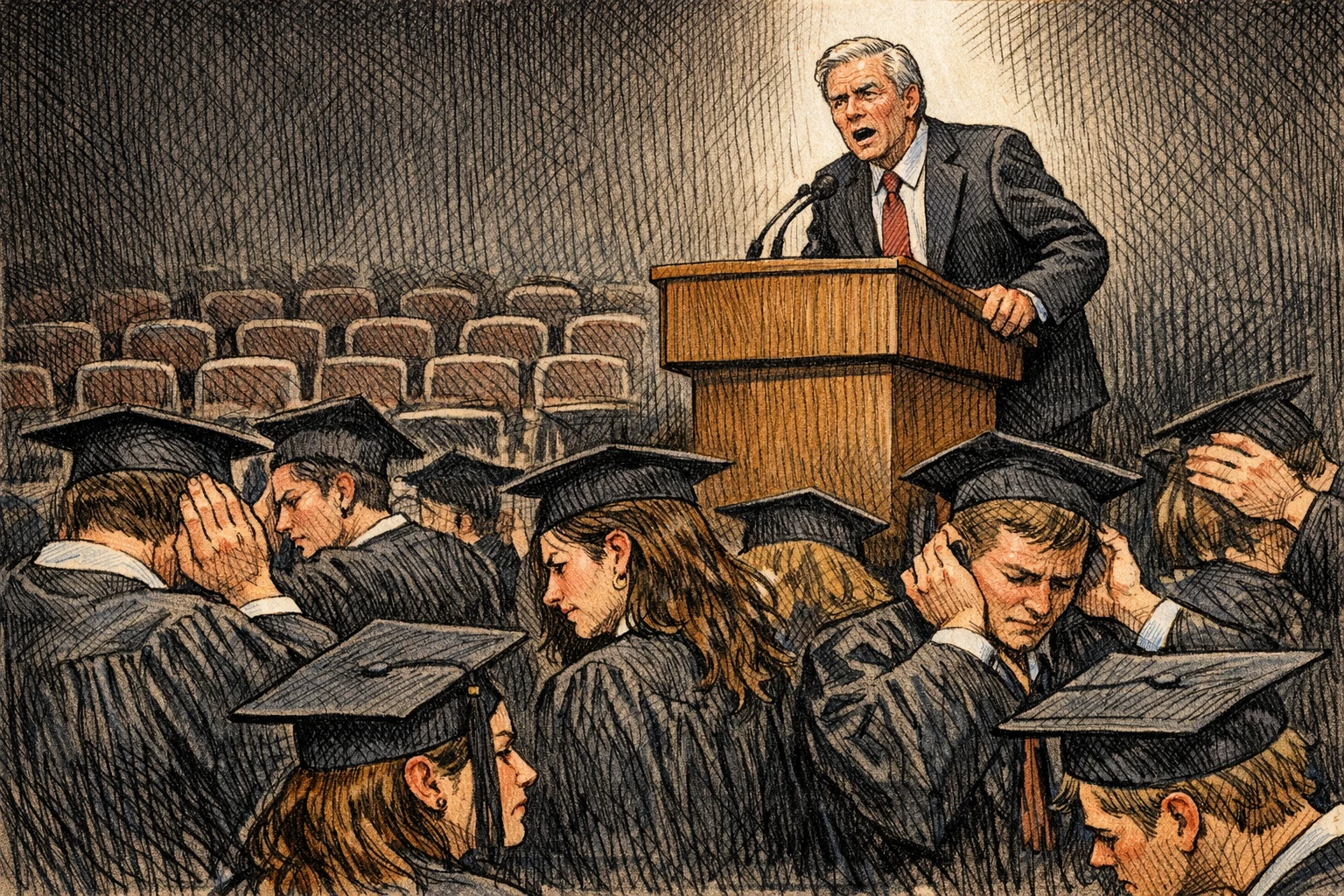
At multiple US commencement ceremonies in 2026, speakers were interrupted the moment they began praising AI. The pattern showed up across campuses and across different guest speakers, including former Google CEO Eric Schmidt and Big Machine Records CEO Scott Borchetta. What should have been routine graduation rhetoric instead drew loud public rejection from students about to enter the workforce.
Similar scenes played out across campuses
On May 8, at the University of Central Florida commencement, real estate executive Gloria Caulfield said that the rise of artificial intelligence was “the next industrial revolution.” She was met with boos before finishing the point. One day later, at Middle Tennessee State University, Scott Borchetta said AI was reshaping how the industry produces work. The crowd responded in much the same way.
At Glendale Community College in Arizona, the tension turned more pointed. The school introduced an AI voice system to read graduates’ names, but the system failed during the ceremony. When the president stepped up to explain that “we introduced a new AI system,” boos broke out again. The reaction was tied not only to the malfunction, but to the mention of AI itself.
The highest-profile moment came at the University of Arizona, where Eric Schmidt said AI would touch every profession, every classroom, every hospital, every lab, and every personal relationship. Students started booing before he had finished.
The backlash tracks with worsening entry-level prospects
The report links these reactions to two sets of numbers. First, ServiceNow CEO Bill McDermott said at a Silicon Valley investor conference in San Francisco in March that, as AI absorbs large numbers of entry-level white-collar roles, unemployment among recent college graduates could reach 30% within two years. That forecast was not about abstract disruption. It was aimed squarely at new graduates.
Second, data from the US Bureau of Labor Statistics shows that openings in entry-level categories such as customer service, secretarial work, and sales assistant roles have been shrinking for two consecutive years. One figure points to the near future, the other describes the current market. Put together, they help explain why students did not hear “industrial revolution” as encouragement.
Students face a contradiction they cannot ignore
NextWeb described the situation bluntly: Gen Z is not booing AI itself, but the job market waiting for them. Fortune called it “cognitive dissonance.” Graduates are angry that AI may replace the work they expected to start with, while also knowing they may need AI tools just to stay competitive in interviews.
That tension gave the boos a clear meaning. Speakers on stage repeated a familiar story about technological change, while the audience heard a message about fewer openings at the bottom of the ladder. For the class entering the labor market in 2026, the issue is not whether AI will change work. It is that the change is arriving just as they are trying to get in.