
Grayscale Research says financial privacy is not a fringe feature of money. In its view, it is a basic part of how money works. In a new report, the firm argues that growing use of stablecoins and blockchain applications, together with new surveillance capabilities tied to artificial intelligence, could push financial privacy back into public focus and set up a repricing of Zcash.

The report was written by Michael Zhao, translated by Luffy, and republished by Foresight News. The original link cited in the republished version is https://www.techflowpost.com/article/33444. WuBlockchain said the piece was shared for information purposes only and did not constitute investment advice or represent its own position.
Grayscale sees a third wave of attention to financial privacy
The report frames the current moment as part of a longer pattern. It says financial privacy tends to become a public issue when technological change and policy shifts put pressure on the existing financial system. In the 1970s, digitized financial records and the Bank Secrecy Act brought more attention to privacy. In the late 1990s and early 2000s, the spread of the internet, online banking, and the Patriot Act pushed the issue back into focus and helped drive wider use of encryption and two-factor authentication.
Grayscale says the market may now be approaching a third wave of public concern around financial privacy. The triggers it identifies are the spread of stablecoins, broader blockchain adoption, and new forms of financial monitoring made possible by AI. The report says several high-frequency indicators already show that public attention to the topic has started to rise.
That is the setting in which Grayscale places Zcash. The report argues that Bitcoin achieved digital scarcity but not digital privacy. Public transparency supports auditability, but it also limits monetary use cases that require confidentiality. If crypto users come to treat private digital money as a separate need from transparent digital assets, Grayscale says Zcash could capture part of that market.
Privacy as a standalone product category
According to the report, balances, counterparties, and transaction histories on public blockchains are permanently visible. Even when users rely on pseudonymous addresses, exchanges, counterparties, wallet behavior, and on-chain analytics can gradually reconnect those activities. In practice, the amount of information exposed on transparent chains often exceeds what users expect.
Grayscale says the need for privacy is not limited to people seeking complete anonymity. Individuals may not want their balances and spending records exposed by default. Businesses may want to keep supplier relationships, payroll, treasury flows, and customer dealings confidential. Institutions may not want their wallet structures and trading patterns mapped in real time. In that sense, the report says privacy demand comes from ordinary confidentiality needs embedded in economic activity.
It also notes a long-running problem inside crypto: privacy products are hard to distribute and integrate. Stronger privacy protections can create more friction for exchange support, wallet integration, and market access. For that reason, privacy in crypto is not only a technical matter. It also involves commercial trade-offs.
Different ways to build on-chain privacy
The report breaks privacy systems into several groups, noting that they do not all hide the same information. Some make transaction flows on transparent ledgers harder to trace. Others hide key transaction fields directly.
- Mixing-based systems: These run on public chains such as Bitcoin and include CoinJoin, Bitcoin Cash’s CashFusion, and Dash’s PrivateSend. They can make tracing harder, but the underlying ledger remains fully public.
- Confidential transaction systems: Litecoin’s MWEB is the example used in the report. It can hide transaction amounts and provide a basic layer of structural privacy, though Grayscale says it still differs from systems that fully shield transactions.
- Default-private chains: Monero is the main example. Privacy is enabled by default rather than selected by the user.
- Shielded transaction systems: Zcash is the example here. The network can verify transaction validity without exposing the sender, receiver, or amount.
Grayscale says Zcash occupies a distinct place in this field. It is an optional-privacy base-layer blockchain, and its shielded transactions hide the sender, receiver, and amount at the transaction layer itself. The report contrasts that with privacy add-ons built on top of transparent chains.
What Zcash is and how it works
Zcash is a blockchain for peer-to-peer value transfer. It has a maximum supply of 21 million tokens and uses a proof-of-work security model, with many features that resemble Bitcoin. The main difference, the report says, is that users can choose to use shielded transactions instead of exposing all transaction details by default.
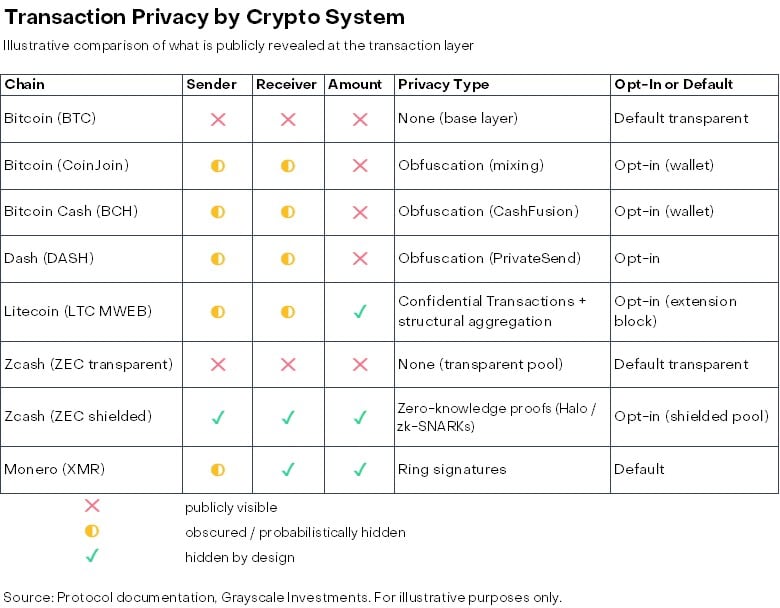
The network supports two kinds of transactions. Transparent transactions are fully visible on-chain and work much like Bitcoin transfers. Shielded transactions allow the network to verify that a transfer is valid without revealing the sender, the receiver, or the amount. In Grayscale’s description, Zcash makes it possible to validate transactions without fully exposing them to the public.
Zcash relies on zero-knowledge proofs to build a shielded pool. As long as funds remain inside that pool, on-chain information leakage can be minimized. The report adds that zero-knowledge proofs are used in blockchain not only for privacy but also for scaling.
Zcash also supports selective disclosure. Through viewing keys, users can grant designated third parties access to shielded transaction information when needed. Grayscale says shielded transactions are not a total black box: they are private from the public while still allowing controlled disclosure by the user.
From a 2016 launch to a new phase of upgrades
Zcash launched in 2016. Grayscale says that by crypto standards it is now an older project and can be mistaken for a leftover from a previous cycle. But the report argues that its original goal was broader than privacy alone. It was meant to bring zero-knowledge cryptography into a digital cash system.
That idea was early for its time. Grayscale describes Zcash as one of the first projects to combine a Bitcoin-like monetary model with privacy transactions at the base-layer chain level, rather than treating privacy as a wallet feature or an overlay.
The report says the early technical vision outpaced the surrounding product and infrastructure stack. Shielded transactions were initially expensive to compute and much less convenient than transparent ones. Several major upgrades gradually changed that:
- Sapling (2018): This upgrade sharply reduced proof generation time and memory use, making shielded transactions practical. Grayscale says a shielded transaction could be generated in seconds and with as little as 40 MB of memory, which directly lifted usage.
- Orchard / NU5 (2022): This upgraded the cryptographic base, introduced the Orchard shielded protocol and Halo2, and removed the need for a trusted setup in the new shielded pool.
- Ironwood (2026): This addressed an Orchard circuit flaw, created a new shielded pool, and removed the theoretical risk of token forgery, according to the report.
- Unified addresses and wallet improvements: These changes simplified the user experience so people no longer had to manage multiple address formats to receive both transparent and shielded funds.
Grayscale says the challenge for Zcash is not simply whether private transfers can be done. The harder question is whether they can be used at scale and with less friction. In the firm’s view, years of work on usability are now starting to show results.
Wallets, payments, and ecosystem infrastructure
The report places special weight on the wallet layer. It says Zodl, formerly Zashi, is no longer just a storage tool but an interface built around shielded-first use. The product includes swaps based on NEAR Intents, CrossPay for cross-asset transfers, and cold storage support for shielded balances.
Grayscale says the value of those features lies in reducing the number of steps that force users to leave the shielded pool. Deposits, payments, and asset swaps can stay inside a crypto-native loop as much as possible. The report argues that Zcash’s biggest historical bottleneck was never whether private transaction technology worked. It was whether users could remain secure across the full transaction flow.
The broader infrastructure stack is also improving, according to the report. It notes that Foundry announced in April 2026 a U.S.-based Zcash mining pool aimed at institutional and public-company miners. Grayscale says that does not directly increase shielded wallet usage, but it does point to a more mature ecosystem, more industrial-grade support, and greater institutional awareness of the chain.
The report also mentions fee and mempool policy adjustments that helped ease congestion caused by spam transactions and improved network stability under heavy load. Grayscale does not present that as the core of the investment case, but says it helps move the protocol from theoretical privacy toward practical use.
What comes next: scaling, settlement, and shielded assets
Grayscale says the next phase for Zcash depends on whether the protocol can move from proving that privacy is possible to making privacy deployable at scale. The report highlights several areas to watch.
- Tachyon: Described as the most important scaling proposal, it aims to reduce the cost of shielded transactions and the burden of synchronization, addressing a long-standing obstacle to broader adoption.
- Crosslink: This proposal focuses on transaction finality and network reliability. It does not fully replace the current proof-of-work model, but is meant to strengthen settlement assurances. Grayscale says the future of Zcash depends not only on privacy features but also on the chain’s overall resilience and operational reliability.
- Shielded assets: This would allow assets beyond native ZEC to use the Zcash privacy system. If the feature is restarted and deployed, the report says shielded transaction capability could extend to more assets and applications.
How Grayscale frames ZEC valuation
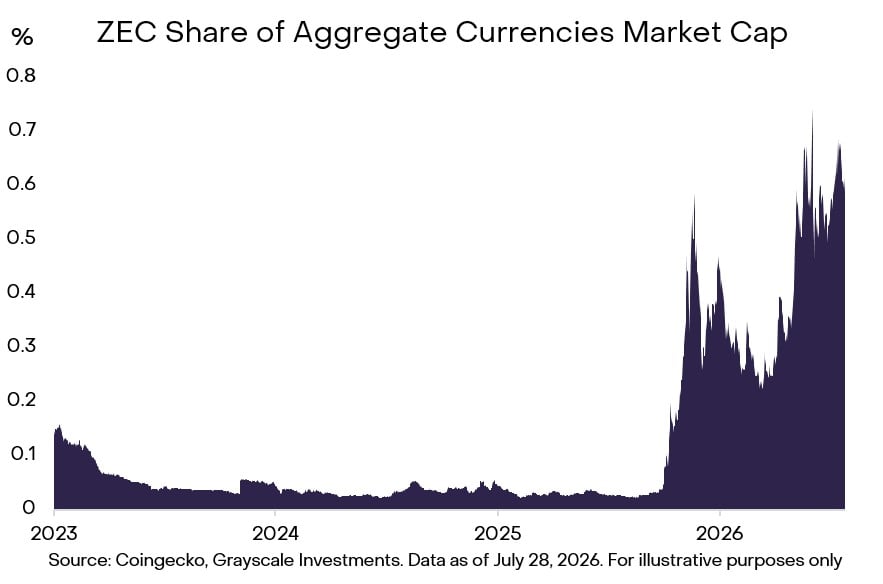
As of July 2026, Grayscale says the broader crypto market assigns very little value to privacy. In its framework, assets used as digital money fall into a cryptocurrency segment that currently includes 15 assets with a combined market capitalization of $1.4 trillion. Bitcoin accounts for about 90% of that total.
ZEC, the report says, has a market capitalization of about $8 billion, equal to roughly 0.6% of the digital money segment. If it were to capture 5% of that segment, its market value would rise 9x. Grayscale says current pricing reflects a dominant market assumption that privacy is a marginal need with a narrow audience and does not deserve a valuation premium.
The report argues that this assumption may not hold if privacy becomes more valuable in an environment of heavier monitoring, tighter compliance constraints, and more frequent financial censorship. In that case, a 0.6% share would not look like a stable equilibrium. Grayscale instead describes it as option value the market has not fully priced.
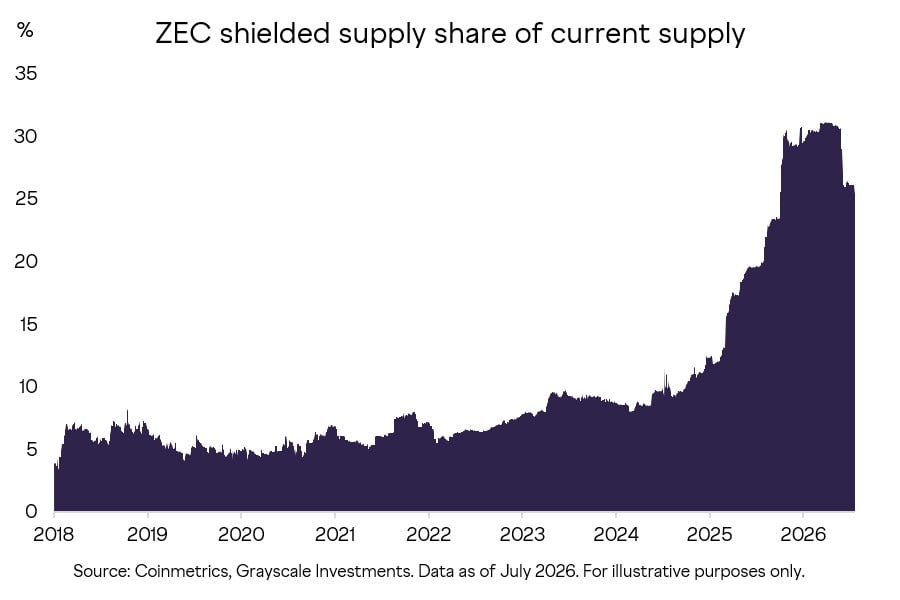
One of the firm’s bullish points is that on-chain data already show real privacy demand. As of July 20, shielded transactions accounted for about 90% of all Zcash transactions, according to the report. Roughly 4.2 million ZEC were in the shielded pool, equal to 25% of circulating supply and a record high. Grayscale says that means privacy is not just a narrative. It is visible in measurable on-chain behavior.
In that framing, Zcash does not need immediate explosive growth to support upside. What it needs, the report says, is a market reassessment of the future value of privacy. If investors decide that privacy should command even a modest premium inside the crypto monetary system, current ZEC pricing could look conservative. For now, Grayscale says the market still treats privacy as an optional feature rather than a core property of money.
Risks: regulation, legacy pools, quantum threats, and execution
Grayscale also lays out several risks. It says the investment case for Zcash depends not only on privacy demand but also on historical cryptographic assumptions, future security issues, and the network’s ability to coordinate through major upgrades.
Regulatory risk
The report says Zcash’s regulatory risk is not simply that it offers privacy. It also depends on whether regulators and service providers accept its selective disclosure model as sufficient for compliance. Compared with privacy systems that offer no disclosure path at all, Grayscale says Zcash’s viewing keys provide a clearer compliance route.
A full viewing key can be granted to a designated party to inspect incoming shielded transactions, recipient addresses in ordinary shielded transfers, amounts, and memos, according to the report. But that disclosure is permissioned. It does not make the chain fully traceable by default.
At the same time, global anti-money laundering rules and the European Union’s MiCA framework continue to impose customer due diligence, recordkeeping, suspicious transaction reporting, and travel rule obligations on virtual asset service providers. Grayscale says viewing keys can reduce risk, but they cannot eliminate the possibility that exchanges and custodians may still avoid supporting shielded transactions for policy or operational reasons.
Legacy trusted setup pool issues
The report says one of the long-running controversies around Zcash came from the trusted setup used in the early Sprout and Sapling shielded protocols. With NU5, the network introduced Orchard and the Halo proving system, and the new Orchard pool no longer required a trusted setup.
Still, Grayscale notes that a soundness flaw was found in the original Orchard circuit in 2026. In theory, that flaw could have allowed undetectable token forgery inside the pool. The network later fixed the circuit in NU6.2. Ironwood, or NU6.3, then introduced a new independent shielded pool, blocked new assets from entering the old Orchard pool, and required funds leaving the old pool to pass through Zcash’s validation and accounting mechanism. The report says that restored independently verifiable circulating supply and materially improved the cryptographic outlook.
A legacy issue remains because the old pool still exists and historical funds remain there. Grayscale says that risk should decay over time, but it still matters when comparing older and newer protocol versions.
Quantum computing risk
Grayscale says quantum computing is a long-term risk for most public blockchains, not something unique to Zcash. Transparent funds and shielded funds face different quantum threat paths because they expose different cryptographic components on-chain.
Electric Coin Company, which has long led Zcash development, has already put quantum resistance on its roadmap. The report says that makes the issue more than a purely theoretical one. Even so, Grayscale treats it as a longer-dated question. In the near to medium term, it says usability, ecosystem adoption, and market structure matter more.
Execution risk
The report says Zcash has improved usability, security, and scaling through repeated major upgrades, but that also creates execution risk. First, the roadmap itself is demanding. Tachyon and Crosslink are major engineering efforts, not simple parameter changes. Second, network upgrades require coordination among engineers, wallet developers, infrastructure providers, and the wider ecosystem.
Grayscale notes that the Zcash improvement proposal process is well documented, which it sees as a strength. Even so, the investment case still depends in part on continued delivery quality and ecosystem coordination.
Bottom line from the report
Grayscale concludes that privacy has always been an important trait of useful money, even if the digital era has made that easier to forget. It says Zcash was created to address a built-in weakness of public blockchains: transactions are easy to verify, but hard to keep confidential. After years of technical work, the report describes it as one of the clearest attempts to close that gap.
The firm also says there is still no settled answer on whether private digital money will become a mainstream category or remain niche. But at current valuations, Grayscale argues, the market is assigning little value to the possibility that privacy becomes much more important in the future. In its view, the opportunity for investors is not a bet that Zcash replaces Bitcoin. It is a bet that the value of private digital money is still not fully recognized.



