
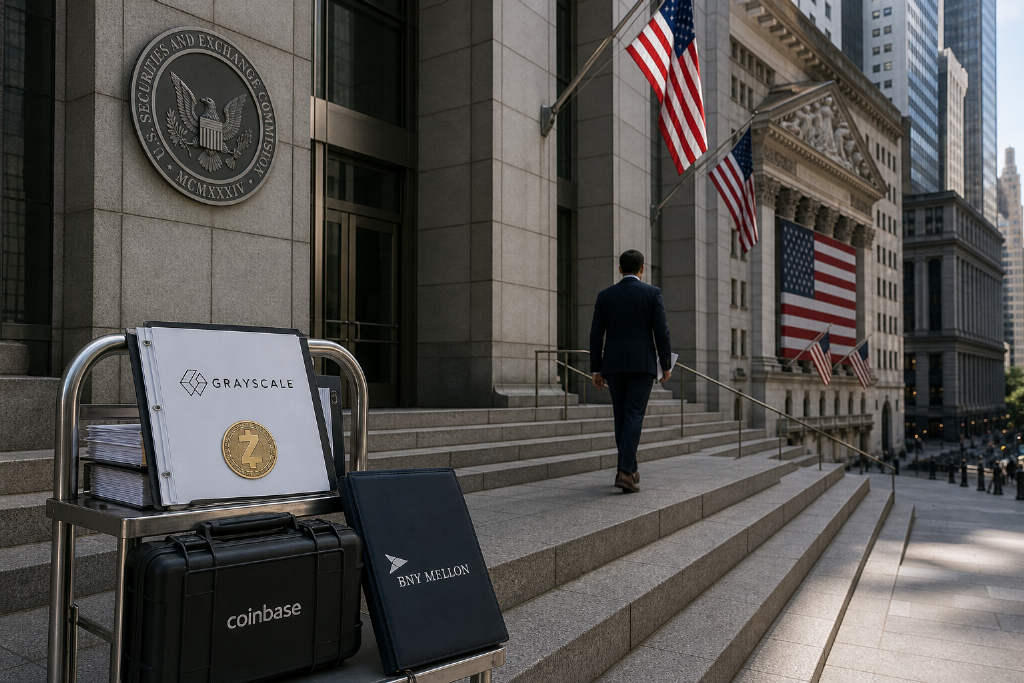
Grayscale submitted a fifth amended registration statement for its Zcash Trust to the U.S. Securities and Exchange Commission on Aug. 21, 2026. If the filing becomes effective, a product called The Zcash ETF, trading under the ticker ZCSH, would list on NYSE Arca as the first U.S. spot ETF to directly hold a privacy coin.
The proposal stands out because Zcash has spent the past three years under heavy regulatory pressure. The asset was delisted by 73 exchanges globally, barred from custody under European Union legislation, and identified by the Financial Crimes Enforcement Network, or FinCEN, as a 「hard-to-track anonymous-enhanced cryptocurrency.」 Now it is being prepared for a standardized securities wrapper administered by Bank of New York Mellon, custodied by Coinbase, and registered with the SEC.
Key terms were retained in the fifth amendment
The latest amended filing settles several terms that had been under review across the prior rounds. The fund’s annual management fee is set at 2.5%, charged daily in ZEC. Bank of New York Mellon will serve as administrator and transfer agent. Coinbase Custody will act as custodian, while Coinbase Inc. is listed as the prime broker.
The structure allows both cash creations and redemptions, and also permits in-kind creations, meaning authorized participants may deliver ZEC directly in exchange for shares. In-kind redemptions, however, are not supported at this stage.
A detail disclosed in the fourth amendment remains in place as well. DCG International Investments, a subsidiary of Grayscale parent Digital Currency Group, is in discussions to contribute about 200,000 ZEC to the trust. Based on the price cited at the time, that stake was estimated at roughly $110 million. The filing says no binding agreement has been signed, and the final contribution could end up above that amount, below it, or at zero.
Trust assets rose as ZEC surged
As of June 30, the trust held about 388,700 ZEC with a fair value of roughly $155 million. By Aug. 21, the day the fifth amended filing was submitted, assets under management had climbed past $260 million.
According to the report, that increase came almost entirely from ZEC’s price move. The token rose from around $250 at its April low to above $800 by this weekend, reaching its highest level since 2018 and pushing its market capitalization into the top 12 among crypto assets.
James Seyffart, an ETF analyst at Bloomberg Intelligence, said the filing shows Grayscale is getting closer to converting the trust into an ETF.
Investors get price exposure, not on-chain privacy
Zcash is built around privacy. It uses zk-SNARK zero-knowledge proof technology to enable shielded transactions, allowing the network to verify transfers on-chain without exposing the sender, receiver, or amount. That feature is central to how Zcash differs from Bitcoin, and it is also one reason the asset has faced a decade of regulatory scrutiny.
ETF investors would not be buying that privacy function. They would be buying dollar exposure to ZEC. The filing states that Coinbase Custody will hold all of the trust’s ZEC in cold storage through segregated custody accounts. Every asset movement must be auditable, traceable, and reportable. In the creation and redemption process, authorized participants must also demonstrate lawful source of assets and satisfy risk and compliance requirements.
In practice, the report says, the trust’s holdings would almost certainly remain in transparent addresses because shielded addresses do not fit with current KYC, OFAC screening, and transaction-monitoring procedures. The structure preserves the asset’s price exposure while stripping out the privacy function that defines the network.
Optional privacy gives Zcash a route into the ETF framework
The report argues that Zcash has reached this point because its privacy model is optional. The network supports both transparent and shielded addresses, giving regulators an access point they can work with. If the trust holds ZEC only through transparent channels, existing anti-money-laundering controls remain intact.
That is not the case for Monero, whose privacy design is default and mandatory. In that comparison, Zcash’s optional privacy has become the feature that makes a Wall Street product possible.
Open questions remain despite the rally
ZEC has gained more than 200% over the past four months, and its market capitalization now stands at about $13 billion. The report says the market is aggressively pricing in the idea of institutional access.
Still, several unresolved issues remain. About 22% of circulating ZEC sits in the shielded pool. If an ETF absorbs more coins from transparent addresses while the shielded share remains stalled, the network’s privacy-coin thesis could face a direct test: whether most holders actually use the feature at the center of its identity.
The report also points to privacy systems being developed in Ethereum Layer 2 ecosystems, including Aztec, which are bringing programmable privacy to the smart contract layer. If on-chain privacy becomes a broader network function rather than the defining trait of a standalone asset, the case for holding a dedicated privacy Layer 1 could weaken.
Price action is another factor. ZEC moved from $250 to $800 in four months, drawing in momentum traders along the way. The report notes that ZEC also saw a sharp pullback after rising from $60 to $700 in 2024. With the ETF timeline still not fully locked in, much of the optimistic view may already be reflected in the current market price.
The fifth amended filing sends a clear signal: traditional finance is trying to repackage an asset from the edge of the regulatory perimeter into a compliant investment product. Where that line is drawn over the next 12 months will be one of the main developments to watch in the crypto ETF market.