
By Kuli, TechFlowPost
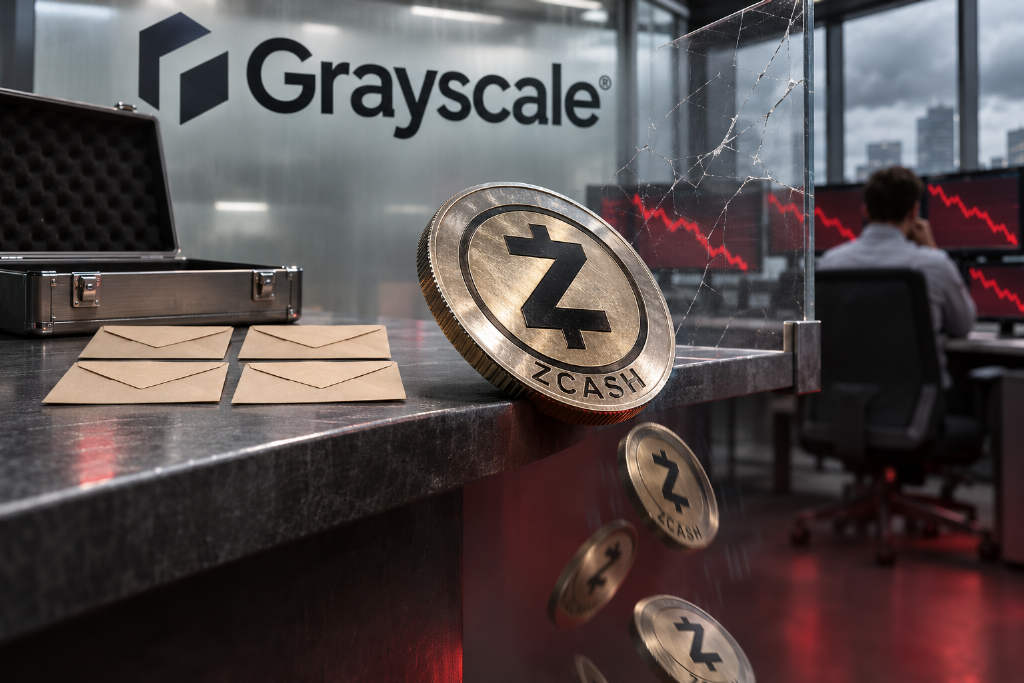
Grayscale’s $1 million support plan for the Zcash ecosystem did not prevent ZEC from falling sharply. On Nov. 10, the asset dropped 11.3% to around $1,043 after Grayscale announced that it would direct all management fees collected by its Zcash ETF, ZCSH, during the fund’s first year toward Zcash development and marketing.
The first grants have already been distributed. The Zcash Foundation and three other nonprofit organizations each received $100,000. Grayscale also launched a nationwide advertising campaign and an investment education website. The article’s lead said ZEC’s 30-day decline had expanded to nearly 20%; the body described the pullback over the past month as close to 19%.
From a privacy trade to a leveraged selloff
One or two months ago, ZEC was a frequent subject of attention from major social-media commentators and crypto research reports. The bullish narrative rested on several developments. Zcash had launched a spot ETF on the New York Stock Exchange’s Arca platform in August, major financial institutions on Wall Street were seen as becoming more receptive to the privacy-coin narrative, and a long-dormant large-cap project was said to be entering a new valuation cycle.
Grayscale’s announcement was presented as a direct financial commitment to that ecosystem. Under the plan, $1 million from the management fees generated by ZCSH will be used to support Zcash. The first $400,000 has gone to four nonprofit organizations, while the remaining $600,000 has not been distributed in the same manner.
The market response was the opposite of what the promotional message might have suggested. ZEC declined throughout the trading session on the day of the announcement. TechFlowPost argues that the concentrated bullish promotion of the previous two months failed to create a stable stream of new capital, leaving late buyers exposed when the anticipated catalyst arrived.
A voluntary grant with limited scale
Returning ETF fees to a public blockchain ecosystem is unusual on the surface. The report says the terms make the commitment less certain than the headline figure implies.
Grayscale’s official announcement described the $1 million commitment as voluntary and said the company retains the right to modify or terminate the sponsorship. The four initial $100,000 grants are the portion that has been delivered so far. TechFlowPost therefore views the remaining $600,000 as a future commitment rather than an already distributed pool of capital.
The report also describes the program as a branding and marketing effort for ZCSH, in addition to its stated ecosystem purpose. That assessment comes from the article, not from a statement by Grayscale about its own trading or marketing objectives.
Scale is another issue. Against Zcash’s market capitalization, $1 million for development and marketing is limited. Since the ETF began trading on NYSE Arca in August, ZCSH has not generated the kind of traditional-capital buying rush associated in the report with earlier Bitcoin and Ethereum ETF launches. The code may be visible on Wall Street trading screens, but TechFlowPost says relatively little capital has been committed to the product for the long term.
Without sustained new liquidity from outside the existing market, the report argues that advertising and sponsorship money alone cannot support the expectations built around ZEC during the previous two months. In that reading, Grayscale’s contribution is a voluntary subsidy rather than a source of recurring capital capable of changing the project’s underlying fundamentals.
$2.3 billion in open interest
TechFlowPost identifies the structure of the market as the main reason ZEC has been vulnerable to a fast decline. Data cited in the report put open interest in ZEC perpetual contracts at roughly $2.3 billion. A large share of the capital surrounding the token therefore appears to be tied to high-volatility, leveraged trading.
The report interprets the wave of ZEC promotion on overseas social media during the previous two months as a process that may have built liquidity for the derivatives market. The “first privacy ETF” theme pushed attention higher, drawing retail traders into leveraged long positions. Once open interest had expanded and Grayscale’s sponsorship had been announced, the arrival of the catalyst could also have offered larger traders an opportunity to close long positions or open shorts.
These are TechFlowPost’s conclusions about market behavior, not an explanation of trading intentions issued by Grayscale. The report describes the move as a case of selling into positive news and using the announcement as an exit window for liquidity.
The unresolved impact of a privacy vulnerability
The report also revisits a major technical problem involving Zcash’s privacy pool. About three months before the ETF listing, the privacy pool was reported to contain a serious vulnerability, and ZEC lost 50% in a short period. The technical team completed a fix in July.
The incident occurred while mainstream regulators were already cautious about privacy technology. TechFlowPost says the episode damaged the confidence of more conservative capital, even after the technical repair. The report places two conditions side by side: a technical network it says has limited real-user retention, and roughly $2.3 billion in highly leveraged open positions.
On that basis, the article argues that a broad market adjustment or the realization of an earlier positive catalyst could lead to concentrated long-position liquidations. It does not cite a separate liquidation figure.
An old-coin narrative and its aftermath
TechFlowPost presents ZEC’s recent move as an example of the “old coin, new trade” pattern in crypto markets. The pattern begins with a theme that can be accepted by traditional capital, builds a broad valuation-repricing story around it, uses overseas influencers to concentrate attention, attracts buyers chasing the move, and then shifts the supply while liquidity is at its most active.
The report says many of the participants who helped turn ZEC into a market favorite during the previous two months may already have taken profits and left. What remains is a lower price and about $2.3 billion in unsettled liquidity in the derivatives market.
For investors who bought after the promotional wave, the expectations built up over the past two months are now being unwound. For Zcash, the report concludes that Grayscale’s advertising and sponsorship cannot substitute for genuine ecosystem use and sustained funding.



