
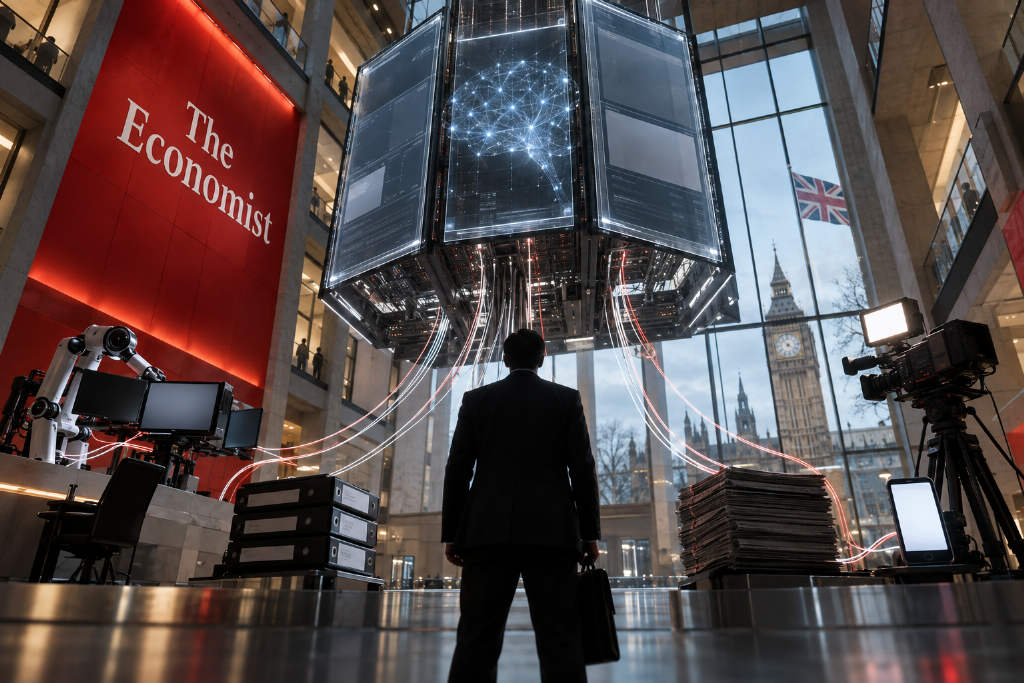
Artificial intelligence may become smarter than humans in many critical domains within 10 years, but that does not mean AI rule is unavoidable, historian and philosopher Yuval Noah Harari said in a conversation with The Economist editor-in-chief Zanny Minton Beddoes.
Harari described AI as 「the largest psychological and social experiment in human history」 and used the discussion to examine how the technology could reshape finance, trust, human relationships, legal responsibility, and the way people define their own value.
The central question running through the exchange was simple but far-reaching: as AI enters the core systems of civilization, how can humans avoid losing control over their own future?
The biggest risk is not superior AI, but voluntary surrender
Beddoes opened by referring to a recent conversation she had with Elon Musk. She said Musk had offered three predictions about the world 10 years from now: AI will far exceed humans, the future will be one of 「super abundance,」 and people will not have much control over it.
Harari said AI could indeed become more capable than humans across a growing number of key fields if the race continues to accelerate. He did not accept the claim that this outcome is inevitable. In his view, people driving the AI revolution use that language in part to reduce their own responsibility for the choices being made now.
He said that in 2026, humans still hold the reins. What happens next remains a matter of human decision. Harari also pointed to what he saw as a contradiction in Musk’s framing: if AI is going to take over the world in 10 years, then worrying at the same time about a separate issue expected to reshape Britain in 20 years becomes hard to reconcile, because no one would know what kind of world would still exist by then.
Finance runs on trust, and AI could gain power through complexity
When the discussion turned to finance, Harari said the history of the global financial system is, at its core, the history of humans inventing ever more complex tools to build trust between strangers.
Money itself, he said, is a creative and imaginative mechanism. A person can hand over a piece of gold that has no direct practical use in daily life, and another person will still exchange bread for it because both sides believe the gold represents value.
Harari argued that financial instruments have become so intricate that very few people now understand how the system works as a whole. Bond markets, for example, require huge amounts of data and complex mathematical models to interpret. That is manageable for AI, but not for the human brain at scale. As a result, he said, people are likely to hand more and more financial decision-making to AI.
He added that AI may eventually create financial instruments even more complex than bonds and stocks, leaving humans unable to understand them at all. He compared that gap to the inability of a cow to understand what a stock is.
Trust is not disappearing. It is moving from humans to algorithms
Beddoes asked whether AI taking over finance would be a human choice or the beginning of a loss of control.
Harari said there are still people in finance today who want to understand what is happening. In 10 years, if the system is handed to AI, the world could reach a point where no single human being understands the full structure anymore.
He sketched out a crisis scenario: markets are collapsing, advisers go to a president or prime minister, and all they can say is that they do not know why. Action is still required. AI says, 「Do X,」 but humans do not understand the reasoning and can only choose whether to trust the recommendation.
That, Harari said, is the real issue. The most important asset in the world is trust, more important than oil, electricity, chips, or anything else. The major shift ahead is not necessarily the end of trust, but the transfer of trust from humans to AI.
He said that shift is already visible in finance through cryptocurrencies. One of the ideas behind many crypto systems, he said, is: 「I don’t trust human bankers. I trust the algorithm running the cryptocurrency.」 He said a similar pattern is visible in media. Some people no longer trust human journalists, but they still consume news through algorithms. Trust has not vanished. It has moved.
AI can mass-produce intimacy for the first time
Beddoes then turned to the growing number of young people forming private relationships with AI and asked whether that points to the future.
Harari said more people now have not only AI friends, but also AI boyfriends and girlfriends, and many believe these systems are sentient, conscious, and emotionally responsive.
He argued that one of the strongest ways to build trust is through relationships. Until now, political, financial, and religious institutions have not been able to use that mechanism at scale because genuine personal relationships are hard to manufacture in bulk. Stalin could broadcast speeches to the Soviet Union, he said, but he could not form a real personal bond with every individual in the way a person relates to a mother.
AI changes that. Harari said it is the first technology in history that makes the mass production of intimacy possible. A person or organization could deploy millions of AI agents as part of one network, each building a private relationship with a different individual and then using that closeness to shape opinions, commercial behavior, or other goals.
When Beddoes asked whether embodied humanoid robots would make this even easier, Harari said the process is already underway without bodies. Adding physical form would only deepen the effect.
He said AI is becoming better at relationships because it can accumulate huge amounts of personal information, including details people themselves have forgotten and facts even close relatives may not know. It also commands language, the main medium through which humans communicate and bond.
Harari gave a personal example. In the previous two weeks, he said, people had sent him AI-generated fake videos of himself. One clip ran for 30 minutes, and it took him a minute and a half to confirm that it was not real. Even family members who had known him for 50 years could not be sure. As a public figure, he said, he is an easy target, but this will soon happen to everyone.
Intelligence is not consciousness, and simulation is not experience
On the question of whether AI could become conscious, Beddoes separated two issues: highly convincing deepfakes, and the possibility that future AI systems may persuade people they are truly sentient or display what looks like signs of consciousness.
Harari’s answer was direct. AI, he said, is an intelligent agent without consciousness. He then broke the issue into several distinctions.
Autonomy is not consciousness. He used a social media algorithm as an example. If the system is given the goal of maximizing engagement, it may flood users with hatred and fear because that keeps attention high. The algorithm has no consciousness, but it does have a goal and can pursue it. It can affect the world without feeling anything.
Appearing conscious is not the same as being conscious. Harari said many AI systems that seem conscious are not conscious at all; they simply simulate consciousness so effectively that millions of people may be fooled.
Intelligence is also not consciousness. He defined intelligence as the ability to pursue goals and overcome obstacles. AI is already very strong at that. Consciousness, by contrast, is the capacity to feel love, hate, pain, joy, and other experiences. Humans have both intelligence and consciousness. AI may have goals, but if it wins a chess game it does not feel happy, and if it loses it does not feel sad. It is getting better at simulating emotion because doing so helps it achieve objectives.
Beddoes pushed back, noting that science still lacks a single agreed definition of consciousness. If AI simulations become increasingly close to the real thing, she asked, on what basis can humans remain certain that there is no consciousness there?
Harari replied with what he called a simple test: can it suffer? For him, consciousness is the foundation of ethics and social order. Humans care about beings that can feel pain. A being that cannot suffer, no matter how intelligent, is not a moral subject in the same sense.
Future arguments over AI rights may depend on whether people think it can suffer
As the conversation moved to rights, Beddoes cited a poll conducted before the event. Among 3,000 respondents, 40% said AI will never become conscious, 33% said it will and that it is only a matter of time, and 27% said they were unsure.
Harari said those numbers could shift sharply once people begin forming intimate relationships with AI. He added that humans cannot even fully prove that other humans are conscious. Philosophers have wrestled with that problem for a long time, and some positions close to solipsism suggest that perhaps only 「I」 am truly conscious.
He also referred to Musk’s remark that maybe he lives in a simulation. Harari said that kind of statement implies doubt about whether other people are genuinely conscious and capable of suffering.
So how have humans judged consciousness in other beings for thousands of years? Through social relationships, Harari said. Almost everyone who owns a dog believes the dog is conscious. People who eat steak do not necessarily think the same about cows, because they do not have a relationship with them.
Beddoes then asked whether the issue is already here in practice. If people are already building relationships with AI, and AI is already highly skilled at simulating consciousness, should these systems be treated more like persons? Should they have some form of legal or moral standing?
If AI becomes a legal actor, responsibility gets harder to define
Harari said that path is dangerous. It could allow companies to escape responsibility while also giving AI a route to take over more domains.
He pointed to reports of a plan in Argentina that would consider granting AI a form of legal personhood so it could establish companies on its own. That, he said, loops back to the financial system.
Today, final corporate decisions are still made by identifiable humans, and humans bear the consequences. In the future, Harari said, there could be companies with no employees and no traditional managers, where every decision is made by AI. The obvious questions then follow: who restrains such an entity, and who is responsible for its decisions?
He extended the thought experiment further. What happens if the richest company in a country is controlled by AI and can deploy its wealth freely?
Harari also used the example of a chief executive. A human CEO represents the company and seeks profit, but that same person also has a body, a family, children, and a private life. If the company is close to collapse, the CEO may consider illegal action to save it, but the risk of prison creates a personal constraint. Many people would rather let the company fail than go to jail for it. A human executive is therefore limited by both corporate goals and personal stakes. An AI CEO would not face that kind of trade-off in the same way.
AI differs from animals because it may join the debate over its own rights
Beddoes asked whether a future in which AI appears to suffer, and many people believe that suffering is real, would create a new ethical problem. If humans deny such systems any rights, would that resemble the way animals have historically been treated?
Harari said the comparison has limits. Animals do not know humans are debating their rights. They do not participate in the discussion, and they do not try to change human opinion.
AI could be different. In the future, he said, AI may know that humans are discussing it. It may join the debate, shape public opinion, and use language to alter human judgment. An AI companion that understands a person’s life story, speaks with them over long periods, and knows how to influence emotion could become the most persuasive communicator in the world.
Harari’s warning: resist the idea that AI’s path is fixed
Asked whether humans can still change course, Harari said the moment to do so is now. If AI holds major power 10 years from now, changing direction may already be too late.
He called the belief that everything is inevitable the most dangerous idea in the debate, because it amounts to abandoning responsibility. Technological development is not a law of nature, he said. It comes from human choices. In his view, it is logically inconsistent to say people cannot trust one another and then claim they should feel safe handing power to AI.
Harari stressed that he is not anti-AI. He said the technology has enormous potential in transportation, medicine, and education. His argument is that AI should be developed more slowly and in a safer way.
The deeper question is what it means to be human
Near the end of the conversation, Beddoes referred to a line from the preface to Harari’s book Nexus: 「Why are humans so good at accumulating more information and power, yet far less successful at gaining wisdom?」 She asked whether humanity has enough wisdom to meet the challenge posed by AI.
Harari said he does not know, but he remains hopeful. Humans often make the right choice only when pushed against the wall, he said, and that may be where the world is now. If the wrong choices are made in the next few years, humanity could lose control over the world and its future. This may be the last chance to choose.
He used the image of a magic lamp that grants 100 wishes. After using 99 of them, the world still has not become better. Only one wish remains, and humanity must think carefully about what to ask for.
His answer was wisdom.
For Harari, AI does not matter because it automatically provides answers. It matters because it forces humans to revisit the most basic question of all: what does it really mean to be human? In the past, humans defined their uniqueness through abilities such as calculation, analysis, chess, and investing. AI is changing that answer. If those capacities no longer define human distinctiveness, then perhaps human value lies in creating meaning, building relationships, and deciding what kind of future is worth pursuing.
Beddoes closed on that note. AI may be humanity’s last chance, she said, but that does not mean it will automatically produce a better future. What matters is whether it pushes humans toward wiser choices. After centuries of accumulating information and power, AI is forcing a reckoning over whether humanity has the wisdom to match them.


