
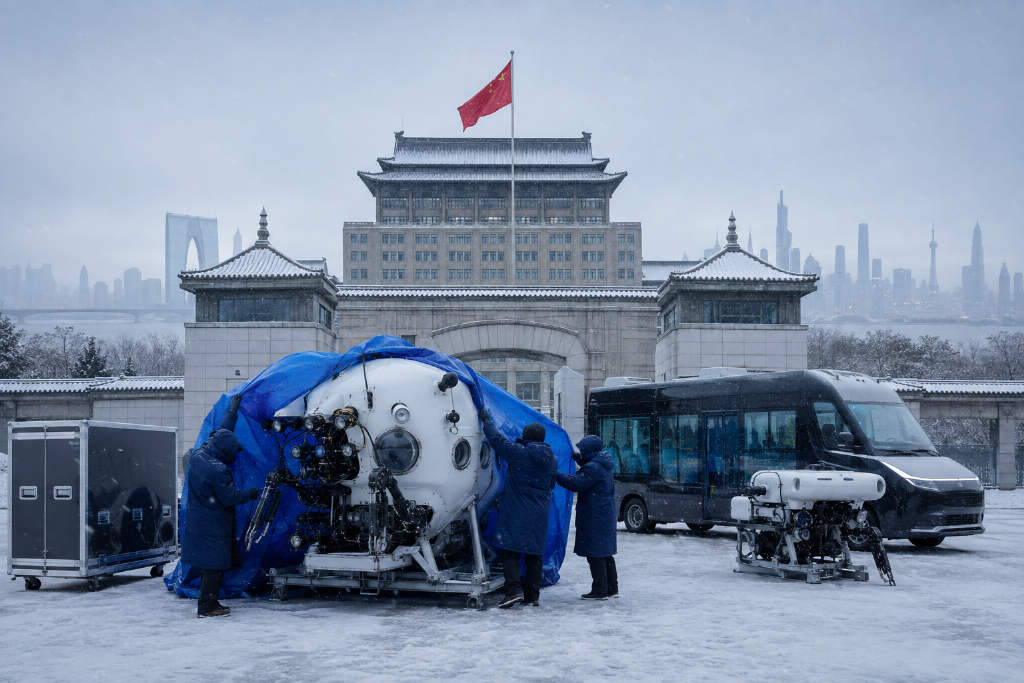
Deep-sea robotics is turning into one of the livelier pockets of China’s hard-tech market. And a string of recent funding news keeps circling back to the same school network: Harbin Engineering University.
A PEdaily report, cited by MarsBit, said Suzhou-based Gongzhi Ocean and Shihang Intelligence, along with Greater Bay Area-based DeepSea Humanoid, have all recently revealed financing deals. All three were founded by Harbin Engineering University alumni. The report says many of these founders spent years working in marine industries before money started rushing in as deep-sea embodied intelligence edged toward commercialization.
Three financings, one alumni network
This week, Gongzhi Ocean said it had wrapped up an angel round worth nearly RMB 100 million. The investors were Zhongxin Zhidi, Leaguer Finance, Yinfeng Capital, Xiaojishida Venture Capital, and Harbin Engineering University Asset Management. The report called it a record-setting angel-round size for the deep-sea sector.
Gongzhi Ocean is based in Suzhou. The person behind it is Guo Chunyu, a Harbin Engineering University professor with more than 20 years in shipbuilding and marine fields. The report says Guo was born in Bengbu, Anhui, in 1981, entered Harbin Engineering University at 18, finished his bachelor’s, master’s, and doctorate there, and then did postdoctoral and visiting research at Shanghai Jiao Tong University and University College London before returning to Harbin Engineering University as a doctoral advisor. He also spent a long stretch as vice dean of the university’s School of Naval Architecture and Ocean Engineering.
The article says Guo’s work has stayed fixed on marine propulsion, deep-sea equipment, and polar technology. Gongzhi Ocean was founded in 2024. The company presents itself as a future “Huawei of the deep sea” and has released what the report describes as the world’s first deep-sea robot that combines exploration and operations, putting it among the few embodied-intelligence platforms to solve core deep-sea operating tasks.
Last month, DeepSea Humanoid completed an A round worth more than RMB 500 million. The investor lineup got special attention in the report: new shareholders included LightHouse Capital, Fortune Capital, GGV Capital, Cowin Capital, China Insurance Investment, CETC Investment, and an energy technology fund managed by Cathay Capital with TotalEnergies as the capital contributor. Existing backers, including Zhengxuan Investment, Yunze Capital, Yunshi Capital, Gaojie Capital, and Xingzhi Capital, also added sizable follow-on investments.
The central figure at DeepSea Humanoid is another Harbin Engineering University graduate. Ma Yiming finished the university’s ship and ocean engineering program in 2013. The report says he spent years at an internationally known deep-sea robotics company as chief overall technology lead, became one of the earliest industrial talents in China to systematically bring in deep-sea robotics technology from Europe and the U.S., and helped draft multiple national standards for underwater robots. It also says he led or took part in projects including Nautilus, the world’s first commercial deep-sea mining robot, a full ultra-deepwater work-class ROV, and China’s first heavy-duty subsea operation robot.
The article says Ma decided to build deep-sea robots himself after seeing rows of heavy-duty work-class machines in a workshop early in his career. That image stuck. DeepSea Humanoid was founded in 2023 and goes after hard industrial demand in offshore oil and gas, subsea communications, offshore wind power, and deep-sea mining. According to the report, the company quickly won most commercial complete-machine orders in the domestic market.
Another company in the report is marine robotics unicorn Shihang Intelligence, whose products can work across the full ocean depth range from 0 to 10,000 meters. In June, it announced an A round of more than RMB 1 billion.
The report says Shihang Intelligence also emerged from a Harbin Engineering University lab. Founder Chen Xiaobo explained where his bond with marine robotics began: “A lot of people ask me where my connection with marine robotics started. My answer is the Ewei Association at Harbin Engineering University, in the basement laboratory of Building 21.” The report says Chen independently built his first underwater cleaning robot as a sophomore, won a first prize for national defense science and technology progress at age 28, and founded Shihang Intelligence in 2023.
Why Harbin Engineering University appears so often
The report ties the current wave of startups to Harbin Engineering University’s long buildup in naval architecture, ocean engineering, and related fields.
The university is administered by China’s Ministry of Industry and Information Technology. Its educational strategy is organized around “three seas and one nuclear,” meaning the shipbuilding industry, naval equipment, ocean development, and nuclear energy applications. The article says its history goes back more than 70 years and that it is now part of the national Double First-Class initiative. Its ship and ocean engineering program is described as a major domestic training ground for marine equipment talent.
The report runs through a list of achievements linked to the university, including China’s first experimental submarine, first hydrofoil, first shipborne computer, and first strip echo sounder. It also says results such as dual-mode submersibles, hovercraft, and gradient velocimeters once reached world-leading levels.
In subject rankings, ship and ocean engineering has been named a Double First-Class discipline. The report says eight fields — engineering, materials science, computer science, chemistry, environment/ecology, physics, geosciences, and social sciences, general — sit in the top 1% of ESI, while engineering is in the world’s top 1‰.
To train top-tier innovation talent, the university has created four experimental tracks: the Chengeng Class, Ship and Ocean Class, Ship Power Class, and Nuclear Innovation Class. And it pushes student entrepreneurship too. The report says its Ha Chuan maker ecosystem park is a national-level maker space. It also points to the Ewei team, saying it won the world championship in an international underwater robotics competition in two straight editions.
The article quotes Chen Xiaobo saying that from the laboratory to the 10,000-meter deep sea, Harbin Engineering University graduates have followed a path that is “hard but right.” It also says humanity has developed less than 0.1% of the ocean by area. In deep-sea mining alone, a UBS report published in November 2025 put the total potential value of global deep-sea mineral resources at between $177 trillion and $280 trillion.
The report’s message here is blunt: deep-sea technology matters on a very large scale, and Harbin Engineering University — with its long record of training marine talent and producing first-of-their-kind domestic marine equipment — now stands close to the front of that drive.
A northeastern “twin-star” story in hard-tech entrepreneurship
The article then pulls back from Harbin Engineering University alone and shifts to another Harbin school, Harbin Institute of Technology. Its argument is simple: the two universities now make up a northeastern “twin-star” force in China’s hard-tech startup cycle.
Harbin Institute of Technology was founded earlier. The report says the Harbin Sino-Russian School of Industry was set up in Harbin in 1920 with two departments, railway construction and electrical mechanical engineering, and was renamed Harbin Institute of Technology in 1938.
The article presents HIT as a university that has long stayed focused on hard, heavy, capital-intensive sectors. Its name keeps showing up around aerospace, advanced equipment manufacturing, robotics, and artificial intelligence.
On robotics, the report says the HIT network makes up a large slice of today’s startup scene. It names Leju Robot, Viatom-style transliterated Woan Robot, and Standard Robots as companies that have moved toward public listings or bell-ringing moments. It also mentions younger ventures such as Luobo Party founded by Huang Yi, collaborative robotics company FAOIWEI founded by post-80s alumni, and Xuanchuang Robot founded by Fu Zhe.
The report says HIT’s public image is that of an “engineer’s cradle.” It says the university has produced 131 academicians of China’s two national academies and more than 1,000 chief designers in aerospace and national defense, putting it near the top among Chinese universities. Its motto, “strict standards, solid skills,” is described as a lasting mark on its students.
Policy tailwinds and a long-delayed commercialization window
The article says both universities have, in different ways, written themselves into the story of China’s industrialization. Then came the next stage. Years of technical buildup inside the national system met a commercialization window, and a fresh chapter involving capital, founders, and industrial technology began to open.
Deep-sea robotics is the clearest case in point. The report says that because the technology and industrial use cases stayed immature for years, some prototypes that cost tens of millions of yuan to build ended up parked in laboratories for 10 or 20 years. But once the window opened, money moved fast into a field that had been ignored for a long time.
It points to two policy signals. In 2025, the government work report named “deep-sea technology” for the first time as a key field of strategic emerging industries, alongside commercial space and the low-altitude economy. Then in March this year, the outline of the 15th Five-Year Plan was formally approved, calling for faster progress in turning China into a strong maritime nation and improving capabilities in deep-sea access, exploration, development, and security. The report says deep-sea economics then rose into a new level of global strategic competition.
The article quotes DeepSea Humanoid founder Ma Yiming describing deep-sea embodied intelligence as a foundational capability for both the country and humanity: “the ability to freely enter, fully understand, and effectively develop the blue territory that covers 71% of the Earth’s surface.” In the report’s framing, hardware and intelligent systems will decide how far humans can reach into the deep sea.
It also looks back 10 years, to a period before robotics drew the level of attention it gets now. Even then, groups of students from Harbin Institute of Technology and Harbin Engineering University were already heading into labs and competitions, building alongside like-minded classmates, and waiting for the technical tipping point that would finally bring wide attention.
The piece ends on that thought, not a prediction: whenever China enters a golden era for engineering-led entrepreneurship, these hard-science universities keep turning out founders.
This article originally came from the WeChat account PEdaily and was written by Yu Mengying.