


Talent has been repriced first in the current AI cycle. As model companies compete for algorithm engineers and large tech groups offer outsized packages to top researchers, the market value of key employees has kept rising. In sectors where technical paths change quickly and top talent remains scarce, a single hire can affect product direction and R&D speed.
That has pushed another question into view: what should a CEO be worth? In technology companies, the answer rarely sits in a salary line alone. A CEO may also be a founder, a technical leader, and a major shareholder, so total compensation is often split across cash pay, equity value, and expected future upside.
Average CEO pay across 18 companies reached RMB 2.572 million
According to the article, Weilai Kejijie Plus reviewed compensation, productivity, and equity data for 18 leading companies across four sectors: AI large language models, autonomous driving, semiconductors, and embodied intelligence. The goal was to examine how technology companies price CEOs and core talent, and what those prices say about capital allocation and expectations for the future.
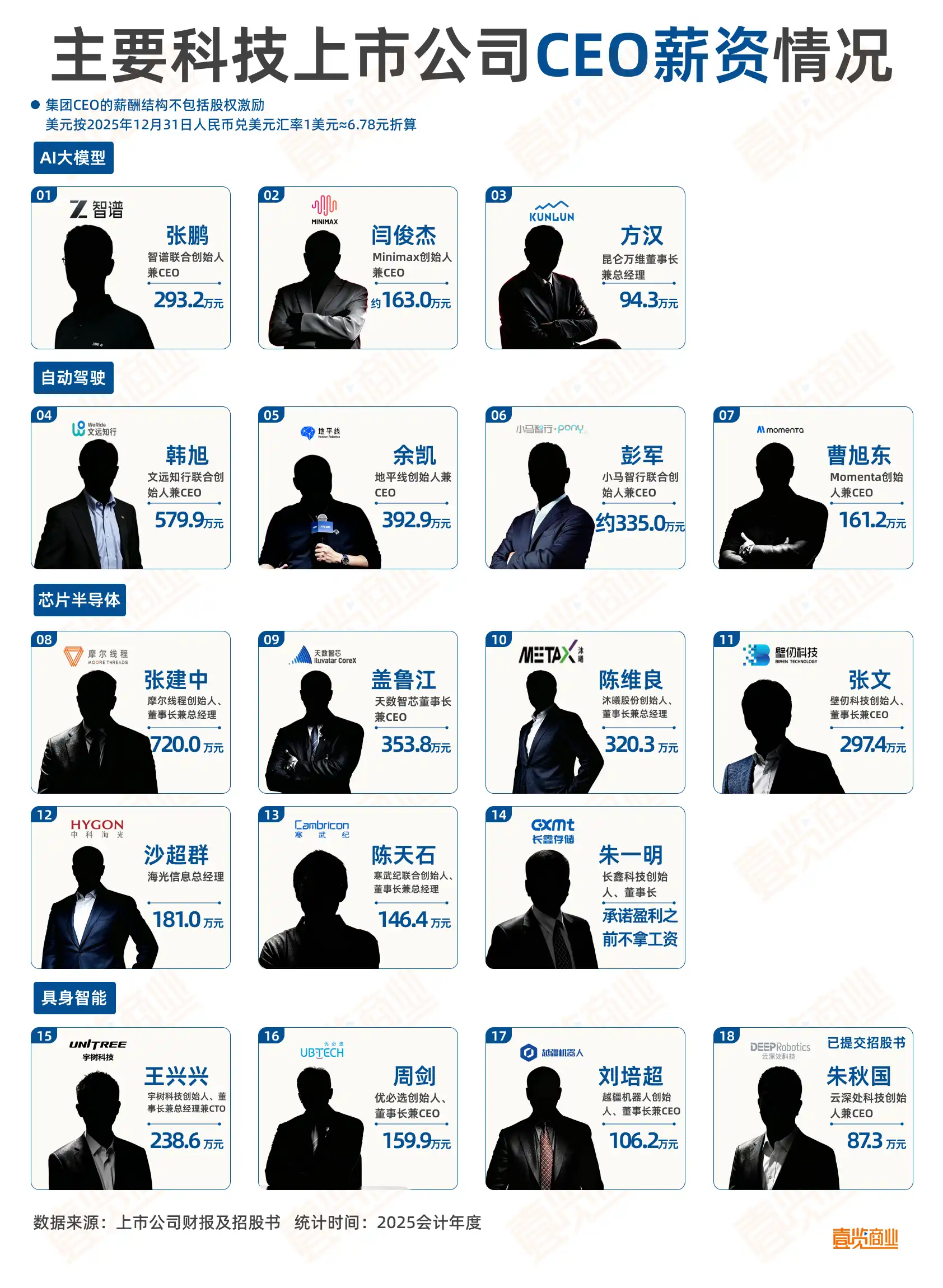
Across the 18 companies, CEO pay showed a clear tiered distribution. Two CEOs earned more than RMB 5 million a year, four fell in the RMB 3 million to RMB 5 million range, nine were between RMB 1 million and RMB 3 million, and three were below RMB 1 million. The average annual salary was RMB 2.572 million, while the median was RMB 2.098 million. Using 250 working days a year, the average daily pay comes to about RMB 10,000.
Autonomous driving led on average pay, while semiconductors showed the biggest spread
By sector, autonomous driving companies had the highest average CEO salary at RMB 3.673 million. Semiconductors followed at RMB 3.365 million after excluding the special case of Zhu Yiming. AI large language model companies averaged RMB 1.835 million, and embodied intelligence companies averaged RMB 1.48 million.
Semiconductors had the widest internal gap. Moore Threads founder Zhang Jianzhong ranked first among all 18 companies with annual pay of RMB 7.2 million, about 1.2 times the compensation of second-ranked Han Xu of WeRide. At the other end, ChangXin Memory Technologies founder Zhu Yiming pledged not to take a salary before the company became profitable, making him the only zero-salary CEO in the sample.
The article also noted that MiniMax founder Yan Junjie publicly said in July 2026 that he would not take any compensation before the company achieves AGI. If AGI is not reached earlier, he would likely join the zero-salary group in 2027.
The contrast between Zhang and Zhu reflects different founder incentive choices. Moore Threads is in a phase of pushing toward the capital markets while accelerating product iteration and commercial expansion, so Zhang’s cash compensation reflects both management responsibility and industry experience, as well as the company’s emphasis on keeping its core leadership team stable. ChangXin, by contrast, operates in the memory chip business, a capital-intensive sector with long cycles and heavy upfront investment. Before profitability, Zhu chose to forgo cash pay and tie more of his return to long-term development and equity appreciation.
That decision had begun to pay off by the first half of 2026, according to the article. ChangXin reported revenue of RMB 150.31 billion, up 873.6% year over year, and net profit attributable to shareholders of RMB 77.61 billion, fully reversing losses and becoming a domestic leader in memory chips.
Autonomous driving showed a different pattern. CEO pay there was concentrated at the high end: Han Xu of WeRide earned RMB 5.799 million, Yu Kai of Horizon Robotics earned RMB 3.929 million, and Peng Jun of Pony.ai earned about RMB 3.35 million. Those figures ranked second, third, and fifth among the 18 companies. Momenta’s Cao Xudong, at RMB 1.612 million, stood well below other CEOs in the same segment.
AI large language model companies were the most balanced group, with average CEO pay of RMB 1.835 million. The article said this runs against the outside perception of the sector as one defined by heavy spending and aggressive pay packages. In practice, major costs at model companies are concentrated in compute infrastructure and research talent, leaving CEO cash compensation as a relatively small share of total spending. When founders also hold meaningful equity, long-term returns do not need to be expressed through high salaries.
Embodied intelligence companies had the lowest average CEO pay at RMB 1.48 million. Zhu Qiuguo of DEEP Robotics earned RMB 872,900, the lowest figure in the group apart from Zhu Yiming’s zero salary. Compared with semiconductor companies that already have more mature revenue models, embodied intelligence firms are still balancing product validation, capacity building, and scenario expansion, which leaves less room for high management cash compensation.
Employee pay showed the biggest internal gap in autonomous driving
If CEO pay reflects board-level incentive design, average employee compensation gives a clearer view of how much companies are actually spending in the talent war.
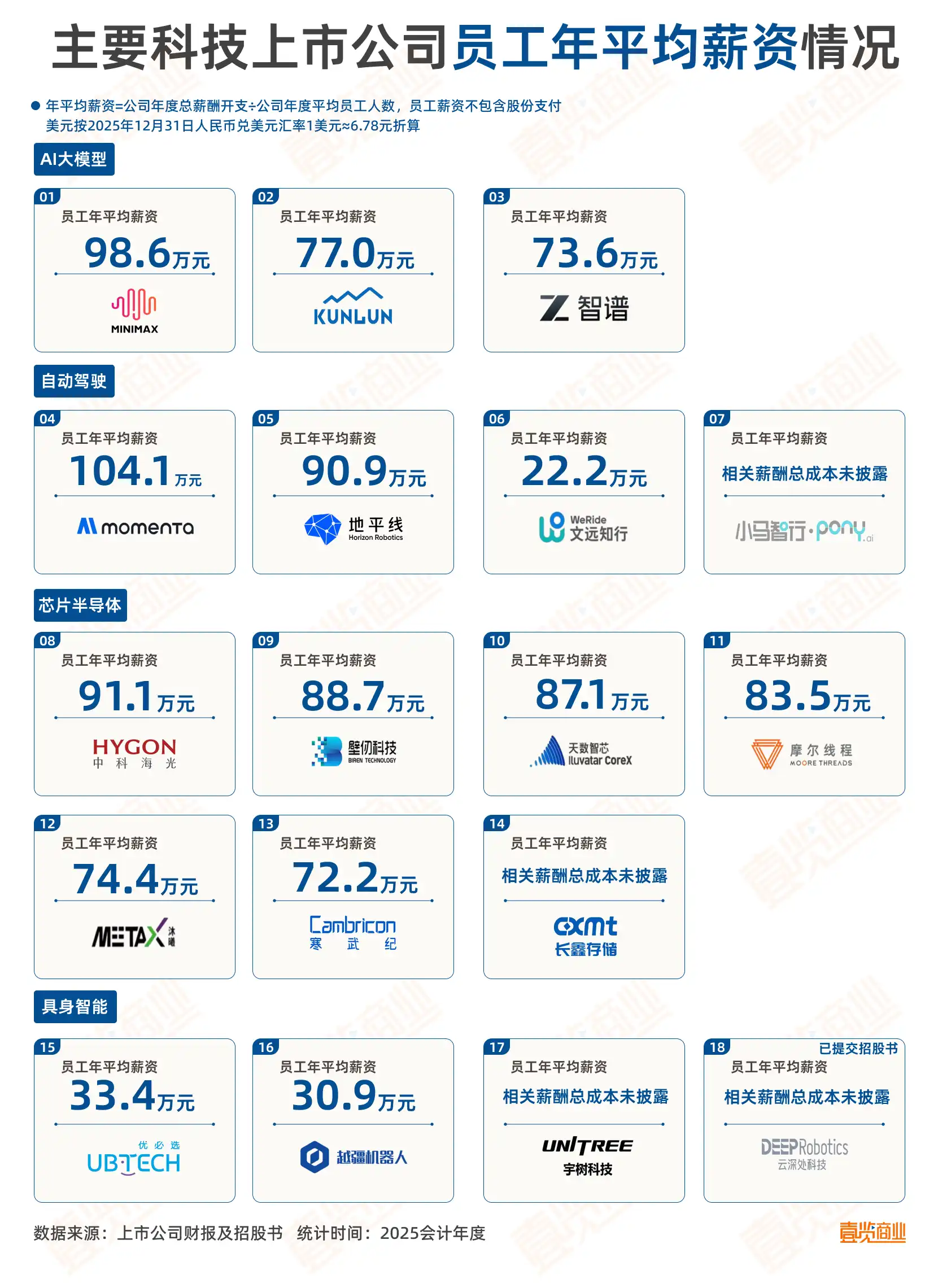
Among the 14 companies that disclosed the data, average employee pay varied sharply. Both extremes were in autonomous driving: Momenta was highest at RMB 1.041 million per employee, while WeRide was lowest at just RMB 222,000. Excluding four companies with incomplete disclosure, the median average employee salary across the 14 companies was about RMB 803,000.
The other three sectors were much tighter. Internal differences were RMB 250,000 in AI large language models, RMB 189,000 in semiconductors, and RMB 25,000 in embodied intelligence. Autonomous driving alone showed a gap of RMB 819,000, nearly a fivefold spread and far wider than the others.
The article tied that gap to different stages of commercialization. Momenta has pursued a mass-production intelligent driving route and works closely with automakers. By the end of 2025, more than 680,000 production vehicles were equipped with Momenta systems. Full-year revenue reached RMB 2.413 billion, with licensing income accounting for more than 40%, giving the company more room to support higher pay.
WeRide, by contrast, was still in the early stage of Robotaxi commercialization. In 2025, it posted revenue of RMB 685 million, a net loss of RMB 1.655 billion, and R&D spending of RMB 1.4 billion, with revenue still far from covering research costs. Staffing structure mattered as well. WeRide had 3,523 R&D employees, or 92.69% of its total workforce. The article said WeRide’s R&D headcount alone was more than twice Momenta’s entire staff, which significantly diluted average pay per employee.
Another point in the review was that average employee pay in the other three sectors all stood above RMB 700,000, while the two embodied intelligence companies were only a little above RMB 300,000. The article linked that gap to industry maturity. Embodied intelligence remains in a transition from technical validation to scaled commercial use.
Citing Interact Analysis, the article said global humanoid robot output exceeded 20,000 units in 2025, but only about 10% entered real operating environments such as factories and logistics. Most units still went to research, data collection, and entertainment, and that pattern has not fundamentally changed. Assembly lines and delivery also require substantial labor, which dilutes average compensation. By comparison, model and chip companies sell design and algorithms, where marginal costs are much lower.
Most CEO-to-employee pay ratios fell between 1x and 5x
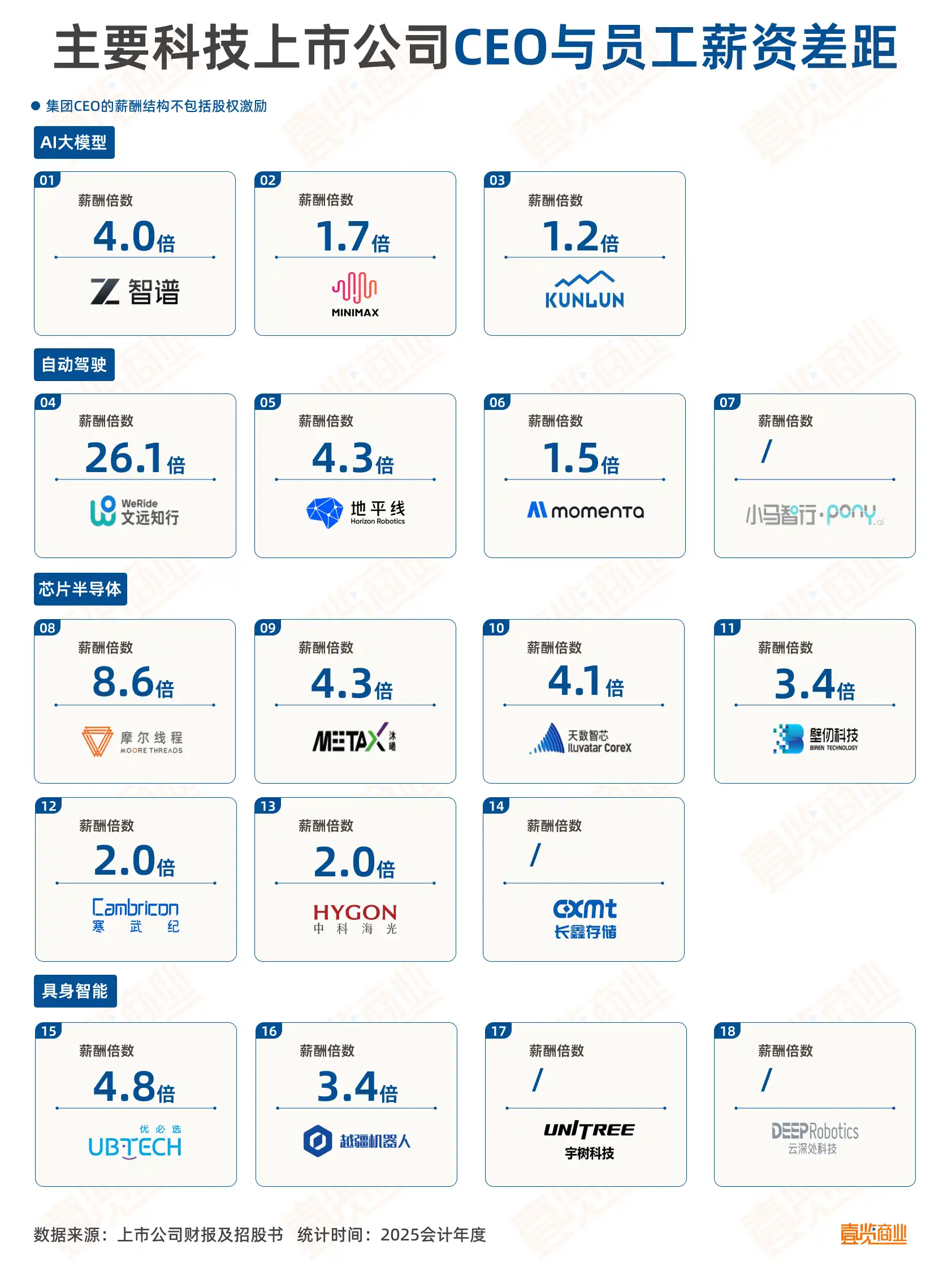
The ratio between CEO pay and employee pay was concentrated overall, though the tail was long. Twelve of the 14 companies with enough data fell between 1x and 5x. WeRide stood far above the rest at 26.1x, more than three times the level of second-ranked Moore Threads and roughly 6x to 20x the level seen at most companies.
Removing WeRide, whose ratio was amplified by low average employee pay, leaves a distribution that the article said better reflects the sector’s general pattern. Average ratios were around 4x in semiconductors and embodied intelligence, about 2.9x in autonomous driving, and about 2.3x in AI large language models.
That suggests that after excluding outliers, the cash pay gap between CEOs and employees at hard-tech companies remains relatively contained. Across semiconductors, autonomous driving, AI large language models, and embodied intelligence, sector averages all stayed within the 1x to 5x range.
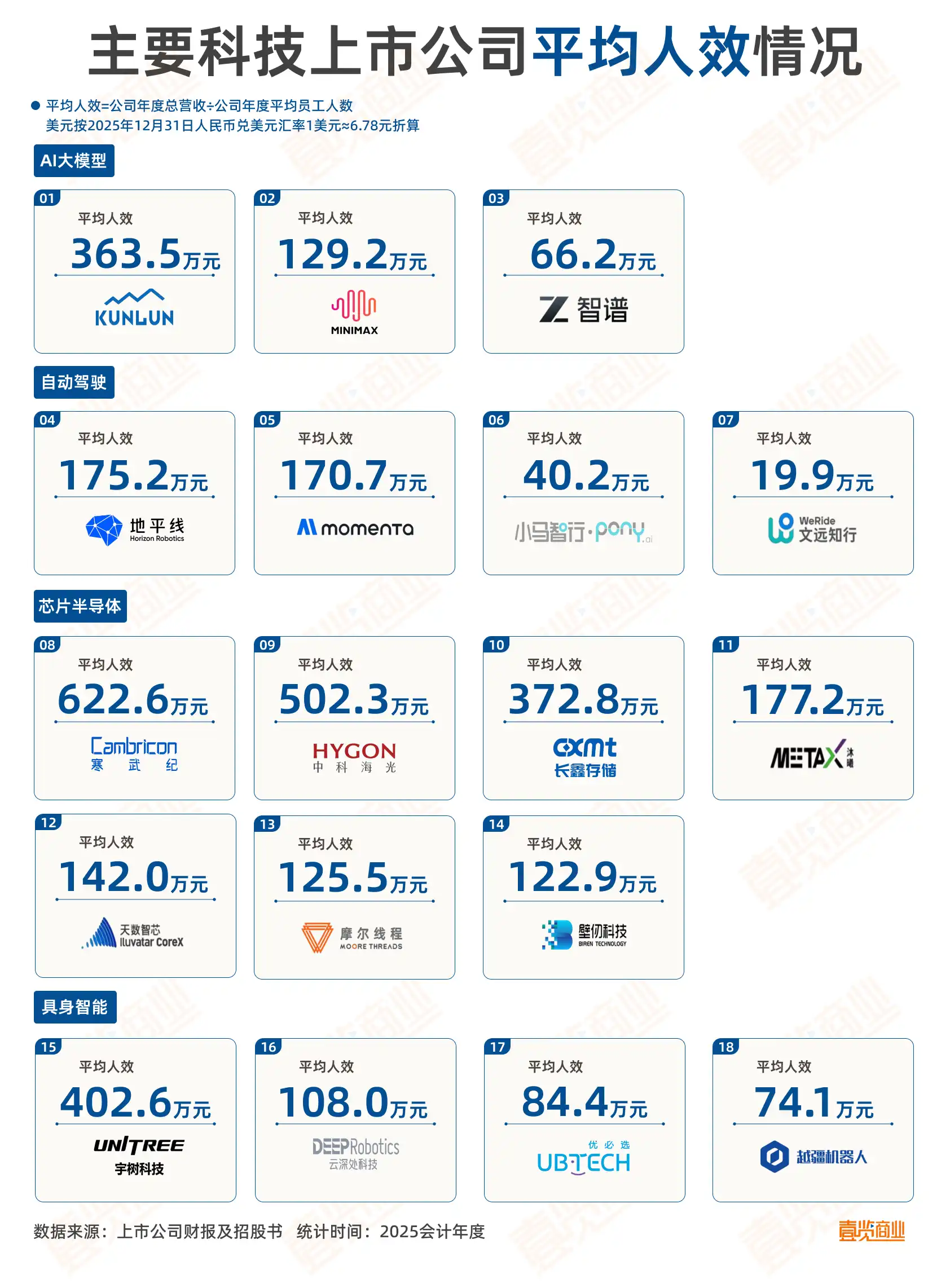
Revenue per employee ranged from Cambricon at the top to WeRide at the bottom
Beyond salaries, the article looked at revenue per employee as a measure of productivity.
Across the 18 companies, the spread was wide. Cambricon ranked first at RMB 6.226 million per employee, while WeRide was lowest at RMB 199,000. The gap between the two was more than 31 times, and the overall median was about RMB 1.36 million.
Cambricon’s result was driven by a sharp revenue increase in 2025. The company’s revenue rose by more than 450% year over year, while total headcount increased by only 127, sharply lifting revenue per employee.
The article said productivity is shaped not only by hiring and revenue timing but also by business model. Chip companies sell design, and once tape-out succeeds, marginal costs are low. Autonomous driving companies are still selling a future vision, with heavy R&D spending and revenue lagging behind, so many highly paid engineers have not yet translated into scaled income. AI large language models and embodied intelligence sit between those two poles, with wide internal differences that reflect uneven commercialization progress.
One of the more striking findings was that autonomous driving had the highest average CEO cash compensation among the four sectors, but the lowest average productivity. The article suggested that when commercialization is not yet proven and technical routes are still shifting quickly, retaining founders who combine technical depth with fundraising ability may be one of the highest-priority expenses.
Founder wealth was driven more by equity pricing than by salary
Founders in hard tech generally carried substantial paper wealth. Among the 14 companies that disclosed equity value, the median was about RMB 8.2 billion. The highest figure belonged to Cambricon founder Chen Tianshi at RMB 185.91 billion, placing him at the top end of the hard-tech field.
The article argued that the logic behind founder wealth in technology differs from that of traditional industries. In older sectors, wealth often comes from profit distributions and asset appreciation. In hard tech, equity value is more closely tied to how capital markets price the future. A chip company may still be unprofitable, but if its technical path is recognized, valuation can be realized ahead of earnings.
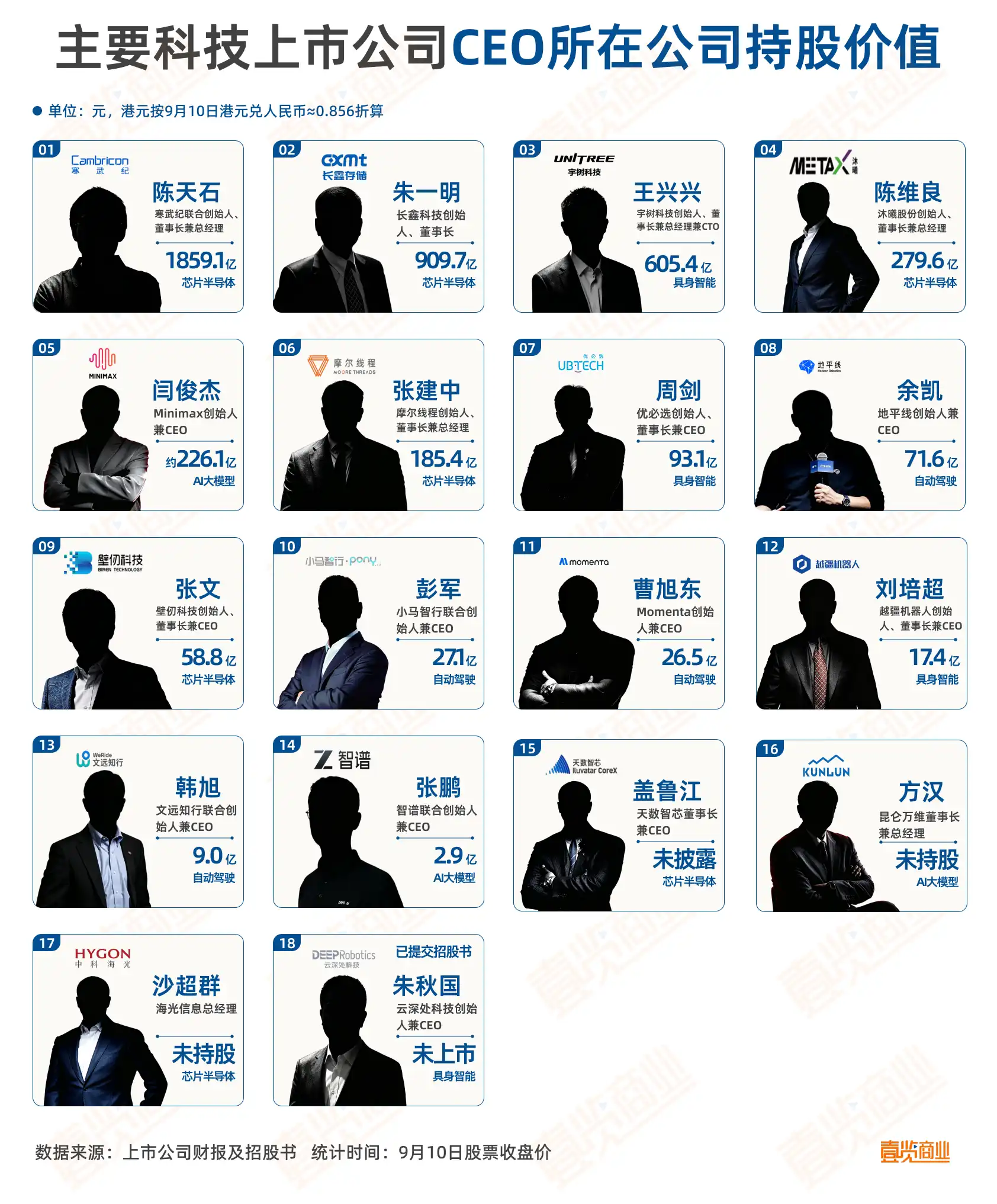
That logic, the article said, rests on the market’s willingness to pay for future possibilities. AI, autonomous driving, semiconductors, and embodied intelligence all carry a large narrative premium, with investors assigning value to technological change before it fully arrives.
The semiconductor sector showed this most clearly. Chen Tianshi’s equity value of RMB 185.91 billion was far ahead of the field and twice that of second-ranked Zhu Yiming of ChangXin. As the first listed domestic AI chip company, Cambricon has seen its share price continue to rise, and Chen’s large ownership stake has lifted his paper wealth with it.
This also helps explain why CEO cash compensation often does not move in step with equity value. Zhang Jianzhong of Moore Threads ranked first in cash pay at RMB 7.2 million, but his equity value was about RMB 18.54 billion. Chen Tianshi of Cambricon earned only RMB 1.464 million in cash compensation, yet his equity value reached RMB 185.91 billion. The mismatch between salary and equity is a typical feature of founder incentives in hard tech: some founders are willing to give up current cash pay in exchange for long-term equity appreciation.
The article ended with a caution that capital’s patience has limits. The future of hard-tech companies will still be judged by commercialization. As Robotaxi, embodied intelligence, and large language model companies move deeper into validation, valuations for businesses that cannot turn narrative into revenue and profit will eventually become more rational.
Whether founders can realize the value of their holdings will depend on whether their companies can establish workable business models. At the same time, the article said, compensation systems that retain core talent without sacrificing long-term interests will be critical for hard-tech companies trying to ride out industry cycles.
The original piece was published by the WeChat account Weilai Kejijie Plus and credited to writer Zhang Yongkun and editor Li Yan.