
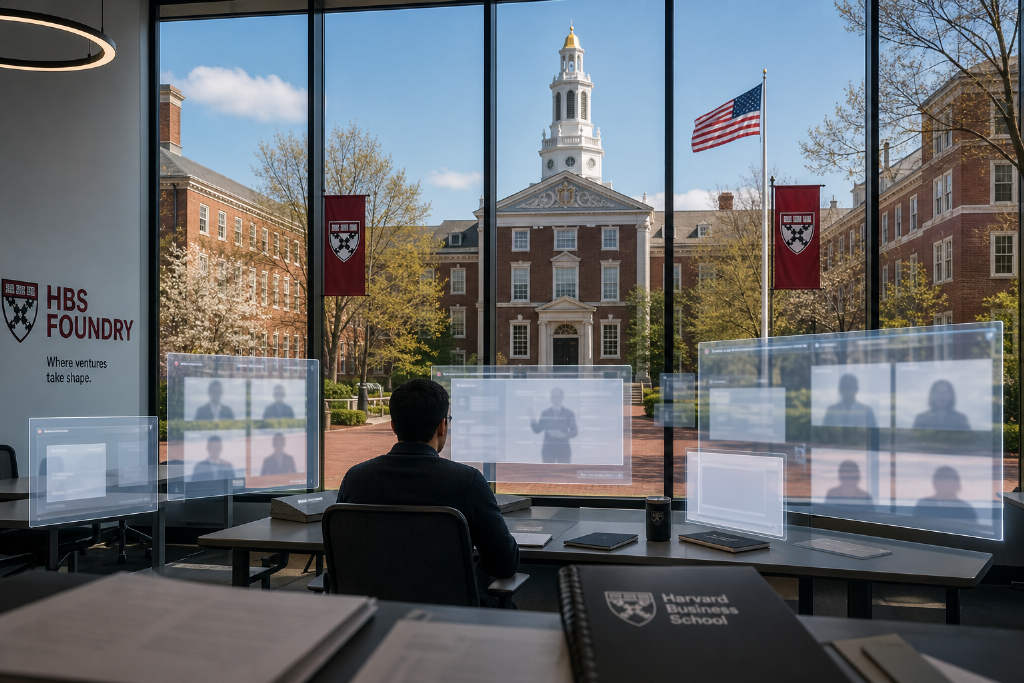
Harvard Business School is selling an eight-week startup training program built around AI versions of seven faculty members, giving entrepreneurs a round-the-clock practice partner for $699.
The price is a small fraction of Harvard Business School's $84,000 annual tuition, but the product is designed to offer something different: unlimited repetitions of high-stakes startup practice without the time limits of a human instructor.
An HBS Foundry program built for repeat practice
The bootcamp sits under HBS Foundry, which Harvard describes as an "AI-native digital workspace." Before meeting real investors, founders can use the AI faculty avatars to rehearse fundraising pitches, sales calls, and board presentations as often as they want.
The currently open cohort gives participants a chance to compete for a $100,000 investment at the end of the program. So far, 760 entrepreneurs have joined, according to the report.
Seven AI faculty avatars across venture and startup disciplines
The seven avatars cover venture capital, business model design, board governance, and startup strategy. One of them is Jeff Bussgang, co-founder of Flybridge Capital and a senior lecturer at Harvard Business School.
The project began in 2024. At first, the team planned to make it more like a text adviser similar to ChatGPT. After a trial run in October 2025, it rebuilt the system based on user feedback and shifted to structured simulation-style conversations. The program officially launched in April this year.
During its pilot phase, the system reached students across all 50 U.S. states and at more than 100 universities.
Created with HeyGen and authorized by the professors
The avatars' video was produced by generative video startup HeyGen. Their voices and appearances were recorded with the professors' authorization.
Kat Rings, director of Foundry, told Fortune that the idea for the AI experience came from entrepreneurs themselves. She said the goal was to make sure founders were challenged and had already practiced before meeting mentors and investors, so those real conversations could focus on the questions that matter most.
Harvard also said the bootcamp does not count toward a degree and does not carry academic credit. Its aim is to extend startup support to people who may never set foot on Harvard's campus or gain access to top innovation networks.
Designed to push back, not just agree
The AI clones were intentionally tuned to be demanding rather than agreeable. The report says very few startup ideas clear the bar on the first try. Instead, the avatars question assumptions, point out weak spots, and force founders to tighten their logic, much like a strict professor would.
Shikhar Ghosh, one of the professors turned into an AI avatar, told Fortune that the goal was never to replace him. He said the point was to give entrepreneurs another channel to refine their ideas first, so in-person time could be reserved for issues that genuinely require human judgment and conversation.
What AI can do, and what it cannot
The report also points to clear limits. AI can copy the repeatable parts of a professor's work, such as answering the same question endlessly or explaining the same concept in different ways. It cannot truly know a student.
Kian Katanforoosh, a Stanford lecturer and founder of AI skills platform Workera, told Fortune that human professors can spot student potential through years of interaction, encourage them, and even make introductions. "AI can simulate some behaviors, but today it can't put its own reputation on the line, and it doesn't actually care about what happens next," he said.
Lindsay Tanne Howe, founder of LogicPrep, said AI may be able to scale a professor's knowledge, perspective, and even judgment, but it cannot reproduce everything that happens between people.
A broader question for higher education
The story raises a question Harvard did not directly answer: if schools use AI to scale scarce faculty resources, at what point does that efficiency start to cut into what students are really paying for.
The report notes that some college students have already complained that professors outsource lesson preparation and grading to AI. Harvard's approach, at minimum, puts the practice in the open and sells it as a stated product rather than using it behind closed doors. If the model proves effective, the question is whether other schools will follow and turn similar practices into formal offerings of their own.