

HashKey Group brought multiple business lines to WebX Tokyo 2026 and held two side events in succession, one aimed at institutions and the other at developers, as it expanded its on-chain finance push in Japan.
Institutional forum centered on on-chain finance infrastructure in Japan
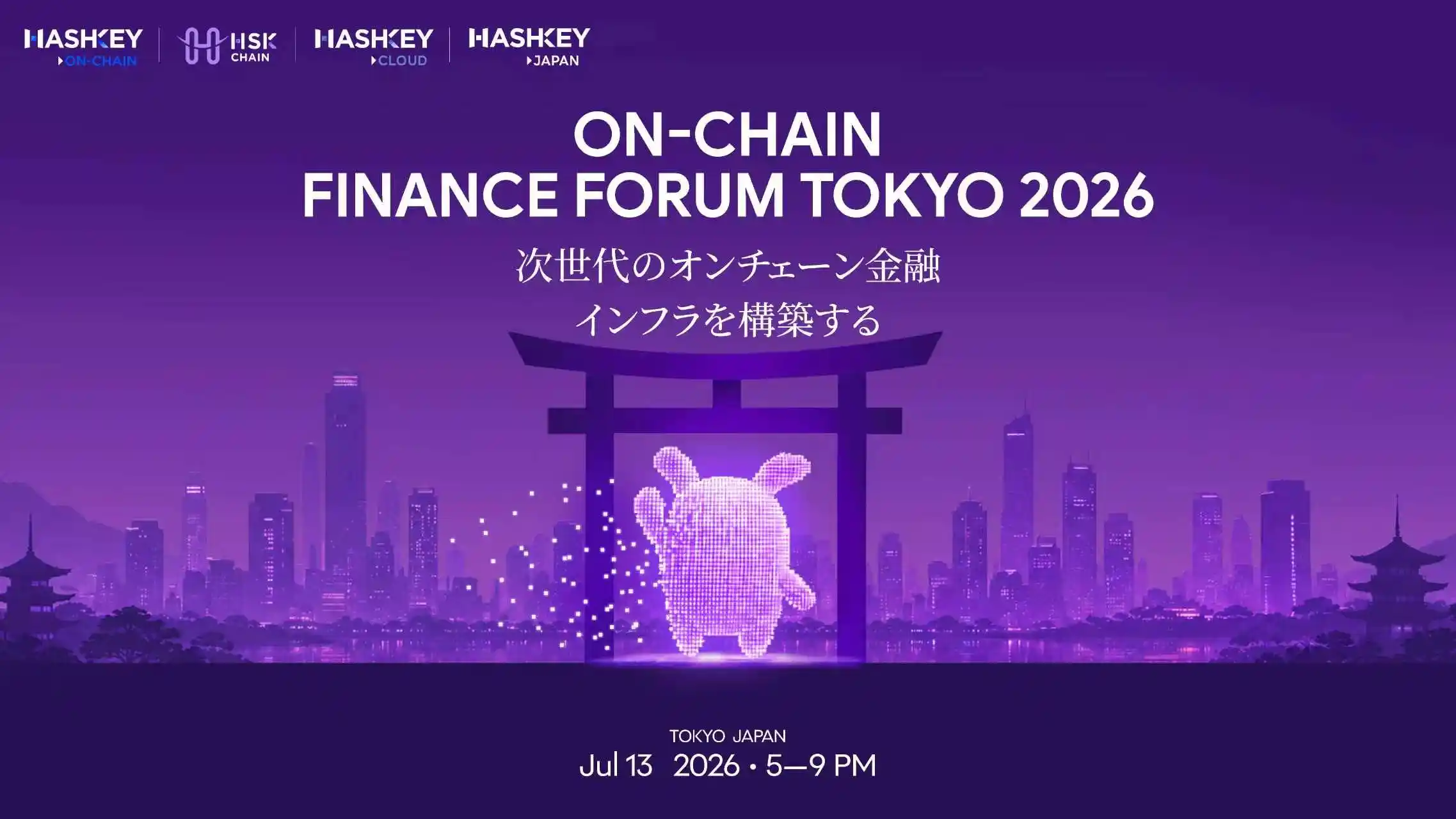
HashKey hosted the On-Chain Finance Forum Tokyo, which drew more than 100 attendees including representatives from financial institutions, blockchain projects, institutional investors, and local Web3 practitioners.
Leo Li, CEO of HashKey On-Chain, delivered the opening remarks. Rachel Qiu, head of BD at HashKey Group and COO of HashKey On-Chain, presented under the title “Building On-Chain Financial Infrastructure” and laid out HashKey On-Chain’s overall path for serving institutions. Serena Wang, head of HSK Eco Labs, spoke on “From CeDeFi to the Future,” focusing on how HashKey Chain approaches the future of on-chain finance. Matthew Dawson, head of enterprise partnerships at the Ethereum Foundation, discussed institutional adoption of Ethereum and offered an external point of reference for the forum.
The event also highlighted the newly released HSK 2.0 white paper. According to the article, the paper sets out the core path and technical direction for HashKey Chain’s institutional-grade on-chain finance strategy.
Two panel sessions examined key institutional themes
The forum’s panel discussions focused on two main topics.
- Panel 1, titled “Bridging RWA and On-Chain Liquidity,” brought together representatives from Ondo Finance, Asseto, DigiFT, and Compound Foundation to discuss new institutional finance models built around the integration of real-world assets and on-chain liquidity.
- Panel 2, titled “The Institutional Yield Stack: Where TradFi Meets On-chain Finance,” featured representatives from Franklin Templeton Japan, OKJ, BitGo, and Babylon, with discussion centered on how traditional financial institutions are approaching on-chain yield and where they see market opportunities.
HashKey executives from several business lines also met with local partners and potential clients in Japan to discuss possible next steps for cooperation.
Hackathon Demo Day focused on AI and DeFi use cases on-chain
The Japan Horizon hackathon, hosted by HSK Chain and co-organized by FEB Event and AKINDO, reached its final presentation stage after nearly a month of selection.
The Demo Day included finalist pitches and two panel discussions. The first asked whether on-chain finance can become “financial infrastructure that is truly used,” covering stablecoins, banking UX, and public-chain deployment while discussing regulation, compliance, user experience, and institutional coordination. The second looked at user boundaries for Web3 products in the AI Agent era, including the degree of automation in on-chain execution, trust mechanisms for users, and design directions for AI-native products.
Developers, investment institutions, and ecosystem partners from Japan and across Asia attended the finalist presentations. They engaged shortlisted teams in detailed exchanges on technical routes, commercial potential, and ecosystem collaboration, which the article said laid the groundwork for future resource matching and ecosystem support.
From WebX to the Japanese market
The article said the back-to-back events show further execution of HashKey Group’s Japan strategy. It described Japan as one of the world’s more mature crypto markets in terms of compliant regulation and said the country is entering a new acceleration cycle for institutional Web3 applications. Through the institutional forum and the developer hackathon, HashKey is presented as pursuing both tracks at once: offering on-chain infrastructure solutions to traditional financial institutions in Japan while also engaging the local developer community and building an on-chain ecosystem that runs from protocol layer to application layer.
About HSK Chain
HSK Chain is described as on-chain financial infrastructure powered by HashKey, whose stock code is 3887.HK. The project says it is focused on reshaping global financial markets on-chain, with trust and innovation as defining features, so that stablecoins, real-world assets, and institutional-grade DeFi can operate together within one system.