

A new platform called Havenex moved into focus on Aug. 26 after Mysten Labs co-founder Kostas Kryptos said it is nearing completion of its Series A round and has already entered the authorization process with Austria’s Financial Market Authority, or FMA.
The market’s first reaction was to frame the project as a move by a Sui co-founder into the exchange business. The positioning described by Kryptos points somewhere else. Havenex is aiming at institutional digital asset infrastructure rather than a direct fight for retail trading users.
According to Kryptos, the funding round is already tight. He said Havenex does not want to become the next Coinbase or Binance. Its target is to act as a digital asset infrastructure provider behind fintech companies, banks, asset managers, and family offices.
That pitch comes as the upside in the retail trading market becomes harder to expand and traditional financial institutions accelerate their entry into digital assets. Compliance-focused infrastructure for institutions is starting to look like a new growth segment.
A backend model instead of a retail exchange push
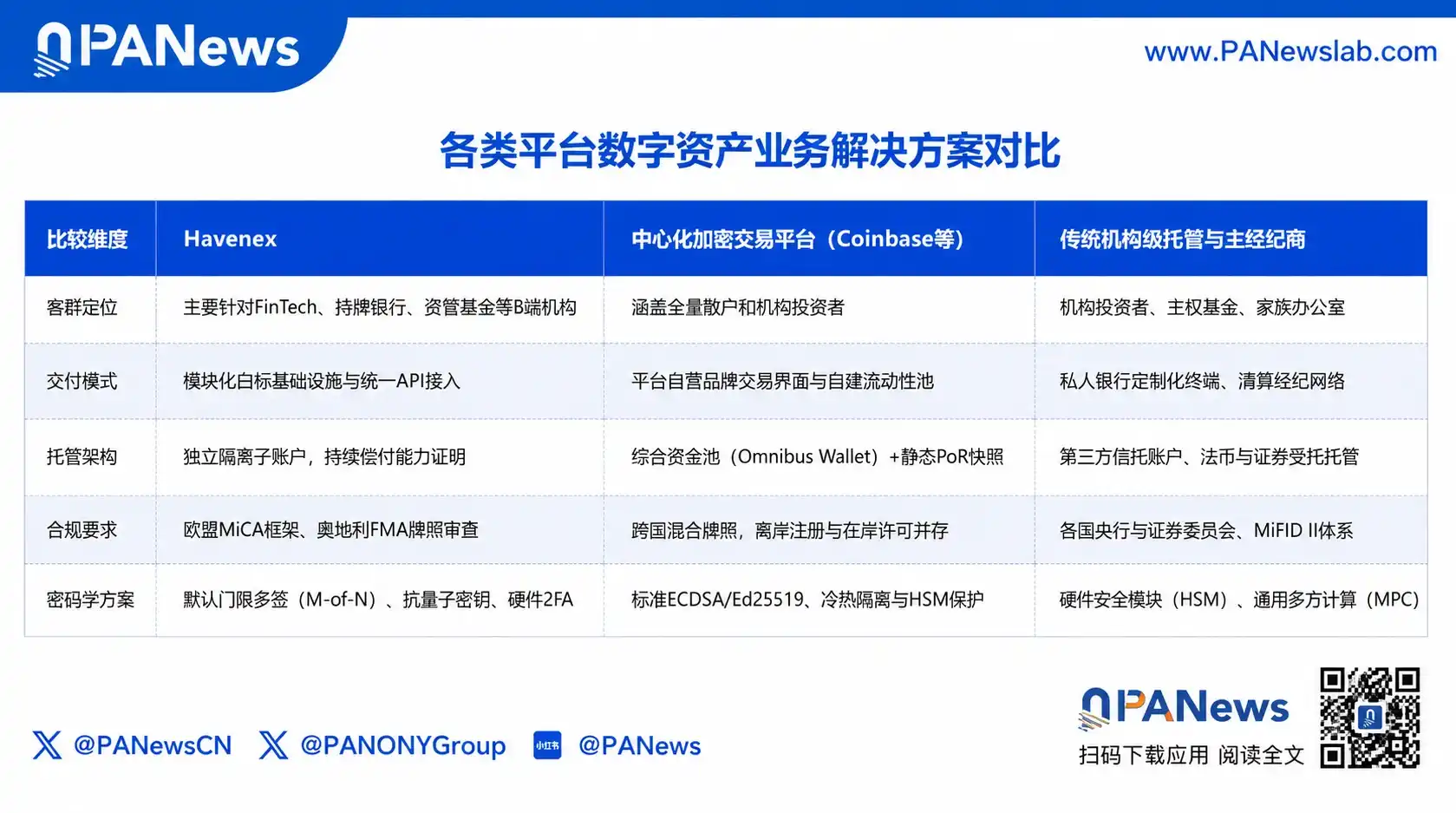
The easiest mistake is to treat Havenex as another crypto exchange. Its stated model differs from platforms such as Coinbase and Kraken.
Large exchanges usually follow a retail strategy: build a consumer brand, gather liquidity from individual traders, offer a wide range of products, and keep users and assets inside their own systems. Havenex is targeting the business-to-business side. It does not need to win end users directly if it can supply the underlying rails to fintech firms, banks, and asset managers.
Under that model, institutions keep their own brands while offering digital asset services to clients. Havenex would handle the underlying wallet layer, custody, trading, compliance, and risk management.
The positioning addresses a real bottleneck for traditional financial institutions. Interest in digital asset services has kept rising among banks, brokerages, and asset managers, but building the full stack internally is expensive and slow. Wallet management, custody architecture, compliance processes, risk controls, and jurisdiction-specific regulatory adaptation each require meaningful investment and long lead times. For many mid-sized institutions, building from scratch is neither economical nor practical.
Havenex’s approach is to standardize those capabilities, turn them into products, and expose them through a single interface so institutions do not have to rebuild the same systems on their own.
There is still a hard problem. Trading and brokerage businesses come with network effects. Liquidity depth, market-making resources, and asset coverage can strongly influence whether clients are willing to use a new platform. For Havenex, that remains a major challenge.
Compliance first, with security and transparency as differentiators
In Havenex’s business logic, compliance is not a bonus feature. It is the entry ticket.
The choice of Austria and the FMA authorization path reflects the post-MiCA setup in Europe. The Markets in Crypto-Assets regulation created a unified framework for crypto asset service providers across the European Union. The article notes that Austria’s FMA has been one of the faster regulators in Europe on approvals: by the end of last year it had authorized eight crypto asset service providers, and that number has risen to nine this year.
Approval alone does not settle the issue. Regulatory action by the FMA against KuCoin EU Exchange since February shows that even with MiCA authorization, business can still face restrictions if governance, anti-money laundering arrangements, or key management functions fall short.
For Havenex, applying for a license is only the first step. The bigger test is whether it can build a governance framework that satisfies regulatory standards and clear the due diligence reviews required by banks and other institutions before making it onto approved vendor lists.
This is a slow business. It does not break open through traffic or hype alone.
Security and transparency form another part of Havenex’s pitch.
The company’s supervisory board includes two Mysten Labs co-founders: Kostas Kryptos and Adeniyi Abiodun. Kryptos serves as chief cryptographer at Mysten Labs and has a background in cryptography and blockchain security research linked to Meta’s Libra project. Abiodun is Mysten Labs’ chief product officer. He led product design for Meta Novi and also built product management experience at Oracle and VMware. Based on the information disclosed, those backgrounds give Havenex some technical credibility.
Havenex is highlighting verifiable custody, continuous proof of solvency, default multisig, quantum-resistant keys, hardware-based 2FA, self-custody support, and mechanisms for key-loss protection.
Continuous proof of solvency stands out. After the collapse of FTX, reserve transparency at centralized exchanges became a persistent concern. Standard proof-of-assets disclosures are periodic. Havenex wants solvency verification to operate on a continuous basis. If implemented as described, that could reduce counterparty risk for institutional clients.
For now, the roadmap remains at the product design and technical target stage. It has not yet been tested through independent audits or large-scale live business. How much institutional trust Havenex can win may depend on whether it later discloses its proof mechanisms, audit standards, and operating data.
Connected to Sui, but not exclusive to Sui
Another point of debate is Havenex’s relationship with the Sui ecosystem. The market has leaned toward describing it as a Sui-aligned exchange, but the facts disclosed so far suggest a different picture.
Kryptos and Abiodun sit on Havenex’s supervisory board, yet their main roles remain at Mysten Labs and Sui. On the technical side, Kryptos said Havenex will use Sui technology where it fits, while also integrating assets, cross-chain protocols, and infrastructure from other blockchain ecosystems.
That makes Havenex a multi-chain infrastructure play rather than a platform built exclusively for Sui.
From an institutional perspective, that is the more practical setup. Traditional financial institutions choose service providers based on capability, compliance, and stability. They are unlikely to move all assets and business onto one chain simply because a vendor’s stack is rooted there. Multi-chain compatibility is closer to a requirement than a bonus in this segment.
If Havenex eventually secures regulatory approval and wins institutional adoption, the implications for Sui could go beyond a standard ecosystem application. It could become an entry point for Sui technology into traditional financial institutions through the supplier layer.
That remains a forward-looking possibility, not evidence of immediate growth for the Sui ecosystem today.
The competitive checklist is changing
For more than a decade, infrastructure providers in crypto competed mainly on liquidity, token coverage, product range, and user scale. As traditional financial institutions become a larger source of new demand, custody, compliance, asset segregation, risk management, and cross-chain security are moving higher on the list.
The firms that can serve institutions behind the scenes may be the ones that shape the next phase of growth.
That does not make Havenex an easy bet. Compliance processes move slowly. Client acquisition cycles are long. In infrastructure, stability, security, and trust matter more than short bursts of expansion. The outcome will likely hinge on the speed of licensing, whether Havenex can land its first institutional clients, and whether its live business can validate the model.