
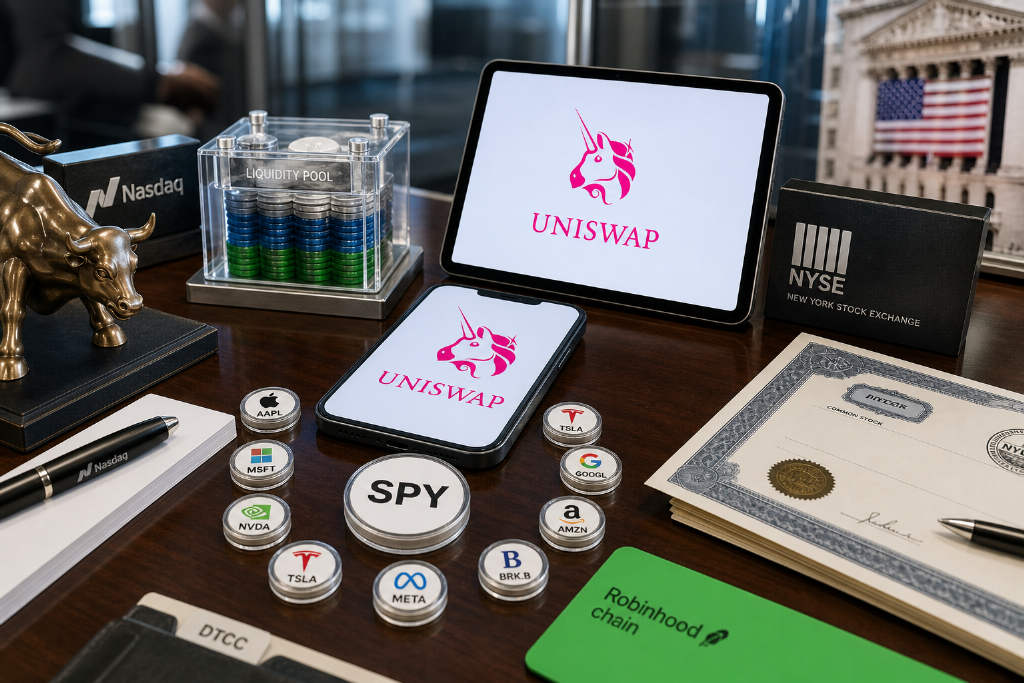
Uniswap founder Hayden Adams said the path for automated market makers to become a core engine of global financial markets is becoming clearer after nine years of DeFi.
Tokenization changes market making and what gets traded
Adams wrote that tokenization is more than an infrastructure upgrade. It also changes who makes markets and what assets the market trades. He added that the U.S. Securities and Exchange Commission has approved Nasdaq and the New York Stock Exchange to trade tokenized stocks, and that the Depository Trust & Clearing Corporation conducted a live tokenized trading test in July.
Blockchain breaks apart the traditional market-making stack
According to Adams, traditional market makers vertically integrate capital, strategy, execution, settlement and distribution, which makes the model expensive. Blockchains separate those functions and leave capital as the scarce input. He argued that if liquidity providers already hold the relevant assets, or if they are the issuers themselves, they can take on inventory exposure at zero cost and compete with professional market makers with a lower cost of capital.
Correlated asset pairs have formed onchain
Adams said onchain markets have naturally developed a model built around correlated asset pairs, such as Ethereum ecosystem assets against ETH and stablecoin pairs. He said that correlation can reduce inventory risk and help deepen liquidity.
Robinhood Chain example and Uniswap’s current scale
As an example, Adams said Robinhood Chain already has 10 tokenized stocks paired with SPY in Uniswap pools. In the first 12 days after launch, those pools generated about $33 million in trading volume, with some trades taking place directly between stocks without touching the dollar.
He added that while Uniswap’s cumulative trading volume has reached about $4.6 trillion, AMMs are still at an early stage, with substantial room left for design and ecosystem improvement.