
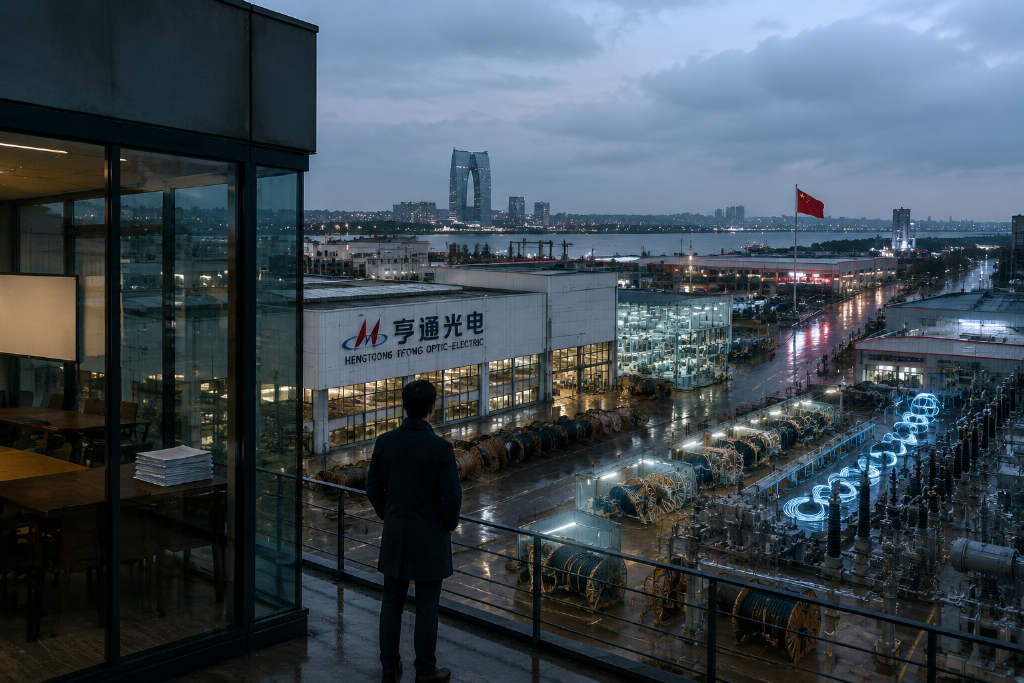
Hengtong Optic-Electric slammed into its daily limit down on Sept. 28.
Just four days before that, on the night of Sept. 24, the company unveiled a private placement plan to raise RMB 6.636 billion, together with an employee stock ownership plan. Trading resumed on Monday after the Mid-Autumn Festival holiday, and the stock finished at RMB 60.64, erasing RMB 16.6 billion in market value in a single session. The drop did not stay isolated. Yangtze Optical Fibre and Cable Joint Stock Ltd. (YOFC), TDG Holding, and Huamai Technology all fell as well. By Sept. 29, pressure was still hanging over the optical communications group, with the sector index probing support near 3,800 points.
At one stage this year, the stock had climbed more than 400%. After that limit-down hit, the issue got pretty blunt: what, exactly, is the market buying when it gives Hengtong a valuation of about 49 times earnings?
Revenue still looks old-school, but profit is coming from somewhere else
Start with the business mix. Hengtong, founded in Wujiang, Jiangsu, has been in fiber and cable for three decades and went public on the A-share market in 2011. Even so, its financial statements do not really line up with the market’s image of it as a pure optical communications leader or a stand-in for AI infrastructure.
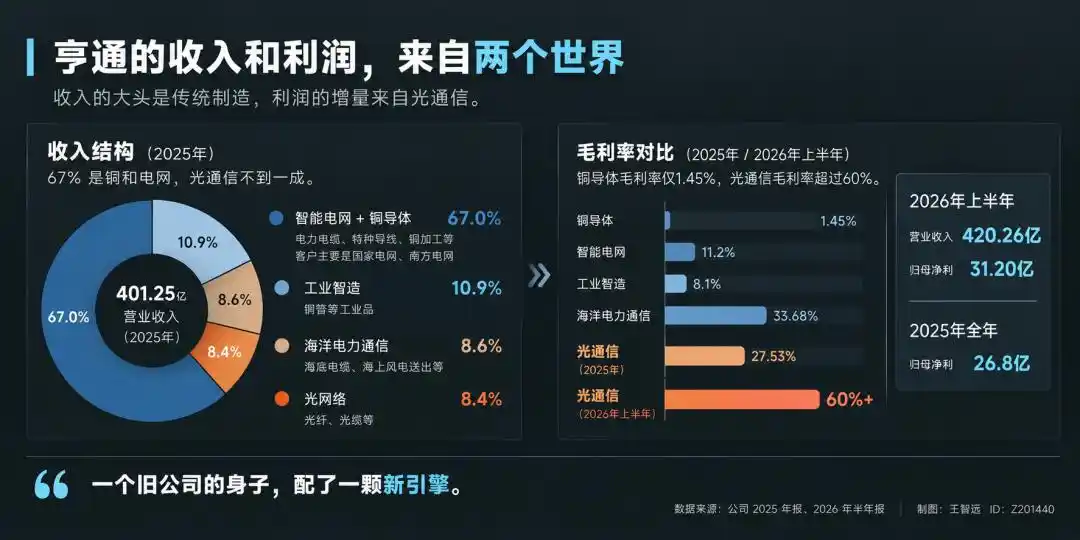
Smart grid and copper conductor operations bring in 67% of revenue. Smart grid contributes 36%, mostly from power cables and specialty conductors sold to customers including State Grid and China Southern Power Grid. Copper conductors account for 31% and are basically described as a processing business: turn copper into wire, collect fees by the ton. Very traditional.
Industrial intelligent manufacturing contributes 10.9%, mainly from industrial products such as copper tubes. Marine power and communications make up 8.6%, including submarine cables, subsea power cables, and offshore wind transmission links. Optical network contributes 8.4%, the piece most investors immediately tie to Hengtong: optical fiber and optical cable. The article says the highest-value part of optical communications is fiber preform, and while Hengtong is present across the chain, the revenue booked under this segment is still not that large.
On the revenue line alone, this still looks a lot like a traditional manufacturer.
But margins tell a much sharper story. Copper conductor gross margin was only 1.45% for full-year 2025. Marine cable gross margin reached 33.68%. Optical communications posted a full-year average gross margin of 27.53%, then leapt to above 60% in the first half of 2026.
That is the split. Revenue and profit are no longer coming from the same places. The businesses generating two-thirds of sales are not the businesses remaking earnings. The much smaller optical communications segment is doing that.
First-half 2026 profit already beat all of 2025
The turn showed up over the last six months.
Back in 2025, Hengtong’s optical communications revenue was still shrinking, down 14.53% year over year. At that point, the market was not treating it like an AI stock, and the company’s own figures did not back that story up either.
Then things changed fast. In the first half of 2026, optical communications revenue surged more than 130% from a year earlier. Over the same stretch, Hengtong posted RMB 42.026 billion in revenue and RMB 3.12 billion in net profit attributable to shareholders. Compare that with full-year 2025 net profit of RMB 2.68 billion. Simple math: the company made more in six months than it made in the entire prior year.
The article’s view is that most of that extra profit came from the optical communications segment, even though it accounted for only 8.4% of revenue. So yes, the company still wears the body of an old-economy manufacturer. But its earnings engine is being rebuilt by optical communications.
Why the market still puts up with a 49x multiple
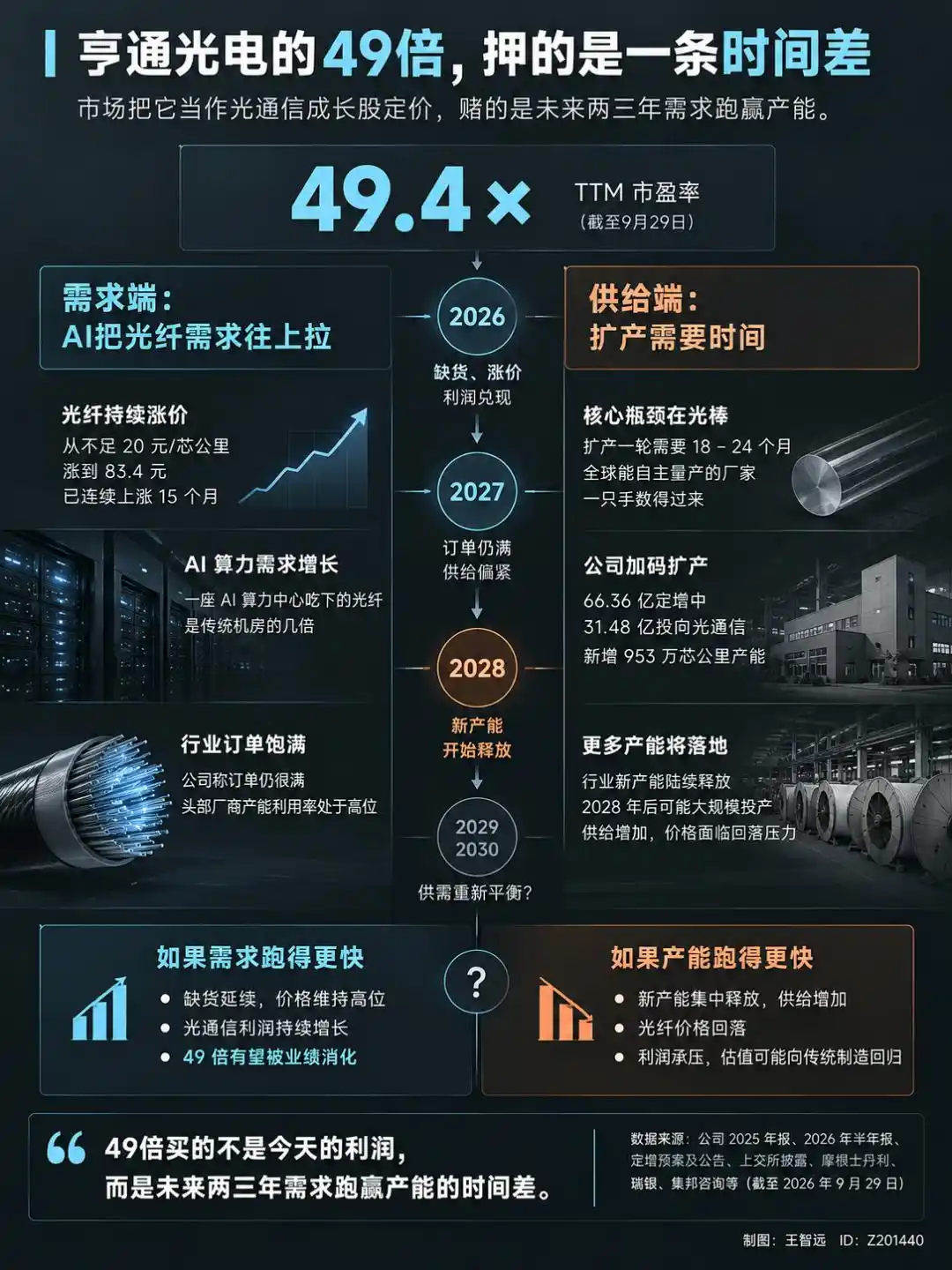
The valuation cited here is about 49 times earnings. That number was anchored to an Aug. 25 reference point, not recalculated after the Sept. 28 limit-down. Since early September, several institutional research notes have kept using that same comparison base, putting trailing twelve-month price-to-earnings at 49.4x and price-to-book at about 5x.
If Hengtong were priced only as a copper processing and smart grid name, that multiple would look rich. The article says businesses like that usually trade around 10x earnings, which would leave 49x at roughly four times the sector norm.
Peer comparisons say much the same thing. Zhongtian Technology, active in the same broad area and with a similar fiber-and-cable business, was trading at 36.2x. That means Hengtong carried a premium of about 35%. UBS, in its first coverage of YOFC this year, gave a buy rating, but its target price worked out to only 16x expected 2027 earnings.
There is, though, another way to look at it. Take the post-limit-down market cap of about RMB 149 billion and annualize first-half net profit of RMB 3.12 billion, and the forward multiple comes out closer to 24x. The article’s argument is that trailing earnings still contain the weak second half of last year, so the market is not measuring Hengtong with the old yardstick alone.
And that gets to the real point: what do investors think they are actually buying?
First prop: fiber prices have been rising for 15 months
The first reason behind the premium is the fiber price cycle.
Fiber prices climbed from below RMB 20 per core-kilometer to as high as RMB 83.4, stretching a rally that has now lasted 15 months. In 2025, fiber was still stuck, prices were hovering near cost, and optical communications revenue dropped 14.53% for the year. Then the reversal came. Fast.
Demand shifted because the buyer mix shifted. China Mobile’s latest bulk procurement round for standard optical cable was priced about 90% above the previous round. Spot prices for specialty fiber jumped 650%. The article also says an AI computing center uses several times more fiber than a traditional data room.
Supply is still boxed in by fiber preform, the raw material used to draw fiber. Adding preform capacity takes 18 to 24 months. The deposition process depends on years of accumulated know-how, and the number of manufacturers worldwide that can independently mass-produce it can be counted on one hand. The last price war knocked out weaker players and left the industry more concentrated. In the article’s framing, every fiber shortage is really a preform shortage. And that bottleneck is not getting fixed anytime soon.
Second prop: the fundraising plan leans hard into optical communications
The second support is where the money is headed.
Under the private placement plan, Hengtong wants to raise RMB 6.636 billion. Of that, five optical communications projects would get RMB 3.148 billion, covering fiber preform, next-generation fiber, advanced optical interconnects for AI, and advanced CPO packaging. Energy interconnection projects would receive RMB 1.498 billion, and the remaining RMB 1.99 billion would go toward replenishing working capital.
The article argues that if you strip out the working-capital piece, optical communications take roughly two-thirds of project spending. The issuance cap is 739 million shares, equal to as much as 30% of the current share base. Read that one way, and the company is not putting fresh chips on copper. It is pushing them toward optical communications.
That matters because it shows where management wants the business mix to head, not just where it sits now.
Third prop: submarine cable scarcity still is not fully showing up in earnings
The article points to one more source of value outside the main optical communications story: submarine cable.
It says only four companies worldwide can build transoceanic submarine optical cable systems: U.S.-based SubCom, Japan’s NEC, France’s ASN, and Hengtong. Hengtong is described as the only Chinese company in that club, with RMB 31 billion in orders on hand.
This business leans heavily on qualifications and delivery records, which makes it hard for newcomers to break in. And the barrier got higher after the U.S. Federal Communications Commission tightened submarine cable regulation in June this year. According to the article, Hengtong Marine Communications operates across 78 countries. It cannot access U.S. landing points, but U.S. buyers still do not have a fifth supplier available, and the new rules have instead raised the cost of submarine cable construction in the United States.
So in that framework, the market is not just paying for optical communications growth. It is also assigning scarcity value to the submarine cable business.
The big variable is how long the fiber upcycle lasts
The article says the 49x logic only holds if the market keeps viewing Hengtong as an optical communications growth stock. If that story cracks, the valuation could drop quickly back toward the copper processing and smart grid world, around 10x earnings.
Which leaves one very plain question: how long can higher fiber prices stay high?
For now, the market seems willing to believe the cycle still has legs. Morgan Stanley, in its Sept. 13, 2026 report titled AI Infrastructure: Materials Supercycle, listed fiber as one of the four scarcest materials in AI infrastructure. The article says global fiber quotations are still rising, and Hengtong’s 400%-plus rally this year reflected that faith.
But that same setup cuts both ways. The stock is highly exposed to any turn in the cycle.
Why the stock still dropped even with strong earnings
The article then shifts to the immediate cause of the selloff. If first-half profit had already beaten full-year 2025, why did the stock still hit limit down?
On the surface, the fundamentals had not fallen apart. The company that dropped on Sept. 28 was the same company that announced the private placement on Sept. 24, and the same company that reported RMB 3.12 billion in first-half net profit, more than double from a year earlier. Management’s message was straightforward: orders were still full, industry capacity utilization remained high, and leading companies in the sector had order books stretching into 2027.
The article’s takeaway is that fundamentals alone do not explain the move. The answer sits more in how the financing load and the future upside are being split up.
Dilution, discounted issuance, and financing history hurt sentiment
Dilution is the most obvious issue. If all 739 million shares are issued, existing shareholders would see their ownership diluted by 23.1%. The issue price can be set at no less than 80% of the average trading price over the previous 20 trading days, and the placement can be sold to as many as 35 specific investors. So yes, new buyers may get in at a discount.
The article also goes through Hengtong’s financing history. The company raised RMB 3.061 billion through a private placement in 2017 and RMB 5.004 billion in 2020, with the latter issued at RMB 12.31 per share. Add the current RMB 6.636 billion plan, and the total raised from the market in less than a decade comes close to RMB 14.7 billion.
At the same time, the Hengtong group already controls five listed companies and is pushing ahead with a sixth IPO. Its submarine cable unit, Hengtong Huahai, is also preparing for a spin-off listing on the STAR Market, a plan approved by shareholders with 99.99% support. The article quotes one investor’s blunt reaction: "It asked for money when it was not making money, and it still wants money now that it is making big money."
The employee stock ownership plan made the backlash worse
The employee stock ownership plan came out together with the placement proposal. It covers 222 people, has a maximum size of RMB 289 million, and a subscription price of RMB 34.27 per share, which the article says is about half the market price.
At first glance, the performance conditions look tough: 15% revenue growth in 2026 or 90% net profit growth. But there is the catch. Only one of those conditions has to be met. The article points out that first-half net profit of RMB 3.12 billion is already recorded, while the full-year target is RMB 5.092 billion. Unless the second half goes badly wrong, that hurdle looks reachable.
The unlocking rule is binary. Hit the target fully, and the shares unlock fully. Fall below the trigger, and nothing unlocks. Given the current trajectory, the article says the market sees full unlocking as highly likely.
Working-capital pressure was not made up out of thin air
Even so, the article does not present the fundraising as pure empire-building. The balance sheet shows real cash pressure.
Operating cash flow in the first half of 2026 was negative RMB 865 million, a reversal from positive territory. Accounts receivable rose by RMB 4.4 billion, and inventory increased by RMB 1.4 billion. Interest-bearing debt climbed by RMB 3.7 billion in six months. Spending on equipment and production lines went from RMB 1.224 billion to RMB 1.968 billion. The article also says the controlling shareholder has pledged more than half of its shares.
Against that backdrop, the RMB 1.99 billion allocated to working capital is framed as a practical need, not some random extra line item.
This expansion cycle is different from the last one
The article also insists that this investment cycle is not the same one that fed the previous price war.
The new capacity involved is 9.53 million core-kilometers. The fundraising projects center on fiber preform and next-generation fiber, and also reach into MPO high-density optical cable and FAU precision connections. That is different from the standard G.652.D commodity products that defined the last expansion wave.
UBS, in its Sept. 28, 2026 initiation report on YOFC, argued that high-end fiber has a much higher technical threshold than in the prior cycle. New capacity may take longer to come online than the market expects, and the supply shortage could last through 2028. The report also said spending on fiber is moving away from telecom operator procurement budgets and toward global AI infrastructure investment, easing the pricing pressure operators once imposed.
YOFC President Zhuang Dan was also cited as saying that new preform and fiber products needed by computing data centers remain in short supply. The article adds that the technical barriers in this round have screened out some low-quality copycat investment.
The real argument starts after 2028
In the end, the article puts the whole debate on a timeline.
New capacity from these fundraising projects will take years to go from construction to stable shipments. TrendForce expects large-scale new capacity no earlier than after 2028. Morgan Stanley pushes supply-demand normalization even farther out, to 2029 or 2030.
That leaves the market staring at the same facts and seeing two different futures. In 2026, investors see shortage. By 2028, they may be looking at severe oversupply. Bulls see the gap as a buffer. Bears see a countdown.
The article does not try to hand down a final ruling. It says anyone confident about how long the optical communications cycle can last may keep holding. Anyone who cannot answer that may choose to sell first. In the previous cycle, quoted prices fell from RMB 60 to RMB 16.98, an 80% decline that pushed prices below production cost, and that happened only six years ago.
As of June 30, the company had 590,600 shareholder accounts, up 165.65% over half a year, while average free-float shares per holder dropped 62.36%. The shareholder base had become more fragmented at higher prices. Turnover on the limit-down day was 4.70%. The article also says Zhang Jianping and his spouse held positions worth RMB 6.154 billion, implying a mark-to-market loss of more than RMB 600 million in a single day.
The final point is tight and plain. The Sept. 28 limit-down forced two questions into the open: how quickly growth can turn into earnings, and who ends up paying for the RMB 6.636 billion financing plan.