
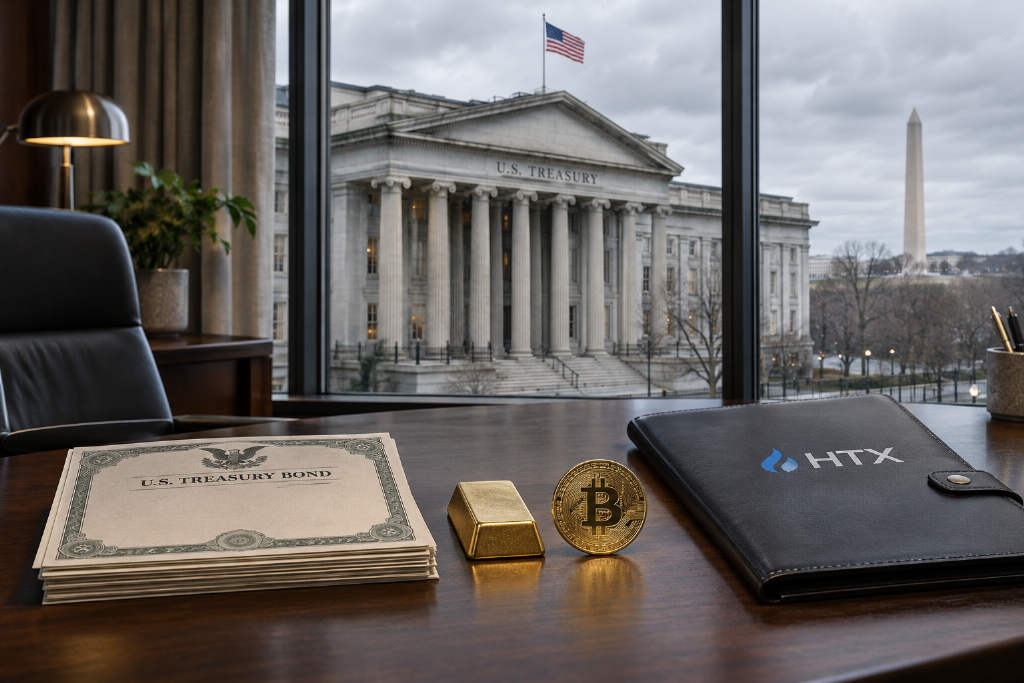
High interest rates are changing the benchmark used to compare traditional and crypto assets. Cloud, chief analyst at Huobi HTX, said during a Huobi lecture on Nov. 12 that U.S. Treasuries, gold and BTC should not be treated as interchangeable investments. Each serves a different function in a portfolio: cash flow, defense or growth exposure.

The event, titled “Global Asset Revaluation: A New Wealth Logic in the High-Rate Era,” examined the global macro environment, Treasury yields, gold’s pricing mechanism and the institutionalization of BTC. Cloud also compared the three assets under four macroeconomic scenarios: a soft landing, stagflation, recession and renewed inflation.
“There is no universal asset, only different roles,” Cloud said. He argued that investors need to move beyond the return expectations of a single asset and pay closer attention to risk-adjusted returns and portfolio construction.
Higher rates raise the hurdle for risk assets
Cloud began with Federal Reserve policy and the U.S. fiscal environment, focusing on changes in the global asset-pricing system.
In September 2026, the Federal Reserve raised interest rates by 25 basis points, lifting the federal funds target range to 3.75%-4.00%. Persistent inflation, fiscal deficits and the supply of government debt continue to shape expectations for the future path of rates.
A sustained high-rate environment does more than increase the cost of capital. It also raises the return hurdle for risk assets. If short-term Treasuries can deliver relatively stable coupon income, assets such as gold and BTC, which do not generate cash flow, need a stronger case for the additional risk they carry.
That comparison is changing the appeal of different assets. For high-volatility assets such as BTC, the long-term growth narrative and scarcity remain important. Yet macro liquidity, risk appetite and institutional fund flows are also becoming important variables in price performance.
Three assets, three pricing frameworks
Cloud summarized the differences with a simple analogy: “U.S. Treasuries are wages, gold is insurance and BTC is an option.”
The main value of Treasuries lies in coupon income and relatively predictable cash flow. In a high-rate environment, short-term Treasuries can provide a comparatively stable source of returns and serve as a defensive allocation. Long-term Treasuries also pay coupons, but their prices are more sensitive to interest-rate changes. Investors must also take on duration risk and price volatility.
Gold does not derive its value from cash flow. Its role is tied to hedging credit risk and diversifying assets. Global central-bank purchases, changes in reserve structures and geopolitical uncertainty have provided long-term demand support for gold in recent years.
Cloud cautioned that gold does not rise in every market environment. Higher real interest rates and a stronger dollar can still weigh on its performance. Central-bank buying may offer long-term support, but it does not guarantee a short-term rise in the gold price. For that reason, gold is better suited to risk hedging within a portfolio than to a strategy focused solely on pursuing high returns.
For BTC, Cloud focused on the two-sided effect of institutionalization. As spot exchange-traded funds, institutional custody and investment products mature, BTC is becoming more closely linked to traditional financial markets. That development expands BTC’s potential investor base. It also leaves the asset more exposed to macro liquidity, equity-market volatility and changes in institutional allocations.
BTC has scarcity and long-term growth potential, Cloud said, but scarcity does not equal downside protection. Calling BTC “digital gold” also does not mean it will act as a safe haven in every period. When risk appetite falls and funds continue to leave the market, BTC can still display the characteristics of a high-beta risk asset.
How the assets compare across four macro scenarios
During the livestream, Cloud used four macro scenarios to compare Treasuries, gold and BTC.
Soft landing
If inflation gradually declines while economic growth remains resilient, a moderate drop in interest rates could create an opportunity for long-term Treasuries to recover in price. The same setting could also support gold and BTC.
Stagflation
If slower growth occurs alongside persistent inflation, gold’s ability to hedge credit risk and diversify assets could become more important. Long-term bonds and high-valuation risk assets would face pressure.
Recession
If a clear economic slowdown prompts a shift toward easier monetary policy, falling yields could give long-term Treasuries a capital-gain opportunity. Gold could also benefit from demand for defensive assets. BTC would still depend on the direction of risk appetite and liquidity.
Renewed inflation
If inflation returns and monetary policy tightens again, short-term Treasuries could have greater relative defensive value. Long-term bonds, gold and BTC could all face valuation pressure, though the degree would differ.
Cloud stressed that macro scenarios are not single market forecasts. They are tools for identifying risks and testing the resilience of a portfolio.
From return seeking to risk management
Cloud said investors should not view Treasuries, gold and BTC as three substitutes. Their roles should be determined by each investor’s risk tolerance, investment horizon and funding needs.
Under that framework, Treasuries can serve as a relatively stable core holding, gold can support diversification and credit-risk hedging, and BTC can be used as a more aggressive allocation with higher volatility and potential return elasticity.
For BTC’s future performance, Cloud advised investors to watch changes in monetary policy, market risk appetite and institutional fund flows. He also warned against judging market direction solely by the size of a price pullback or the halving cycle.
“In the high-rate era, patience is actually the most expensive thing,” Cloud said at the end of the livestream.
When relatively stable assets can also offer attractive returns, every decision to take on additional risk requires a fresh assessment of whether the potential reward is sufficient to cover the uncertainty.
The lecture covered the coupon-based case for Treasuries, gold’s role in hedging credit risk, and the institutionalization and risk-asset characteristics of BTC. Huobi HTX’s “Expert Lecture” is a long-running investor education series that invites industry experts, researchers and experienced practitioners to discuss global macroeconomics, digital assets, blockchain technology and industry trends.
The views above were shared by the guest during the livestream and do not constitute investment advice.



