
The Three-Year Hoarding Myth Shattered: Strategy's First Net Bitcoin Sale of 32 BTC
Strategy, known as the "DAT first stock" and holding the world's largest corporate Bitcoin reserve, has broken its three-year diamond-hand image of only buying. According to a voluntary disclosure, the company sold 32 Bitcoin at an average price of $77,135 last week, generating $2.5 million in cash. The news sent markets tumbling: BTC fell below $71,000 overnight to around $70,560; crypto-related stocks plunged—Bullish down 7.99%, DeFi Development down 7.97%, Circle down 7.11%, Strategy itself down 5.85%, and Upexi down 5.04%. With major exchanges racing into US stock trading and liquidity already tight, Strategy's shift from buyer to seller deals another blow to the bleeding crypto market.
STRC Dividend Pressure Forces the Sale; Q1 Earnings Had Warned
The direct catalyst is the need to cover preferred stock dividends for STRC, a fixed-income digital credit product. After repurchasing $1.5 billion in convertible debt last month, Strategy's cash reserves plunged to about $871 million, covering only about six months of its annual ~$1.7 billion preferred dividend obligations. On May 29, STRC dipped to $97.11 before closing at $98.57. As early as the Q1 2025 earnings report released in early May, the company had warned: "if convertible notes mature or are redeemed without conversion, the company may need to sell common stock or Bitcoin to generate sufficient cash." That quarter, Strategy recorded a net loss of $12.54 billion, nearly all from a $14.46 billion unrealized loss on Bitcoin; by quarter-end, it held 818,334 BTC at a total cost basis of $61.81 billion, averaging $75,537 per coin. (Read more: "Strategy Q1 Earnings: $14.4B Book Loss, Does Not Rule Out Selling BTC to Pay Interest")

Currently, Strategy still holds 843,706 BTC, worth $60.936 billion at market prices, with an average cost of $75,699 and an unrealized loss of $2.932 billion. Ironically, during the market rebound last month, its position briefly showed an $8.2 billion profit. On May 28, founder Michael Saylor published a "HODL" (Hold On for Dear Life) article urging investors to hold during the downturn — a striking contrast to the company's subsequent sale.

Historical Precedent: A 2022 Sale and Quick Rebuy, but This Time No Immediate Plan
This is not Strategy's first-ever Bitcoin sale. In December 2022, amid the FTX collapse, the company sold 704 BTC at an average of $16,776 on December 22, and rapidly bought back 810 BTC at $16,845 just two days later — effectively a profitable swing trade. This time, the 32 BTC sale came without any announced buyback plan or commitment, fueling fears of a deadlock in the "DAT treasury model." Michael Saylor once pledged that "even if we sell 1 BTC, we will buy 10 to 20 times more," but the current environment leaves the market skeptical. Strategy's move not only marks a symbolic end to the hoarding model but also significantly dampens the industry's enthusiasm for accumulation and buying.

The Polymarket Farce: Prediction Markets Distort Facts
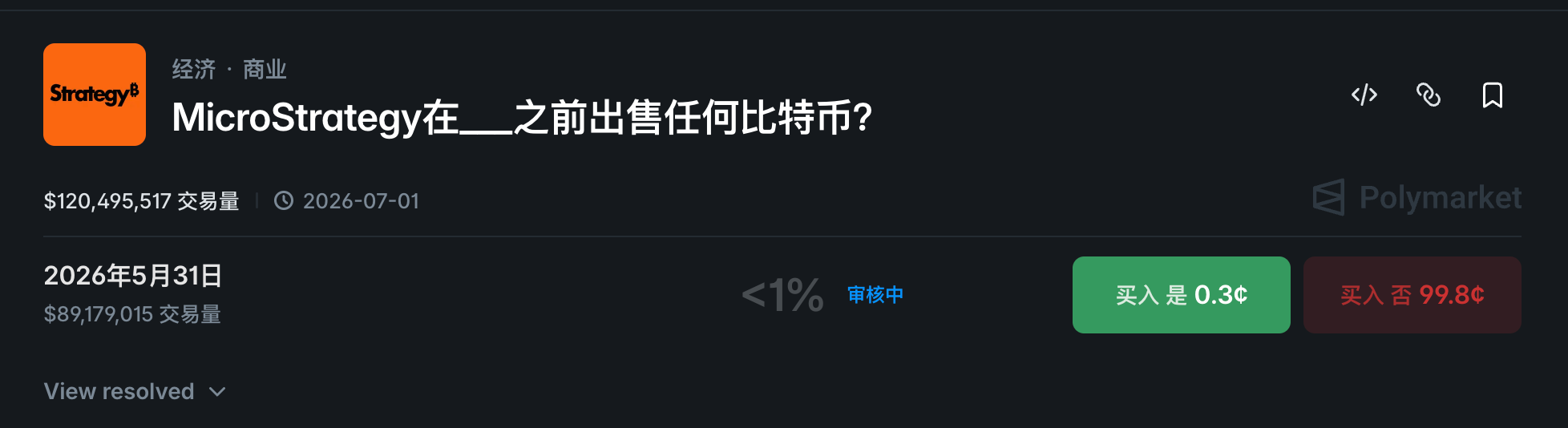
On decentralized prediction market Polymarket, a heated bet emerged on whether Strategy would sell Bitcoin before May 31. Initially the probability was just around 40%, but as May drew to a close, it spiked from a low of 12% to 80% on June 1, before settling back to 58%; total volume exceeded $16.4 million. Because Strategy hadn't issued an official statement of a May sale, the contract resolved to "Strategy did not sell Bitcoin in May." This episode again proves that prediction markets trade on the rules-defined event, not the underlying truth — a sobering lesson for investors relying on such signals.

Mounting Criticism and a Crisis of Confidence
The news drew quick fire from critics. Economist, gold proponent, and crypto skeptic Peter Schiff pronounced the sale a signal that Strategy is pivoting from "biggest buyer" to seller, and questioned where future demand would come from. Billionaire investor Mark Cuban, who once called Bitcoin "a better gold," revealed he has sold most of his BTC holdings, citing weakening faith in Bitcoin as an inflation or geopolitical hedge and disappointment in the "digital gold" narrative.

JPMorgan's recent analysis also pointed out that both gold and Bitcoin are experiencing a "devaluation trade," with investors exiting safe-haven assets. As Bitcoin's price continues to slip, the entire crypto market may now have to wait for the Trump administration to "love crypto again" — policy warmth being one of the few potential catalysts left. In such an environment, market participants can only pin their hopes on policy goodwill, with Trump's crypto-friendly signals standing as one of the few remaining bright spots.