
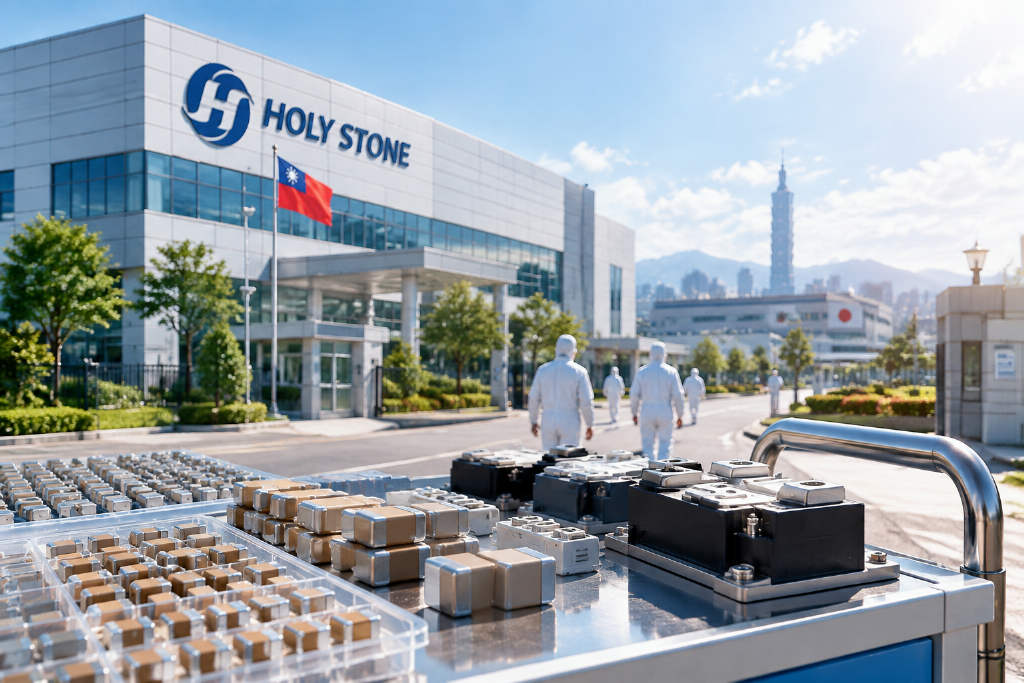
Passive component maker Holy Stone Enterprise was required to disclose updated self-reported financial data after recent trading volume put the stock under an exchange alert. The company said pretax profit for August 2026 reached NT$273 million, up 317.95% year over year, with earnings per share at NT$1.33, reflecting stronger operating performance tied to growing demand for high-end MLCCs used in AI applications.
Demand for large-size multilayer ceramic capacitors, or MLCCs, has been rising as power consumption in artificial intelligence servers increases. To meet orders tied to high-end power modules and automotive-grade specifications, Holy Stone has also launched a multinational expansion plan covering 2026 to 2029, with total capital expenditure expected to reach NT$3 billion. The market is watching the payoff from that expansion, changes in the company’s AI shipment mix, and supply-demand trends for higher-end components.
August revenue and profit both moved higher
According to Holy Stone’s August self-reported figures, consolidated revenue for the month was NT$1.44 billion, up 33.22% from a year earlier. Net profit attributable to the parent came to NT$221 million, up 285.04%, translating into monthly EPS of NT$1.33.
Based on those figures, August net margin after tax was estimated at 15.3%, staying near the relatively elevated range seen since the second quarter. Over the latest four quarters, from the third quarter of 2025 through the second quarter of 2026, net profit attributable to the parent totaled NT$1.7 billion, while cumulative EPS for the same period reached NT$10.25.
NT$3 billion expansion plan spans Taiwan and Japan
To meet long-term contract demand and product specification upgrades, Holy Stone said in late September that it would spend NT$440 million to acquire land and buildings near its Longtan plant in Taoyuan as the main base for expansion.
The broader plan, which runs from 2026 to 2029, calls for NT$3 billion in capital spending. It includes restarting the Lizhe plant in Yilan for high-end mass production and adding a dedicated production line at the company’s R&D center in Hokkaido, Japan. Holy Stone’s current monthly capacity is about 800 million to 1 billion units, mainly focused on larger sizes of 0603 and above. Management expects total capacity to increase 40% to 50% across this year and next year combined.
AI server power requirements lift high-end MLCC mix
As AI computing architectures consume more power, a single graphics processing unit, or GPU, platform requires noticeably more capacitors than a traditional server setup. Power-side requirements for heat resistance, voltage tolerance, and low-loss electrical performance have also become stricter, supporting steady demand growth for larger and higher-spec ceramic capacitors.
Holy Stone said AI-related applications accounted for about 25% to 30% of passive component shipments in the first half. The company is targeting 40% by year-end. At the same time, it is allocating capacity to automotive electronics and gallium nitride, or GaN, charging products in an effort to keep average selling prices and product mix stable.



