
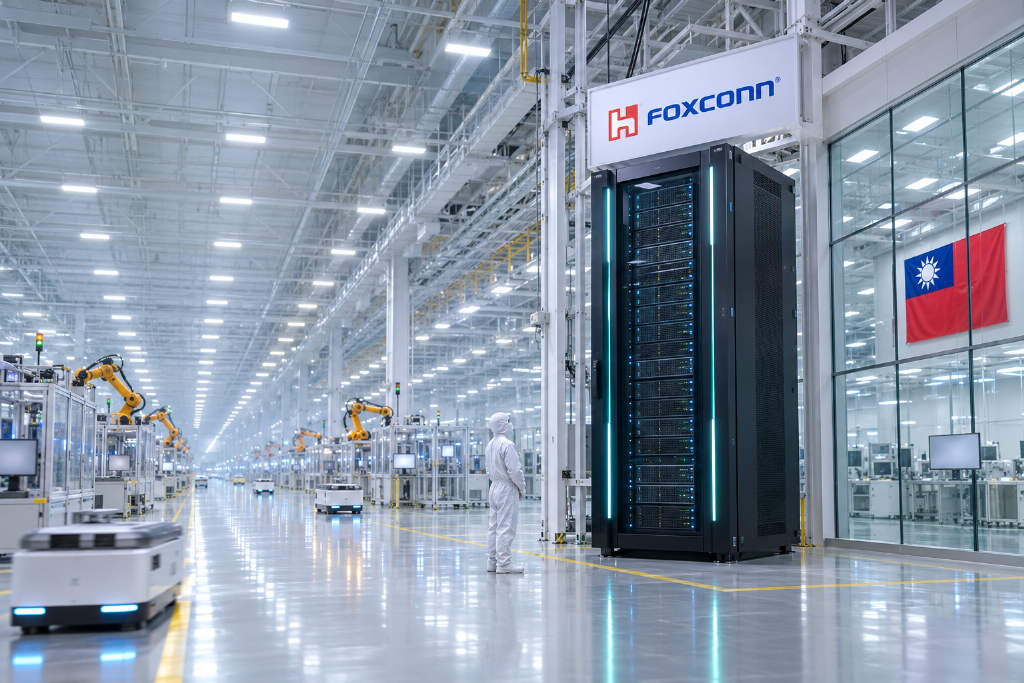
Hon Hai Chairman Young Liu said end-market demand for artificial intelligence computing continues to increase, with no sign of slowing. Speaking at an earnings call, Liu addressed concerns about whether cloud service providers (CSPs) can sustain capital spending. Hon Hai’s third-quarter shipments of ASIC AI servers rose 1.5 times year over year, growing significantly faster than GPU server shipments, the company said. Large CSPs are expanding their in-house chip programs, adding to demand for customized racks.
Liu grouped users of AI computing into four categories: model developers, CSPs, governments and enterprises. Demand is currently concentrated among model developers and CSPs, while government and corporate users are accelerating the adoption of AI applications. That end-market demand is encouraging CSPs and NeoCloud operators to build computing capacity. Hon Hai has seen no near-term pullback; customers that have already placed orders may even accelerate deployment.
Asked whether political and economic changes after the U.S. midterm elections could affect customer orders, Liu said the near-term impact should be limited. He said the longer-term effects require continued observation, while customers that have ordered systems and committed to building capacity could move faster to make that computing power available.
ASIC development cycle falls to about nine months
AI workloads are expanding from model training into inference, while AI agents are gaining adoption. Large CSPs are increasing investment in their own application-specific integrated circuits (ASICs). The process from setting specifications to producing a chip now takes about nine months, Liu said. Hon Hai’s ASIC server shipments rose 1.5 times year over year in the third quarter, and the company said inference demand could drive future growth faster than in GPU servers. The source article’s section heading also identifies inference demand as a driver of CPU growth.
ASIC systems require customized architectures, liquid cooling and power design. Hon Hai said its vertical integration capabilities have helped it secure major CSP projects. Some projects use a consignment model, leaving their share of reported revenue below their share of shipments, but Liu said the arrangement improves capital efficiency.
Automation and precision manufacturing support rack production
Responding to questions from foreign investors about the production ramp-up of next-generation AI racks, Liu said automation and vertical integration have reduced bottlenecks in traditional server assembly. He said manufacturing the new products did not involve a transition-period ramp-up challenge.
Large language models place demanding requirements on memory bandwidth, and the shift in data transmission from electrical to optical has taken hold, according to the report. Hon Hai has begun shipping co-packaged optics (CPO) switches. Its micron-level precision machining addresses the challenge of aligning multiple optical fibers, and the company offers optical communications solutions spanning cables and switches.
Long-term investments target EVs and robotics
Alongside its AI infrastructure push, Hon Hai is developing electric vehicles (EVs) and robotics as longer-term business opportunities. Liu said EV investment represents a smaller share than AI investment. The group will monitor the industry’s pace, prepare capacity and wait for the right opportunity to enter at scale. Hon Hai is also making long-term strategic investments with international partners, including Japan’s Mitsubishi, to build its second and third growth engines.



